




South Carolina has 38 snake species and six of them are venomous. In practice one matters: the copperhead. The other five are secretive, and most people go a lifetime without meeting one.
The fastest identification is the pattern, not the head. A copperhead's crossbands are hourglass shaped — wide along the sides, pinched narrow at the spine. Nothing else in the state has that.
Most of the snakes South Carolinians actually see are black racers, ratsnakes and watersnakes — all harmless, all useful. The Savannah River Ecology Laboratory puts it plainly: the venomous species tend to be quite secretive and are among the least frequently encountered.
That does not mean ignore them. It means learn the one pattern that matters and stop relying on the rules that do not work.
The six venomous species, and how likely you are to meet one
| Species | Size | Markings | Where | Odds of meeting one |
|---|---|---|---|---|
| Copperhead | 2–3 ft | Hourglass crossbands, coppery head | Throughout the state, including suburban lots and parks | High — this is the one |
| Cottonmouth | 2–4 ft | Dark olive to near-black; banding often obscured in adults; white mouth lining | Coastal Plain wetlands | Moderate near water |
| Timber / canebrake rattlesnake | 3–5 ft | Dark chevron bands, often an orange stripe down the spine | Hardwood forest, pine ridges, swamps | Low |
| Pigmy rattlesnake | 16–24 in | Small, dorsal blotches, dark bar through the eye; rattle often inaudible | Coastal sandhills and flatwoods | Low, but easy to step on |
| Eastern diamondback | 3–6 ft | Diamonds edged in light scales, dark eye stripe | Scattered lower Coastal Plain and barrier islands | Rare — now uncommon in SC |
| Eastern coral snake | 2–2.5 ft | Red, yellow and black rings; black snout; slender and smooth | Coastal Plain, mostly underground | Very low |
Two things worth knowing about the copperhead, since it is the realiztic risk. Its venom is relatively mild as North American vipers go — in a regional study cited by SREL, most bites were mild to moderate, only 6% were classed as severe, and there were no fatalities. And the pigmy rattlesnake, despite the alarming name, has never had a documented death attributed to it.

One number to be careful with. You will see "42 species" quoted for South Carolina. That figure is real but it covers South Carolina and Georgia combined. For this state alone it is 38.
Reading the pattern
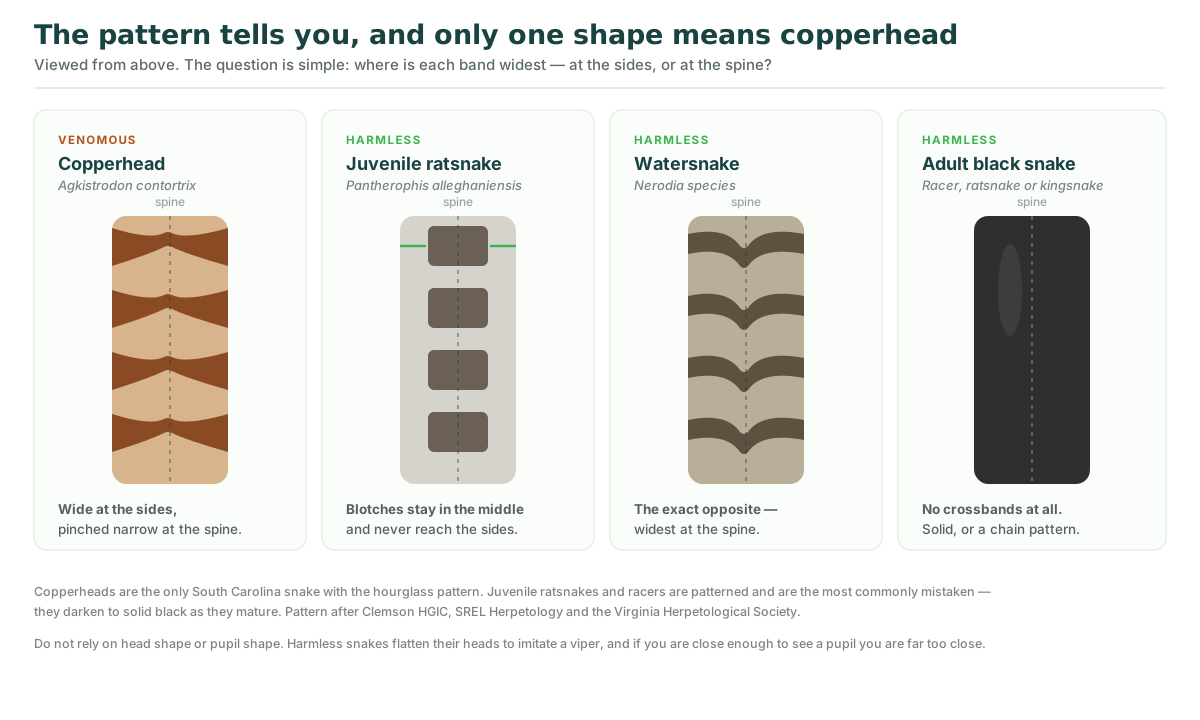
Clemson describes the copperhead pattern precisely: the hourglass lies sideways across the back, so the wide part starts on one flank, narrows towards the spine, then widens again on the other side. They are the only species in the state with it.
The juvenile ratsnake problem
This is the single most common misidentification, and it has a clean test.
Juvenile eastern ratsnakes are boldly blotched — gray-white with dark brown squares — and they look alarmingly like a copperhead to anyone who has not been told otherwise. But their blotches run down the center of the back and never extend to the sides. A copperhead's pattern starts at the side. Juvenile black racers are patterned too, and both darken to solid black as they mature.
There is a seasonal wrinkle that matters for anyone in the pest control business: juvenile ratsnakes look for somewhere warm to overwinter and frequently pick an attic, crawlspace or basement. Copperheads generally do not shelter in occupied buildings. So a patterned snake in your attic in October is far more likely to be a harmless ratsnake than a copperhead.
Cottonmouth or watersnake?
Behavior separates these two better than markings do. A cottonmouth will often stand its ground and gape, showing the white mouth lining that gives it its name. A harmless watersnake almost always flees — into the water if it can.
Be honest about the difficulty here: adult cottonmouths darken with age until the banding is faint or gone, so an adult cottonmouth can genuinely read as "a black snake". That is exactly why the pattern rule needs a companion — if it is near water, dark, and it holds its ground rather than fleeing, treat it as a cottonmouth and leave it alone.
Two rules you should stop using
"Venomous snakes have triangular heads." NC State notes the obvious problem: several harmless snakes flatten their heads and flare their jaws when threatened, deliberately imitating a viper. Eastern hognose snakes are famous for it. Copperheads even vibrate their tails to sound like rattlesnakes. Mimicry runs in both directions.
"Venomous snakes have cat-like pupils." Clemson's response to this is the best line in the literature: if you are close enough to examine a snake's pupils, you are entirely too close to that snake.
Both rules also fail completely on the coral snake, which is a slender elapid rather than a stocky pit viper. And color rhymes are no better — SREL warns that color variation and pattern irregularities are natural, and identification should never rest on color alone.
Learn the hourglass. Photograph anything you are unsure about from a safe distance, and let someone identify it from the photo.
If someone is bitten
Call 911, and call Poison Control on 1-800-222-1222. That is a single national number, free and staffed around the clock; in South Carolina it routes to the Palmetto Poison Center at the University of South Carolina, covering all 46 counties.
- Move out of range of the snake and sit or lie down.
- Call 911. Do not drive yourself — a bite can make you dizzy or cause you to pass out.
- Remove rings, watches and anything tight before swelling starts, or they will have to be cut off.
- Keep the bitten limb still, at roughly heart level or in whatever neutral position is comfortable. Movement increases how fast venom is absorbed.
- Wash the bite with soap and water and cover it with a clean, dry dressing.
- Mark the leading edge of the swelling on the skin and write the time next to it. It tells the hospital how fast things are progressing.
- Photograph the snake from a safe distance if you can do so safely — but do not go looking for it, and do not delay.
The 2024 American Heart Association and American Red Cross first aid guidelines grade several traditional remedies as actively harmful, not merely useless:
No tourniquet — concentrating venom in one part of a limb has caused tissue death and amputation. Do not cut the wound. Do not try to suck the venom out, by mouth or with an extraction device; both are graded as causing harm and remove no meaningful amount of venom. No ice or cold packs. No electric shock. No pressure immobilization bandage — it is specifically not recommended in North America. And no alcohol or anti-inflammatory painkillers such as aspirin or ibuprofen, which raise bleeding risk when the venom is already anticoagulant.
You do not need to identify the snake before treatment. American pit viper antivenom is made for the whole group rather than a single species, so care is guided by symptoms. Never handle a snake to identify it — not even a dead one. One study of rattlesnake bite admissions found roughly 15% came from snakes the victim believed were already dead.
For scale: around 7,000 to 8,000 people are bitten by venomous snakes in the US each year and about five die. Across 30 years to 2018 there were 101 deaths in total, and copperheads accounted for five of them. Roughly a fifth to a quarter of pit viper bites are "dry", delivering no venom — which is a reason for calm, never a reason to skip the hospital.
What South Carolina law actually says
This part is widely misreported, so here is what the statute text says.
No South Carolina law prohibits killing a common native snake. The prohibition in § 50-15-20(C) applies only to species the department has specifically designated. Across the entire state wildlife regulation chapter, the only snake listed is the southern hognose snake, which is designated in need of management and cannot be taken or possessed without a permit.
That means two claims you will see repeated are simply wrong as a matter of state law: the timber rattlesnake is not protected in South Carolina, and the eastern diamondback is not legally listed either. Both are protected in some other eastern states, which is probably where the confusion comes from.
Two provisions do apply to homeowners:
- You may trap a snake indoors. § 50-11-2460(A)(5) expressly allows property owners or occupants to use commonly used traps at any time to capture snakes, rats or mice in homes and businesses.
- You may not hand a caught native snake to anyone else. Regulation 123-151.3(A) prohibits selling, trading, transferring or re-homing native reptiles outside a short list of exceptions. Giving away a snake you caught is the part people get wrong.
Reptiles are also fully protected on certain designated Department of Natural Resources properties. And relocating a snake a long way is a bad idea regardless of legality — NC State notes that snakes have distinct home ranges and moving them significant distances raises their risk of dying.
This is general information drawn from the published statute and regulation text, not legal advice. Verify current requirements with SCDNR before acting.
Keeping snakes out of the yard
Snakes follow food. Clemson's line is the one to remember: brush piles and stacked firewood are magnets for snakes because they are magnets for the rodents and insects that snakes eat.
- Deal with the rodents first. This is the real lever, and it is why snake problems and rodent problems are usually the same problem.
- Clear the harborage. Brush piles, stacked lumber, debris and tall vegetation against the foundation.
- Raise the firewood off the ground and move it away from the house.
- Seal the gaps — crawlspace vents, foundation cracks, and gaps under doors.
- Skip the repellents. Clemson is clear that snake repellent products give inconsistent results and that liquid products offer limited control at a cost that makes them impractical.
If one is already in the house, NC State's advice is that a harmless snake can simply be swept out with a broom — and that you should never try to move a venomous snake, whatever you are wearing. Call someone.
Why the harmless ones are worth keeping
Eastern ratsnakes feed mostly on rodents, squirrels and birds, and NC State credits large ratsnakes with saving farmers money on rodent control outright. Black racers eat other snakes — in South Carolina populations, lizards and snakes make up over 85% of stomach contents.

And the eastern kingsnake eats venomous snakes. It is resistant to pit viper venom and is, relative to body size, among the strongest constrictors measured. A kingsnake living around your property is doing something no product can.
When to call someone
- You have a venomous snake, or one you cannot confidently identify, somewhere people or pets go.
- Snakes keep appearing — which almost always means a rodent population supporting them.
- They are getting into a crawlspace, garage or outbuilding you cannot easily seal.
Our rodent control service covers South Carolina, North Carolina and Virginia, and on snakes it is usually the honest fix: remove the food supply and the harborage, and seal the way in. If you are trying to work out what you saw, are black snakes in South Carolina poisonous covers the harmless species in more detail.
The short version
- 38 species in South Carolina, six venomous — and realistically only the copperhead is likely to turn up.
- Hourglass bands, wide at the sides, means copperhead. Nothing else here has that pattern.
- Blotches confined to the middle of the back mean a harmless juvenile ratsnake — the most common mix-up, and the snake that actually overwinters in attics.
- Forget head shape and pupils. Harmless snakes fake the head, and pupils mean you are far too close.
- If bitten: 911 and 1-800-222-1222. No tourniquet, no cutting, no suction, no ice — all graded as harmful.
- Only the southern hognose is protected in SC. The timber rattlesnake is not, despite what you will read.
Further reading: the Savannah River Ecology Laboratory at the University of Georgia publishes free, non-commercial species accounts and safety guidance for the snakes of this region — Snakes of South Carolina and Georgia (SREL Herpetology). For bites, contact Poison Control on 1-800-222-1222.
Frequently Asked Questions
South Carolina has 38 snake species and six of them are venomous: the copperhead, cottonmouth, timber or canebrake rattlesnake, pigmy rattlesnake, eastern diamondback rattlesnake and eastern coral snake. Be careful with the figure of 42 species that circulates online, as that count covers South Carolina and Georgia together rather than this state alone.
Look at where each crossband is widest. A copperhead's bands are hourglass shaped, wide along the sides of the body and pinched narrow at the spine, and it is the only South Carolina snake with that pattern. A juvenile ratsnake, the most common mix-up, has blotches that stay in the middle of the back and never reach the sides. A watersnake is the reverse of a copperhead, with bands widest at the spine.
Both rules are unreliable. Several harmless snakes flatten their heads and flare their jaws to imitate a viper, and the eastern hognose is well known for it. Clemson's response to the pupil rule is the practical one: if you are close enough to examine a snake's pupils, you are far too close. Neither rule works on the coral snake, which is slender rather than stocky.
Call 911 and call Poison Control on 1-800-222-1222, which routes to the Palmetto Poison Center in South Carolina. Move away from the snake, sit down, remove rings and watches before swelling starts, keep the bitten limb still at roughly heart level, wash the bite and cover it, and mark the edge of the swelling with the time beside it. Do not drive yourself. Do not apply a tourniquet, cut the wound, try to suck out venom, apply ice, or use a pressure bandage: the 2024 first aid guidelines grade these as harmful.
No. American pit viper antivenom covers the whole group rather than a single species, so treatment is guided by symptoms rather than identification. Photographing the snake from a safe distance can help, but never handle a snake to identify it, including one that appears dead. One study of rattlesnake bite admissions found around 15% involved snakes the victim believed were already dead.
No state law prohibits killing a common native snake. The only snake designated in the state wildlife regulations is the southern hognose snake, which cannot be taken or possessed without a permit. Contrary to what is often repeated, the timber rattlesnake and eastern diamondback are not legally protected in South Carolina. Note two rules that do apply: trapping snakes indoors is expressly allowed, but transferring or re-homing a caught native snake is prohibited. This is general information rather than legal advice.
Remove what they are hunting. Clemson notes that brush piles and stacked firewood attract snakes because they attract rodents and insects. Control rodents first, clear brush piles, debris and tall vegetation from around the foundation, raise firewood off the ground and away from the house, and seal crawlspace vents and foundation gaps. Snake repellent products give inconsistent results and are not recommended.
Photo credits: David George, CC BY 4.0, via Wikimedia Commons; Krenkelm, CC0, via Wikimedia Commons.