Home Exterminator & Pest Control Plans
Protect Your Home & Family From Unwanted Pests





Home Exterminator Services & Pest Control Plans
Your home should be a safe haven for your family, not a refuge for pests. At Vinx Pest Control, we understand the stress and discomfort that comes with a pest infestation. That's why we offer comprehensive residential pest control services designed to eliminate current pest problems and prevent future invasions.
Our trained technicians use the latest techniques and EPA-registered products to effectively treat your home while keeping your family and pets safe. We take the time to understand your specific pest concerns and develop a customized treatment plan that addresses your unique situation.
Common Household Pests We Treat
 Ants
Ants
 Roaches
 Spiders
 Rodents
 Termites
 Mosquitoes
 Ticks & Fleas
 Bed Bugs
What Happens at Every Visit
Inspection & Reporting
Every time we come out, our technicians aren't just treating, they're looking. We're checking for things you'd never notice on a normal day: early signs of termite activity, conditions attracting pests, moisture issues, entry points bugs might be exploiting, wasp nests forming in spots you can't see from the ground. Having a trained set of eyes on your home every 90 days means you're not caught off guard. If we see something, we'll tell you, straight up, no pressure, no scare tactics.
Exterior Foundation Treatment
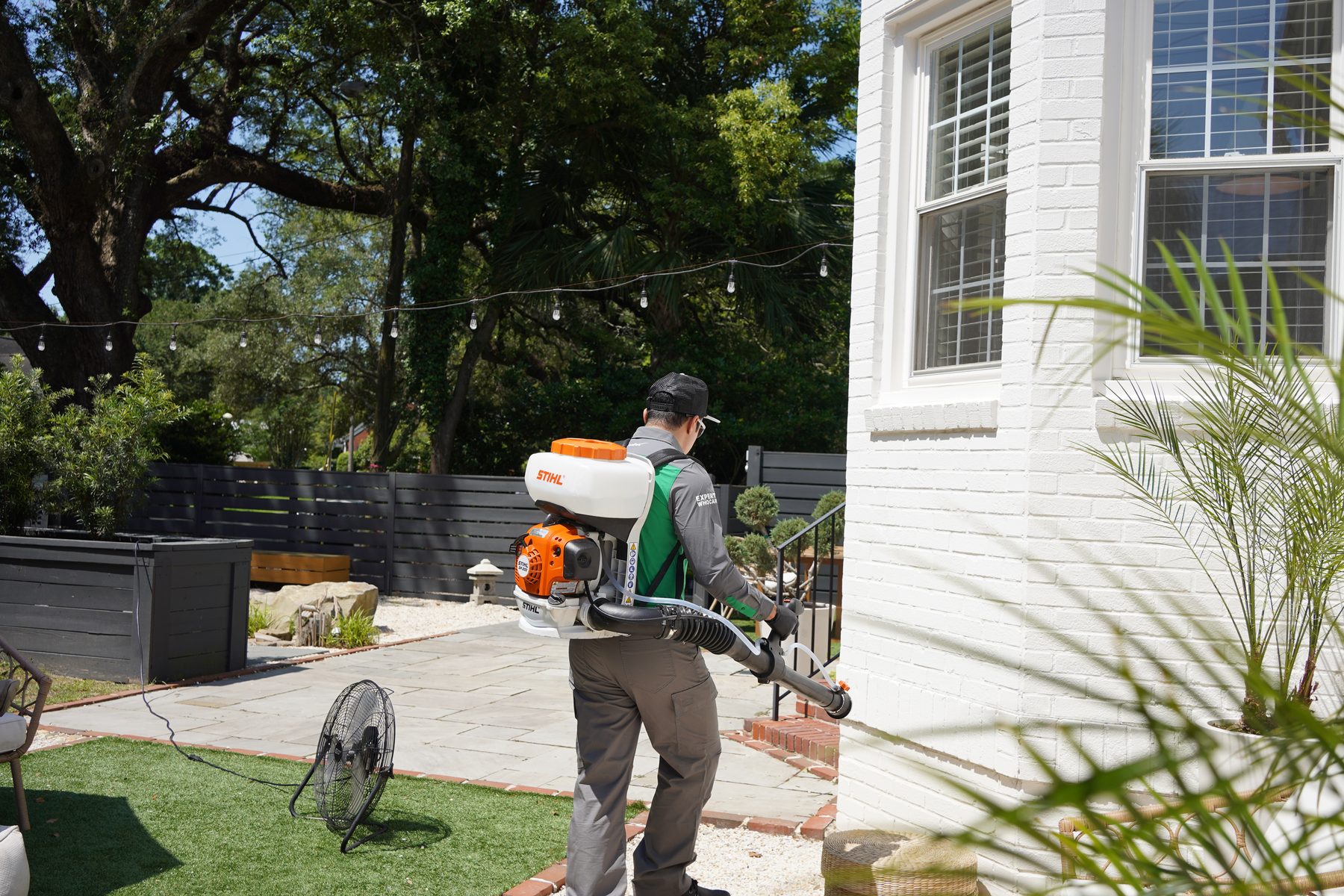
We treat the foundation with a micro-encapsulated product, a time-release barrier that attaches to pests and gets carried back to their nesting site. We go three feet up and three feet out, creating a real buffer zone. Since we're focused almost entirely on the outside of your home, your kids and pets can stay safely inside while we work. Once the product dries, usually 15 to 20 minutes, it's safe. These are EPA-approved products used at pet boarding facilities and child care centers.
Yard Treatment
We treat the full yard, up to 30 feet out from the home, to reduce pest pressure before bugs get close to your foundation. Between the yard treatment and the foundation barrier, we're building two lines of defense. The whole philosophy is simple, take care of the bugs on the outside so they're never a problem on the inside.
Cobweb & Wasp Nest Removal
We sweep the first and second-story eaves on every visit, cobwebs, wasp nests, spider webs, all of it comes down. Then we spot treat those areas with a residual product. Wasps will come back to spots where they've built before because they leave pheromones behind, but when they return, our product is waiting for them.
Power Dust Injection
We use a handheld compressor to inject a dust product deep into cracks and crevices on the outside of your home, gaps around pipes, weep holes, expansion joints. Bugs love wall voids because they're dark and undisturbed. The dust gets pushed deep into those areas, flushes out anything already in there, and stays active much longer than a surface spray because it's protected from rain and heat.
Interior Treatment (If Needed)
We rarely need to treat inside, that's by design. Because we do so much more on the outside, we stop the problem before it gets in. But the inside is always covered under your service guarantee with no extra charge. If you're seeing bugs inside, we'll come in and take care of it, baseboards, entry points, the garage, a detached shed. Once the product dries, it's safe for kids and pets. No questions, no additional cost, no hassle.
Why Choose Vinx for Home Pest Control?
- Family and pet-safe treatments
- Next day service available
- 100% satisfaction guarantee
- Licensed and insured technicians
- Flexible scheduling options
- Transparent pricing with no hidden fees
How Residential Pest Pressure Differs Across Our Service Area
The homes we treat in coastal South Carolina (Charleston peninsula row houses, elevated beach cottages on Sullivan's Island, and the older bungalows in North Charleston) share one structural characteristic: open crawl spaces. These are not finished, conditioned spaces. They are damp, often vented directly to exterior air, and they collect standing moisture after rain. That makes them ground-zero for subterranean termites, American roaches pushing in from soil contact, and moisture ants that most Upstate technicians rarely encounter. Pest pressure here is year-round because the temperature rarely stays cold long enough to knock down outdoor populations.
The Midlands and Upstate (Columbia, Lexington, Greenville, Spartanburg) tell a different story. Many homes in the newer suburbs have slab foundations, which cuts off the crawl space entry points but creates a different problem: gaps around plumbing penetrations, expansion joints in concrete, and compressed vinyl siding at the base that harbors trailing ant colonies. The Piedmont clay soil in the Upstate also drains slowly, keeping it attractive to subterranean termites even without the coastal moisture. German cockroaches in apartment complexes and student housing near Clemson and USC Columbia are a persistent problem because of high unit turnover.
In Tidewater Virginia (Virginia Beach, Chesapeake, Hampton Roads) the housing stock mixes 1960s-era naval housing, post-war brick ramblers, and rapidly expanding new construction in the western suburbs of Chesapeake and Suffolk. The older homes have accessible soffits, deteriorating weep holes in brick veneer, and large attic voids that roof rats exploit. Stink bugs are a measurable fall nuisance across the Hampton Roads corridor in ways they simply are not in South Carolina. Treatment strategies shift by home type: perimeter-focused liquid treatments on slab homes, crawl space barrier and moisture management on pier-and-beam structures, and attic-access exclusion work on brick ramblers.
Treatment Prep Guide: What to Do Before We Arrive
- Clear a two-foot perimeter along all interior baseboards, move furniture away from walls so technicians can treat the full perimeter without obstruction.
- Remove items stored under sinks and in lower kitchen cabinets, since these are primary treatment zones for ants, roaches, and moisture pests.
- If you have pets, secure them in a room that won't be treated or arrange for them to be off the property for two to three hours after interior application.
- Pick up pet food and water bowls from the floor before the technician arrives, these attract pests and interfere with baiting strategies.
- Clear clutter from garages, laundry rooms, and utility areas where pests often harbor undetected between quarterly visits.
- If you have a crawl space, make sure the access hatch is unlocked and not blocked by stored items, our technician needs to inspect and treat inside.
- Note any specific areas where you have seen pest activity and be ready to point those out; the technician's inspection is more targeted when you can direct them to hot spots.
- Do not mop or scrub baseboards immediately before treatment, clean floors remove the residual that protects you between visits.
What Doesn't Work: Why DIY Falls Short
The hardware store options (aerosol sprays, bait strips, ultrasonic plug-ins) address what you can see. The problem is that the vast majority of a pest population is never visible. Ant trails follow pheromone highways behind walls. Cockroach colonies live in wall voids and appliance motors. Subterranean termites tunnel up from the soil in protected mud tubes and can honeycomb floor joists for years before producing a single visible swarmers. Over-the-counter repellent sprays around doorways push pests deeper into the structure without eliminating the colony, and the effect dissipates within days in coastal South Carolina's heat. Here is specifically where DIY residential pest control breaks down:
- Perimeter sprays from consumer products do not reach void areas, crawl spaces, or attic entry points where colonies actually live.
- Grocery store ant bait is often the wrong formulation, protein baits don't work on sweet-seeking species and vice versa, so homeowners buy the wrong product for their specific ant species.
- Bug bombs (total-release foggers) have been shown by university research to fail against cockroaches: the insects detect the aerosol and move away from it rather than being eliminated.
- Ultrasonic devices have no peer-reviewed evidence of efficacy against any home-invading pest species.
- Store-bought sprays applied by homeowners typically lack the residual duration of professional-grade products, requiring reapplication weekly rather than quarterly.
- Without an inspection for entry points, you can eliminate existing pests and have a full reinfestation within weeks from the same gaps the first population used.
Frequently Asked Questions
Each quarterly visit includes an exterior perimeter treatment with a residual product applied around the foundation and up the base of the structure, treatment of entry points including weep holes, utility penetrations, and door sweeps, interior spot-treatment of known problem areas, and a crawl space or attic inspection if conditions warrant. The specific scope adjusts based on what our technician observes on that visit, active pest pressure gets more attention than areas that are clear.
For exterior-only quarterly visits, you do not need to be home as long as we have access to the perimeter and any gated areas. For interior treatments or the initial service, we do ask that an adult be present so the technician can inspect problem areas with you and get your sign-off before applying products indoors. We will call or text a 30-minute heads-up before arriving.
Our re-service guarantee covers exactly this situation. If you see pest activity between scheduled treatments, call us and we will return at no charge to re-treat the affected area. This is not a rare exception, it is a built-in part of the service, especially during peak activity seasons like late spring and early fall when population pressures spike.
We use EPA-registered products applied at label-specified rates. Once treatments have dried, typically 30 to 60 minutes for most interior applications, people and pets can return to the treated areas. We will tell you explicitly how long to stay clear before we begin, based on the specific products being used that day. If anyone in your household has respiratory sensitivities, let us know in advance so we can plan accordingly.
Increased pest activity immediately following the initial service is normal and expected. Treatment disturbs harborage areas and drives pests out of hiding as they try to escape the treated zones. You are seeing the population that was already there, it is just more visible now. Activity typically drops sharply within five to seven days as the products work through the population. If you are still seeing heavy activity after two weeks, contact us for a re-service.
Yes, and it matters a great deal in coastal SC and older homes across our service area. Crawl spaces are the primary entry zone for subterranean termites, American cockroaches, moisture ants, and even rodents. A technician who only treats the interior and perimeter without looking at the crawl space is missing the origin point of a significant portion of pest pressure in pier-and-beam homes. We inspect crawl spaces on every initial visit and whenever conditions suggest activity below the floor.
Vinx offers three residential plans. Standard protection starts at $49 per month for four seasonal treatments covering 50+ pests. Vinx Plus starts at $75 per month for six treatments and adds a yard ant elimination guarantee and flea and tick coverage. Platinum starts at $109 per month for nine treatments, seasonal mosquito control, interior flea and tick coverage and free bed bug treatments if needed. Every plan includes unlimited free re-services and a 100% money-back guarantee. Your exact price depends on your home's square footage and service area, and you can see it instantly by signing up online.

Residential Pest Control Near You
We provide professional residential pest control across South Carolina, North Carolina, and Virginia. Select your city for local service details:
Related Pest Control Services
Pest problems rarely travel alone. If you're dealing with more than one pest, we have you covered:
Trusted Resources
Learn more about residential pest control from authoritative sources:
Customer Reviews
What Our Customers Are Saying
"Tony's inspection highlighted several issues. With a good explanation of solutions, he's getting my house back on track."
Verified Google Review"I called at 1pm on a Friday and they squeezed me in the same day, amazing. Mike and Jonathan did a fantastic job explaining the treatment plan."
Verified Google Review"Jonathan is very thorough, friendly and professional. He kept me informed about finding the termites, showing pictures and video."
Verified Google Review