





What does a water bug look like? Almost always, like a big cockroach. If you found it indoors — kitchen floor, bathroom, basement, crawl space, under the sink — it is a cockroach, and in South Carolina, North Carolina and Virginia it is one of three: an American cockroach (red-brown, 1½ to 2 inches, with a pale yellow halo around the shield behind its head), a smokybrown (uniform glossy mahogany, 1 to 1½ inches, no markings) or an Oriental cockroach (near-black with a greasy sheen, about 1 to 1¼ inches, stubby wings). All three have antennae as long as the body and six spiny running legs. The first two fly; the Oriental cannot.
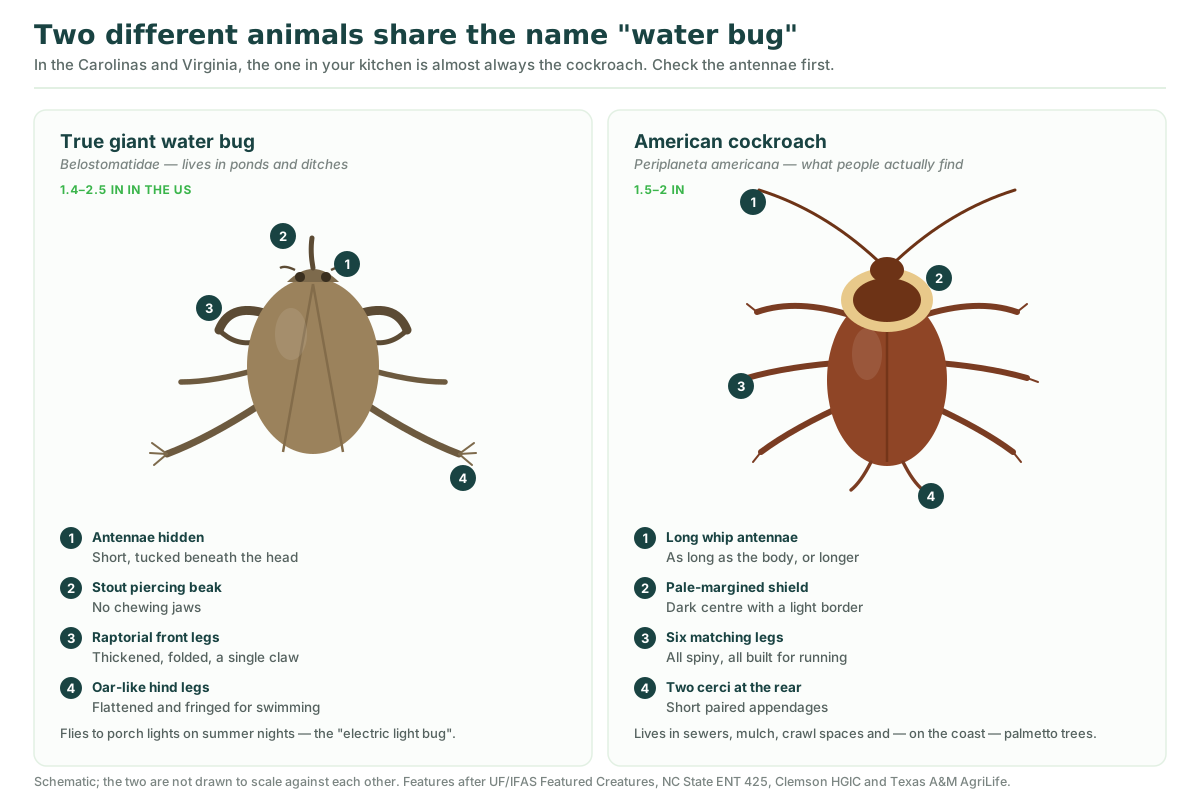
A true water bug is a different insect altogether: the giant water bug, a flat, oval, mud-brown predator about 2 inches long with thick hooked front legs, paddle-shaped hind legs, a short beak, and antennae so small they are tucked out of sight under the head. It lives in ponds and ditches, flies to porch lights and swimming pools on summer nights, and does not infest houses.
The one-second test: long, whip-like antennae waving around means cockroach. No visible antennae and pincer-like front legs means water bug.
So why is it in your house? Big outdoor roaches come inside for moisture — up floor drains and sewer lines (American and Oriental), or in from mulch, gutters, tree holes and soffits (smokybrown). One or two in late summer is a wanderer. Several a week, or small black-and-white-banded nymphs, means they are breeding close to or inside the structure. Ask a homeowner in Charleston about water bugs and they mean exactly this animal — we wrote a whole guide to water roaches in Charleston, the two species behind the Lowcountry nickname and how to keep them out. The rest of this page shows each one, then how to deal with them.
What a true water bug actually is
The genuine article is a giant water bug, family Belostomatidae. Three genera live in North America and their range covers the entire eastern seaboard — the standard key to the group was built partly from a Virginia Tech catalogue of Virginia's aquatic bugs, so they are certainly here.

In the US they run roughly 1.4 to 2.5 inches. You will see "four inches" repeated widely; that belongs to South American species, not anything in a Carolina pond.

Their build is unmistakable once you know it. The front legs are raptorial — thickened, held folded, tipped with a single claw for seizing prey. The hind legs are flattened and fringed with hairs for swimming. Instead of jaws they have a stout beak. One entomology department describes the overall effect as a cross between a cockroach and a praying mantis, which is about right.
They breathe through short retractable appendages at the rear, which is the character that separates them from water scorpions, whose breathing tube is long and fixed.
So do they get in the house?
Not really. No extension source documents giant water bugs infesting homes, and we are not going to be the first to claim it.
What they do is fly. During mating season they move between ponds at night and come to lights in numbers — which earned them their other name, the electric light bug. So they turn up on porches, under security lights and, most often, in swimming pools. That is a visitor, not an infestation.
Giant water bugs are famous for the males carrying eggs glued to their backs. That is true of Abedus and Belostoma — but Lethocerus, the biggest and most photographed genus, lays its eggs on vegetation above the waterline instead.
What you probably found
Three large cockroaches account for nearly every "water bug" sighting in South Carolina, North Carolina and Virginia.
| American cockroach Periplaneta americana | Oriental cockroach Blatta orientalis | Smokybrown cockroach Periplaneta fuliginosa | Giant water bug Lethocerus spp. | |
|---|---|---|---|---|
| Length | 1½–2 in | 1–1¼ in | 1–1½ in | About 1½–2½ in; the eastern US species runs 2–2.4 in. The “4 inches” repeated online is a South American species |
| Color | Reddish brown | Very dark brown to jet black, greasy sheen | Uniform dark mahogany to black, glossy | Dull brown or tan, flat and oval |
| Key marking | Pale yellow halo around the edge of the shield behind the head, darker center | None — plain and unmarked | None — the unmarked shield is the field mark. Young nymphs: black with two white bands and white-tipped antennae | Short antennae hidden under the head; stout beak; thick, folded, claw-tipped front legs; flattened, hair-fringed hind legs |
| Wings / flight | Full wings; flies, mainly on warm evenings | Male wings cover about three-quarters of the abdomen, female has wing pads; neither sex flies | Wings past the abdomen in both sexes; strong fliers drawn to lights | Flies well; night flights to lights (“electric light bug”) |
| Indoors | Basements, crawl spaces, floor drains, bathtubs, pipe chases; comes up from sewers | At or below ground level: basements, crawl spaces, under sinks and washing machines, floor drains | Attics, soffits, eaves, porch ceilings; enters through lit openings and roof gaps | Does not live indoors; at most stranded under a porch light or in a pool |
| Outdoors | Hollow trees, wood piles, mulch; on the coast, palmettos | Leaf litter, water meter boxes, sewer lines, under sidewalks | Tree holes, mulch, log piles, groundcover, gutters, palm fronds | Ponds, ditches, marsh edges, slow streams; parking lots and porch lights at night |
| Bite risk | Effectively none | Effectively none | Effectively none | Yes — painful (“toe-biter”); do not handle |
The uniform, unmarked gloss of a smokybrown against the pale-bordered shield of an American is the easiest split. And if it is jet black, greasy-looking and cannot fly, you have an Oriental — which in the Carolinas tends to stay in the cooler, damper parts of the house rather than coming upstairs.
And "palmetto bug"?
Same thing. It is a regional catch-all for large cockroaches, not a species. A professor of urban entomology at the University of Georgia put it about as plainly as it can be put: people will say they have palmetto bugs, but it is just a nice way to say cockroach.
The name is not entirely arbitrary, though. Clemson's own factsheet notes that along the coast, both American and smokybrown cockroaches may be found in trees, especially palmettos. Texas A&M lists palm fronds as smokybrown habitat. So the palmetto connection is documented, not folklore — it is just that the animal is a cockroach.
Do they bite?
The water bug can, and it hurts. The only clinical series in the literature covers seven cases, describing the pain as intense and one patient with lasting numbness in the forearm — but no tissue death, no lasting damage, and no fatalities. The mechanism is the same digestive saliva it uses on prey rather than a dedicated venom. The medical recommendation amounts to: do not pick them up.
The cockroach essentially does not. Bites are documented, but in settings with extraordinarily dense infestations — the published cases come from villages where a substantial share of residents had lesions. Neither Clemson nor Virginia Cooperative Extension mentions biting in their cockroach factsheets at all. For a normal Carolina home it is a non-issue.
The health question, answered honestly
Cockroach allergen is a real and well-documented problem, and it is worth being precise about it rather than either dismissing it or overselling it.
Clemson ranks it clearly: cockroaches can transfer germs, but the most serious medical issue associated with them is the allergic reaction many people have to their shed skins and droppings. The landmark study followed nearly 500 inner-city children and found that those who were both cockroach-allergic and highly exposed had markedly more hospitalizations — an effect specific to cockroach, not seen for dust mite or cat.
Here is the part that usually gets left out. Almost all of that evidence comes from dense, sustained indoor infestations of German cockroaches — a different species with a different ecology, one that genuinely breeds indoors. No study shows that occasional smokybrowns wandering in from the mulch bed produce a comparable allergen load. The risk scales with sustained indoor density, not with the occasional sighting.
So: if you are finding one big roach every few weeks in late summer, that is an outdoor insect that came inside. If you have a persistent indoor population, that is a different conversation and worth acting on.
Why the Carolinas and coastal Virginia suit them so well
It comes down to water loss. The smokybrown cockroach loses moisture through its cuticle more readily than most species, which is exactly why it needs warm, humid, sheltered harborage — and why the Southeast is such good country for it.
Everything on the standard Southern property list qualifies: deep pine-straw mulch, ivy and dense groundcover, tree holes, palm fronds, debris-filled gutters, and the block walls, soffits and porch ceiling voids that function as artificial tree holes. A survey of South Carolina homes found indoor harborage in wall voids with water damage, furnace-room exterior walls, and porch and carport ceiling voids.
The American cockroach has a second reservoir. Research in Virginia concluded that sewer and storm drainage systems are the principal reservoir for the species in temperate urban settings, with basements secondary. That is why they appear at floor drains and around plumbing.
In one study, 70% of smokybrown cockroaches were recaptured in the same spot over 10 to 21 days. They barely disperse.
Which means the one in your kitchen almost certainly came from within a few feet of the house — the mulch bed, the gutter, the soffit. That is why the fix is mostly outdoor work, and why treating outside reduces the number you see inside.
What actually works
- Pull the mulch back from the foundation. Large outdoor cockroaches breed prolifically in pine straw. Keep groundcover roughly a foot and a half off the wall, thin deep mulch, and clear ivy against the house.
- Deal with the water. Gutters, downspouts and air-conditioning condensate directed away from the foundation; leaks repaired. Damp harborage is the whole game.
- Cut the bridges. Prune limbs back off the roof, raise woodpiles off the ground, and fill tree holes.
- Seal the way in. Screens, weatherstripping, and caulk around drainage lines and sewer vents. One easy trick: run rarely-used taps and flush unused toilets so the drain traps do not dry out and open a route up from the sewer.
- Use large bait stations. Three separate extension services make the same point — the small stations sold for German cockroaches are too small for these species to physically enter. Buy the large ones.
And one thing that actively backfires: never spray a liquid insecticide where you have put bait. UF's guidance is blunt about it, because the spray repels cockroaches away from the bait you just placed. It is a common and self-defeating DIY combination.
Two products worth skipping
Total-release foggers. A peer-reviewed trial found no measurable reduction in cockroach numbers at two weeks or at one month, while gel baits worked. Worse, insecticide residue on countertops and floors rose several hundredfold — surfaces cockroaches largely avoid — while the cracks where they actually live went untreated. You end up with the pesticide everywhere except where the problem is.
Ultrasonic repellers. Virginia Cooperative Extension's position is unambiguous: many research studies have shown these devices do not repel or kill cockroaches as claimed, and their use is not recommended.
When to bring someone in
- You are seeing them indoors regularly rather than occasionally, which suggests a population rather than wanderers.
- You are finding small nymphs indoors — black with white banding, in the smokybrown's case — since that indicates breeding rather than visiting.
- The harborage is somewhere you cannot easily reach: a crawl space, a wall void, a soffit.
- They are coming up through floor drains or around plumbing, which points at the sewer reservoir rather than the yard.
Our cockroach control service covers South Carolina, North Carolina and Virginia. Given what the research says, most of the work is outdoors — harborage and moisture reduction, exclusion, and correctly sized bait placement rather than a perimeter spray on its own. One trial found an integrated approach lasted twice as long as perimeter spraying alone, 60 days against 30.
The short version
- Check the antennae. Long and whip-like means cockroach. Short and hidden means a true water bug.
- True water bugs live in ponds and come to lights. They do not infest houses.
- "Palmetto bug" means cockroach — though the palmetto connection is real, since they do live in coastal trees.
- It came from a few feet away. 70% of smokybrowns stayed in the same spot for up to three weeks. The mulch bed is the source.
- Foggers did nothing measurable in a controlled trial, and never spray over bait — it repels roaches away from it.
Further reading: Clemson Cooperative Extension's cockroach factsheet covers the species found in South Carolina and how to manage them — Cockroach Control (Clemson HGIC). For the genuine aquatic insect, UF/IFAS Featured Creatures has the reference account — Giant Water Bugs (UF/IFAS). Sizes, colors and habitats in the ID table also draw on Texas A&M AgriLife ENTO-037, Penn State Extension and the University of Kentucky Critter Files.
Frequently Asked Questions
It depends which animal you mean. A true giant water bug is an aquatic insect roughly 1.4 to 2.5 inches long in the US, with a flattened oval body, short antennae hidden beneath the head, a stout piercing beak, thickened folded front legs and flattened oar-like hind legs fringed for swimming. What most people call a water bug is a large cockroach, which has long whip-like antennae as long as its body and six matching running legs.
In everyday use in the Carolinas and Virginia, yes. The insect people find indoors and call a water bug is almost always an American or smokybrown cockroach. A genuine water bug is an unrelated aquatic insect that lives in ponds and ditches and does not infest houses, though it flies to exterior lights and often turns up in swimming pools.
Palmetto bug is a regional nickname for large cockroaches, so in practice both terms usually point at the same animal. The palmetto part is not arbitrary: Clemson notes that along the South Carolina coast, American and smokybrown cockroaches may be found in trees, especially palmettos.
A true giant water bug can, and the pain is significant. The only published clinical series describes intense pain and in one case lasting numbness, but no tissue death and no fatalities. The advice is simply not to handle them. Cockroach bites are documented only in settings with extraordinarily dense infestations and are not a realiztic concern in a typical home.
Treat it as a large outdoor cockroach problem, because that is what it is. Pull mulch back from the foundation, thin dense groundcover, fix gutters and drainage, prune limbs off the roof, seal entry points, and keep drain traps from drying out. Use large bait stations, since the small ones sold for German cockroaches are too small for these species to enter, and never spray liquid insecticide where bait has been placed.
No. A peer-reviewed trial found total-release foggers produced no measurable reduction in cockroach numbers at two weeks or one month, while gel baits did work. Residue on countertops and floors rose several hundredfold, on surfaces cockroaches largely avoid, while the cracks where they actually shelter went untreated. Ultrasonic repellers do not work either.
Red-brown with a pale yellow halo behind the head is an American cockroach. Glossy, unmarked mahogany is a smokybrown. Near-black with a greasy shine is an Oriental cockroach. A true giant water bug is dull mud-brown and flat, with no visible antennae. In a house, “black water bug” almost always means Oriental cockroach.
Indoors it is a large cockroach, 1 to 2 inches, with antennae as long as its body, found near moisture: floor drains, under sinks, basements, crawl spaces, or flying at a light. True water bugs are pond insects and do not live indoors; at most one lands under a porch light or in a pool.
“Water roach” is the American cockroach in most of the Carolinas: 1½ to 2 inches, reddish brown, with a pale yellow border around the shield behind its head and wings that reach or pass the tip of the body. Around basements and drains it may instead be the smaller, jet-black, flightless Oriental cockroach.
Yes, both kinds. Giant water bugs live in Virginia ponds and marshes and fly to lights in summer. The “water bugs” people find in Virginia homes, especially in Hampton Roads crawl spaces and basements, are American and Oriental cockroaches coming up from sewers, drains, and damp foundations.
Photo credits: The High Fin Sperm Whale, CC BY-SA 3.0, via Wikimedia Commons; Jhou5, CC BY-SA 4.0, via Wikimedia Commons; Sputniktilt, CC BY-SA 3.0, via Wikimedia Commons.