




No. Centipedes are venomous, not poisonous. Poisonous means it hurts you if you eat or touch it; venomous means it has to inject you. Touching one does nothing. A big one can bite, with a pair of hollow claws just behind its head, and the bite feels about like a wasp sting: burning, redness, swelling, usually gone in a day or two.
The one in your bathroom almost certainly can’t bite you. The house centipede, the gray-yellow one about an inch long with fifteen pairs of long legs, has claws too weak to get through human skin. Clemson, Kentucky and Ohio State extension entomologists all say the same thing, and Ohio State puts the line at roughly two inches of body: smaller than that, bites are very rare and short-lived.
The dangerous-looking ones are not the dangerous ones. The bright red centipede you turn up under mulch in the Carolinas and Virginia is the eastern red centipede, up to about 2.7 inches and blind. Its bite hurts but is not medically significant. The six-to-eight-inch giant redheaded centipede with a red head, black body and yellow legs, the one in the scary photos, lives in Texas and the Southwest and reaches no farther east than Arkansas and Louisiana.
Your dog is fine. Veterinarians answering “my dog ate a centipede” expect at worst mild stomach upset or a sore mouth. Watch for vomiting or drooling; call the vet only if it persists.
Venomous, not poisonous — and the bit everyone gets wrong
A centipede does not bite you with its mouth.
The first pair of walking legs, immediately behind the head, are modified into a pair of curved piercing claws called forcipules. Each has a venom gland inside and an opening near the tip. You will also see them called maxillipeds, toxicognaths or poison claws, but forcipules is the term the current literature prefers — and the important point is that they are legs, not mouthparts. No other animal group attacks this way.
The venom itself is genuinely remarkable: analysis has identified 61 distinct families of proteins and peptides in centipede venoms, most with no known counterpart anywhere else. All of it evolved for subduing insects, spiders and snails, not for defending against anything as large as a person.
What a bite is actually like
Clemson's comparison is the useful one: a centipede bite is comparable to a wasp sting. The clinical picture is immediate localized burning, redness and swelling, typically with two puncture marks, usually on a hand or a foot because bites happen when the animal is handled or trapped against skin.
Pain generally runs from 30 minutes to three days. Swelling usually settles within a day or two, occasionally longer with larger species. Systemic effects — headache, nausea, palpitations — are rare, and the most genuinely dangerous outcome is an allergic reaction rather than the venom itself. The clinical summary is that the prognosis after centipede envenomation is excellent.
Fatalities are close to non-existent. Across the whole world literature, three deaths are well attested, the best documented being a child bitten on the head in the Philippines in 1932 by a large tropical Scolopendra. Nothing in the Carolinas or Virginia belongs to that category.
You will find "six Americans died of centipede bites between 1979 and 2001" quoted widely. We are not repeating it, because it comes from death-certificate coding under a combined category — "centipedes and venomous millipedes" — not from verified envenomations, and a later review found the underlying records far too few and too inconsistently coded to support any conclusion.
The honest version is simpler: deaths from centipede bites in the United States are essentially unheard of.
Can a house centipede even bite you?
Often not. Three separate extension services state that smaller centipedes generally cannot penetrate human skin, and Ohio State puts a rough threshold on it — species larger than about two inches can bite, but it is very infrequent. A house centipede is one to one and a half inches.
So "usually cannot" is the accurate phrasing rather than "cannot". Handle one roughly enough and you may get a result. Leave it alone and you almost certainly will not.
If one does bite you:
- Wash the spot with soap and water.
- Take acetaminophen or ibuprofen for the pain; a warm-water soak or an ice pack both help.
- Check that your tetanus shot is within 10 years.
- See a doctor for spreading redness, pus or fever. Call 911 for hives, dizziness, throat swelling or trouble breathing — an allergic reaction is the one genuinely dangerous outcome.
What you actually have
House centipede (Scutigera coleoptrata) is the indoor one: one to one and a half inches of body, brown-yellow with three dark stripes down the back, and fifteen pairs of banded legs that make the whole animal look three or four inches across. It moves in a dart-and-freeze pattern at speeds around half a meter per second. It is not native — it originally came from the Mediterranean — and it is the only centipede that can live and breed inside a house.

Outdoors in South Carolina you also have stone centipedes under mulch and logs, and the eastern red centipede (Scolopocryptops sexspinosus), a bright red ground-dweller of forested areas. That last one has a nice quirk: it has no eyes at all and is completely blind.
The giant redheaded centipede is not one of yours. The huge red-and-black Scolopendra heros that people picture — six inches and up — lives in Texas, Oklahoma, New Mexico, Arizona and neighboring states. Its range reaches no farther east than Arkansas and Louisiana. It does not occur in the Carolinas or Virginia, and any article telling you to watch out for one here has copied it from somewhere else.
Species ID at a glance
| House centipede (Scutigera coleoptrata) | Stone centipede (Lithobius spp.) | Eastern red centipede (Scolopocryptops sexspinosus) | Giant redheaded centipede (Scolopendra heros) | |
|---|---|---|---|---|
| Where you meet it | Indoors: bathrooms, basements, crawl spaces. The only species that breeds inside a house | Outdoors under mulch, logs and stones | Outdoors in leaf litter and woods, Gulf Coast north to Ontario | Texas, Oklahoma, New Mexico, Arizona, Kansas, Louisiana, Arkansas. Not in SC, NC or VA |
| Body length | 1–1.5 in (looks 3–4 in with legs) | About 0.7–1.2 in | Up to about 2.7 in | Average 6.5 in, up to about 8 in |
| Color | Yellowish-gray with three dark stripes; 15 pairs of long banded legs; large eyes | Chestnut brown, flattened; 15 pairs of short legs | Bright red to orange-red; 23 pairs of legs; no eyes | Red head, black-green trunk, yellow legs |
| Bite risk to people | Claws usually too weak to break skin; bites essentially unheard of | Rarely breaks skin; brief local pain at most | Painful if handled or mashed; not medically significant | Sharp local pain, swelling, occasional nausea or headache; no confirmed deaths |
If it is red and you are in the Carolinas or Virginia, it is an eastern red centipede, not a giant redheaded one. Different animal, different state.
Can dogs and cats eat centipedes?
Yes, and in almost every case nothing comes of it. Veterinarians fielding “my dog ate a centipede” expect at most a mildly upset stomach, or a sore, swollen mouth if the centipede bit back on the way in. Our native species are not toxic when swallowed. Watch for vomiting, drooling or pawing at the mouth over the next day, and call your vet if it persists or your dog has any trouble breathing. Cats are the same story: Poison Control has a case of a cat that ate a dead centipede with no ill effect, and the only species vets flag as a real concern for pets is the giant desert centipede of the Southwest, which does not live in our states.
Centipede or millipede?
Count the legs on a single segment. That is the whole test.
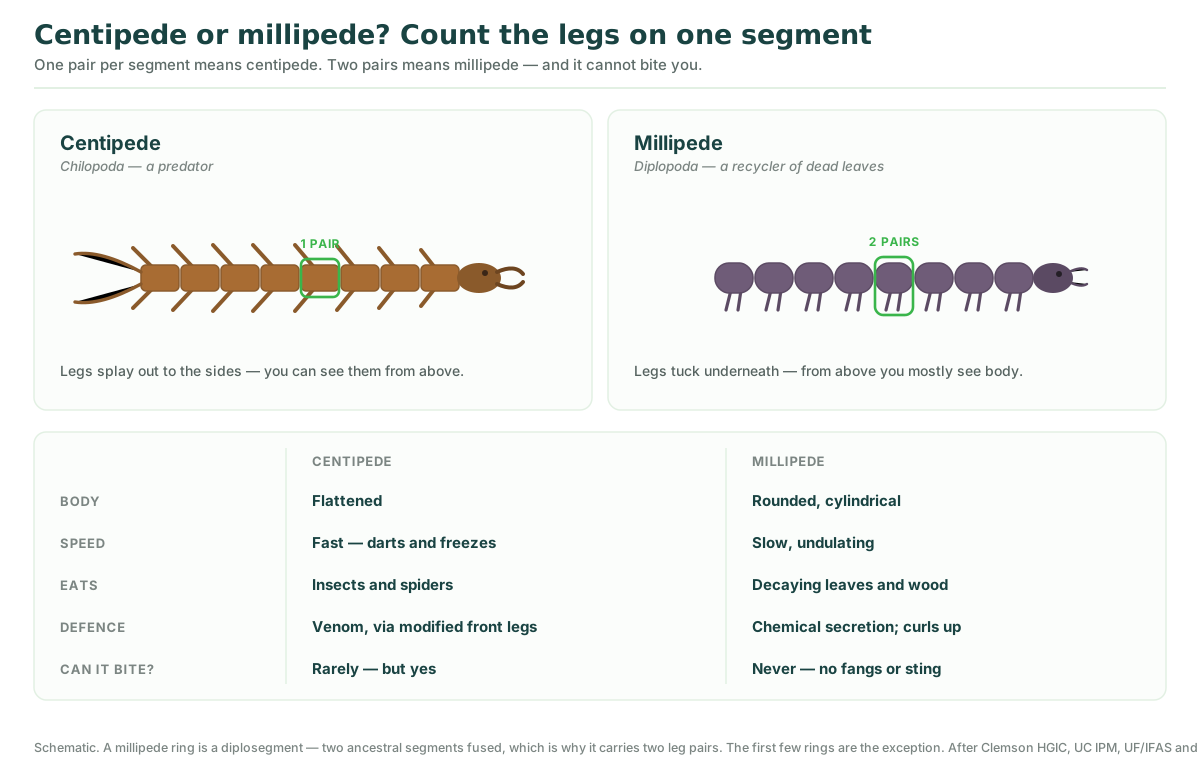
The rest follows from that. Centipedes are flattened with legs splayed out to the sides, move fast, and hunt. Millipedes are rounded with legs tucked underneath, move slowly, and eat decaying leaves and wood. Disturb a centipede and it runs; disturb a millipede and it curls into a coil.
Millipedes cannot bite — but do not crush them
Millipedes have no fangs and no sting. What they have is a chemical defense: secretions from pores along the body containing benzoquinones and related compounds, and in some species hydrogen cyanide.
On skin this is a nuisance — burning, itching, and a brown or purplish stain where the compounds react with skin proteins. Discoloration fades over weeks. The eyes are the exposure that actually matters, where the secretion can cause serious irritation and corneal damage. If it gets in an eye, irrigate immediately and see a doctor.
Practical version: sweep or vacuum them, do not squash them bare-handed, and wash your hands afterwards. Crushed millipedes also stain carpet and fabric.
The case for leaving the house centipede alone
This is the part that surprises people. Clemson's list of what house centipedes eat reads like a pest control brochure: carpet beetle larvae, cockroaches, firebrats, flies, moths, bed bugs, crickets, silverfish, earwigs and spiders.
Which reframes the whole thing. A house centipede is a symptom, not the disease. Its presence is telling you two things — that somewhere in the building is damp enough to suit it, and that there is enough other arthropod life to feed it. Penn State's assessment is that house centipedes are of little concern to homeowners despite their appearance.
You are entitled to not want one in your bathroom. Just know that removing it does nothing about the reason it was there.
Four things worth knowing about them
- No centipede has 100 legs. They always have an odd number of leg-bearing segments, so exactly fifty pairs is impossible. Real counts run from 15 pairs to 191, and the nearest to a hundred are 98 and 102.
- They drop legs on purpose. House centipedes have a built-in breakage point in each leg with a sealing membrane behind it, so a leg detaches cleanly when a predator grabs it. A full replacement can regrow in a single moult.
- They are not born with all those legs. Hatchlings have four pairs and add more at each moult — four, five, seven, nine, eleven, thirteen, then fifteen.
- They are the only centipedes with true compound eyes. Most centipedes have reduced eyes or none — the eastern red centipede in your yard is blind. The house centipede has large faceted eyes, which is part of why it is such an effective nocturnal hunter.
Why it is in your house
Moisture, and food. Centipedes are limited by water loss, which is why they gather in bathrooms, laundry rooms, basements, closets and crawl spaces — the places with the highest humidity.

Penn State adds the structural specifics: beneath concrete slabs, inside cement block walls, in floor drains whose traps have dried out, and under cardboard stored directly on a slab. Entry tends to be through expansion cracks, floor drains and gaps around plumbing.
Outdoors they live under mulch, leaf litter, logs and rocks — which is also where they come from. Indoor sightings rise after spring warm-up and again in autumn, though the house centipede, being a genuine indoor breeder, can turn up at any time of year in a heated building.
What actually works
- Take the moisture away first. Dehumidify basements and crawl spaces, ventilate, fix leaks, direct runoff away from the foundation, and water the lawn in the morning so it dries. Every extension service leads with this.
- Clear the harborage outside. Pull mulch, leaf litter, rocks and boards back from the foundation, keep mulch no more than two to four inches deep, and aim for a cleared strip roughly three feet wide around the house.
- Seal the entry points. Cracks in concrete and block walls, gaps around plumbing, weatherstripping, and screens on floor drains and sump covers.
- Deal with the prey. This is the centipede-specific lever. Treat the silverfish, roaches and other small arthropods and the centipedes lose their reason to stay. Sticky traps are a good way to find out what else is living down there.
- Remove the ones you find with a broom or vacuum. Simple, immediate, and what Clemson recommends.
What does not work is worth stating plainly, because it saves money. Ohio State says total-release foggers are ineffective against centipedes, and that sprays, fogs and total-release insecticides do not prevent millipedes entering a building. Alabama Extension notes that spraying insecticides does little to reduce millipede numbers and that creating dry conditions is the actual cure. UC IPM goes further: centipedes seldom need controlling at all, and although some pesticides are labeled for them, their use is rarely justified.
Clemson's own conclusion is that cultural and mechanical methods usually reduce house centipede numbers to the point where pesticides are unnecessary.
When to bring someone in
- You are seeing them regularly rather than occasionally, which points at a damp harborage somewhere rather than the odd wanderer.
- The moisture source is a crawl space or slab you cannot easily reach or dry out.
- You are finding the prey as well — silverfish, roaches, carpet beetles — since that is the infestation actually worth treating.
- Millipedes are arriving in large numbers, which usually follows heavy rain or drought and points at conditions right against the foundation.
Our centipede control service covers South Carolina, North Carolina and Virginia, and on this particular pest the honest work is inspection, moisture and crawl-space correction, exclusion, and treating whatever the centipedes have been eating. If you are also finding webs and sacs in the same damp corners, how to identify and remove spider egg sacs covers that.
The short version
- Venomous, not poisonous. They inject; they are not toxic to touch.
- It bites with modified legs, not its mouth — a pair of venom claws called forcipules.
- A house centipede usually cannot break human skin, and a bite from a larger one is roughly a wasp sting.
- The giant redheaded centipede does not live here. Its range stops around Arkansas.
- One pair of legs per segment is a centipede, two is a millipede — and a millipede cannot bite at all, though its secretion is bad news for eyes.
- Fix the damp, not the centipede. Foggers and sprays are documented as ineffective here.
Further reading: Clemson Cooperative Extension's factsheet covers the species found in South Carolina and how to manage them — Centipedes (Clemson HGIC). For bites, the National Capital Poison Center has plain-language guidance — Are centipede stings harmful? (Poison Control). Bite duration and first aid follow the Merck Manual; species sizes and ranges come from Clemson, Ohio State Extension and the University of Arkansas Arthropod Museum.
Frequently Asked Questions
No. Centipedes are venomous rather than poisonous. Poisonous means harmful to eat or touch; venomous means it injects a toxin. A centipede is not dangerous to handle in the sense of being toxic, though a larger one may bite if you handle it roughly.
No, and this is the detail most articles get wrong. A centipede bites with its first pair of walking legs, which are modified into curved venom claws called forcipules, sometimes also called maxillipeds or toxicognaths. They sit just behind the head and each has a venom gland with an opening near the tip. They are legs, not mouthparts.
Clemson compares it to a wasp sting. Expect immediate localized burning, redness and swelling, usually with two puncture marks. Pain typically lasts anywhere from 30 minutes to three days, and swelling can take about a week to settle. Systemic effects are rare and the clinical prognosis is excellent. The most genuinely dangerous outcome is an allergic reaction rather than the venom itself.
Usually not. Several extension services note that smaller centipedes generally cannot penetrate human skin, and Ohio State puts the practical threshold at around two inches of body length. A house centipede is one to one and a half inches, so it will rarely manage a bite at all unless handled roughly.
No. The giant redheaded centipede, Scolopendra heros, lives in Texas, Oklahoma, New Mexico, Arizona and neighboring states, reaching no farther east than Arkansas and Louisiana. It does not occur in the Carolinas or Virginia. South Carolina's larger native species is the eastern red centipede, which is bright red, ground-dwelling and completely blind.
Count the legs on one body segment. A centipede has one pair per segment, a flattened body, legs splayed to the sides, moves fast and hunts other arthropods. A millipede has two pairs per ring because each ring is two fused segments, has a rounded cylindrical body with legs tucked underneath, moves slowly and eats decaying plant matter. Millipedes cannot bite at all, though their defensive secretion can irritate skin and is genuinely harmful to eyes.
Remove the moisture first, since that is what limits them. Dehumidify and ventilate basements and crawl spaces, fix leaks, and direct runoff away from the foundation. Then clear mulch, leaf litter and boards back from the walls, seal cracks and gaps around plumbing and floor drains, and treat the small arthropods they are eating. Foggers and sprays are documented as ineffective against centipedes, so they are not worth buying for this.
Not in the Carolinas or Virginia. Our largest native, the eastern red centipede, gives a painful but harmless bite. Worldwide only a handful of the roughly 3,500 species, mostly tropical Scolopendra, cause serious effects, and deaths are very rare and mainly outside the US. The real risk is an allergic reaction.
Yes, with no lasting harm in almost every case. Vets expect at most mild stomach upset or a sore, swollen mouth if the centipede bit back. Watch for vomiting, drooling or pawing at the mouth for a day; call your vet if it persists or your dog has trouble breathing.
No. The bright red one in Southern yards is the eastern red centipede, venomous but not medically significant, and completely blind. The red-headed, black-bodied giant that is genuinely painful (Scolopendra heros) lives in Texas and the Southwest, no farther east than Arkansas and Louisiana.
Wash with soap and water, take acetaminophen or ibuprofen, and soak in warm water or apply ice. Check your tetanus shot is within 10 years. See a doctor for spreading redness, pus or fever, and call 911 for hives, dizziness, throat swelling or trouble breathing.
Photo credits: Kevincollins123, CC BY-SA 3.0, via Wikimedia Commons; Gogerr, CC BY-SA 4.0, via Wikimedia Commons.