




Most people call any mouse with a white belly a "deer mouse" or a "field mouse," and a lot of hantavirus worry starts there. In the Carolinas and most of Virginia, that white-bellied mouse is almost never a true deer mouse. Here's how to tell the house mouse from its outdoor relatives, which ones actually live where you do, and what the health risk really is.
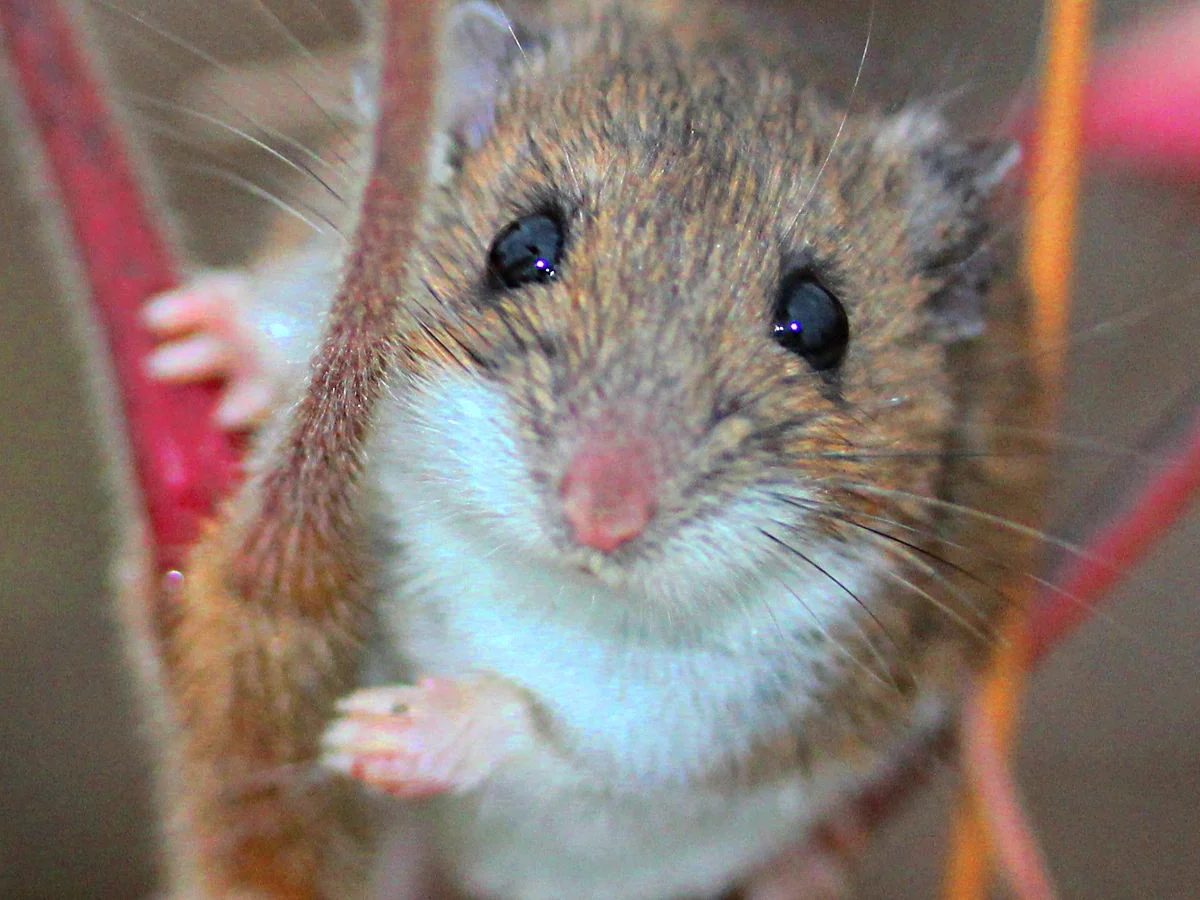
House mouse: one solid gray-brown color, small eyes, and a nearly hairless tail the same color all over. It has a musky smell and breeds indoors all year. Deer, white-footed and cotton mice (the "field mice"): brown on top, bright white belly and feet, big eyes and ears, and a furred tail that's dark on top and white underneath.
Here, a white-bellied mouse is usually a white-footed or cotton mouse, not a deer mouse. In North Carolina the true deer mouse lives almost only in the mountains, and in Virginia mainly in the western half. CDC records show 1 hantavirus case in North Carolina, 1 in Virginia and none in South Carolina from 1993 through 2023. Clean up droppings safely anyway.
How to Tell Them Apart
| House mouse | White-footed mouse | Deer mouse | Cotton mouse | |
|---|---|---|---|---|
| Color | One solid gray to light brown, belly only slightly paler | Reddish to gray-brown back, white belly and feet | Gray to brown back, white belly and feet, sharp line between | Darker brown back, white belly and feet |
| Eyes and ears | Small black eyes, medium ears | Large eyes and ears | Large eyes and ears | Large eyes and ears |
| Tail | Almost no fur, one color, scaly | Furred, two-tone | Furred, sharply two-tone, more than half its total length | Furred, two-tone |
| Size | About 5 to 7 in. with tail, 1/2 oz | 3.5 to 4 in. plus tail | 3 to 4 in. plus tail | Similar to white-footed |
| Smell | Musky "mousy" odor in long infestations | Lacks the house-mouse odor | Lacks the house-mouse odor | Lacks the house-mouse odor |
| Where in our area | Everywhere people live | Statewide in NC; mostly above the fall line in SC | Mountains of NC; western half of VA | Coastal Plain of the Carolinas |
Sources: UC IPM, the Internet Center for Wildlife Damage Management, NC Parks' Mammals of North Carolina and Virginia DWR. Two lookalikes complete the list. Voles have short tails and blunt faces. Shrews have pointed snouts and tiny eyes.
| Quick check | House mouse | "Field" mouse (any Peromyscus) |
|---|---|---|
| Flip it over (or look at a photo) | Belly about the same color as the back | Bright white belly with a clear line |
| Look at the tail | Bare, one color | Furred, dark on top and white below |
| Smell the area | Musky | Little odor |
The House Mouse

The house mouse (Mus musculus) is the one that moves in for good. According to UC IPM, with steady food and shelter it breeds all year. A female can have 5 to 10 litters a year of about 5 or 6 young, which mature in 5 to 6 weeks. That's why a house mouse problem grows through winter instead of fading. House mice seldom travel more than about 30 feet from their nest and food, build nests from finely shredded paper and fabric, and leave a musky odor in long-term infestations.
The "Field Mice": Deer, White-Footed, Cotton and Oldfield Mice
"Field mouse" isn't a species. People use it for any outdoor mouse, and most of the time they mean one of the Peromyscus mice, sometimes called deermice as a group. The irony is that most of them don't live in fields. Here's what NC Parks' Mammals of North Carolina reports about each:
- Deer mouse (P. maniculatus): "essentially limited to the mountain region," mostly above 3,500 feet, and "absent from most of the Piedmont and Coastal Plain." It lives "strictly in cool forests" and is found "hardly even in fields." Virginia DWR says it's fairly common in the western half of that state.
- White-footed mouse (P. leucopus): found essentially statewide in North Carolina and "considered to be the most numerous mammal in the state." It favors hardwood forest, is "infrequent in fields," and "does occur in some buildings in wooded areas." In South Carolina it's mostly found above the fall line.
- Cotton mouse (P. gossypinus): the Coastal Plain species, from the Lowcountry up through eastern North Carolina, preferring wetter woods and bottomlands.
- Oldfield mouse (P. polionotus): the one that really is a field mouse. It "strongly favors brushy and weedy grasslands and fields, in sandy soils." It's "locally common in SC" but known from only a few North Carolina records.

Because they're mainly woodland mice, they turn up most in homes, garages, sheds and cabins that back onto woods, fields or bottomland, and NC Parks notes the white-footed mouse "does occur in some buildings in wooded areas." Unlike house mice, they lack the musky odor (ICWDM).
What a true deer mouse looks like

Hantavirus: What the Numbers Say for SC, NC and VA
Hantavirus pulmonary syndrome is serious. The CDC reports 890 U.S. cases from 1993 through 2023, and 35% of patients died. But 94% of cases were west of the Mississippi River. On the CDC's state map for that period:
| State | Hantavirus cases, 1993 to 2023 |
|---|---|
| North Carolina | 1 |
| Virginia | 1 |
| South Carolina | None reported |
| For comparison: New Mexico, Colorado | 129 and 121 |
The deer mouse carries the main U.S. strain (Sin Nombre virus). Eastern rodents carry their own, rarer hantaviruses. The CDC lists New York virus in white-footed mice, Black Creek Canal virus in cotton rats, and Bayou virus in marsh rice rats, the last two found in the Southeast. House mice don't carry hantavirus, but the CDC says they spread lymphocytic choriomeningitis (LCM) through fresh urine, droppings, saliva and nesting material. LCM is especially risky during pregnancy.
The practical takeaway is the same for every mouse: never sweep or vacuum droppings. The CDC's method:
- Open doors and windows for 30 minutes before you start.
- Put on rubber or plastic gloves.
- Spray droppings and nesting material with fresh bleach solution (1.5 cups of bleach per gallon of water, about 1 part bleach to 9 parts water) and let it soak 5 minutes.
- Wipe up with paper towels, bag them, then disinfect the area.
What People Actually Find
On Reddit's animal-ID and pest forums, people regularly post a caught mouse asking "house mouse or deer mouse?" In many of the threads we reviewed, commenters identified the mouse as a plain house mouse, usually by the solid color and bare tail. One North Carolina post got the regionally correct answer: "Distinctly white belly = deer mouse or white footed mouse." Another common story is a mouse living in a parked car, nesting where the cabin air filter sits. Some owners noticed the white-bellied mice "didn't touch our foods," which fits mice looking for winter shelter rather than a kitchen.
YouTube comments show both extremes. Under naturalist Jeff the Nature Guy's video "A deer mouse in the house," one viewer in Arkansas saw a white belly three feet away and set out 10 traps. Others say they keep rescued wild deer mice as pets and that hantavirus "is not an issue" where they live, in Maryland or Ohio. The truth sits in between. Hantavirus cases are rare in the East, with one each in North Carolina and Virginia and none in South Carolina in CDC records through 2023. But rare isn't zero, so clean up droppings the CDC way.
Can You Tell by the Droppings?
Not reliably. ICWDM notes that deer and white-footed mouse droppings, nests and signs resemble those of house mice. Seeing the mouse itself, or a clear photo of a trapped one, is the dependable way to tell. A musky smell points to house mice, which build nests from finely shredded paper and fabric (UC IPM). See what mouse droppings look like for sizes and comparisons with rats and roaches.
Getting Rid of Them
The approach is the same for all of them:
- Seal first. Mice fit through gaps about 1/4 inch tall (UC IPM). Use copper mesh or steel wool with caulk, and hardware cloth for vents. See how mice get into your house and the gaps to seal.
- Trap close together. UC IPM recommends snap traps no more than about 10 feet apart where mice are active, since house mice stay within about 30 feet of their nest.
- Expect a different season. House mice can show up any time and keep breeding indoors. White-footed and cotton mice mostly arrive with cold weather. See when mouse season starts.
- Native species: ICWDM notes control of deer and white-footed mice is usually allowed, but check your state's wildlife rules.
Need help? Our rodent control service handles inspection, sealing and trapping across South Carolina, North Carolina and Virginia. For the bigger comparison, see rat vs. mouse.
Key Takeaways
- House mouse: one solid color, small eyes, bare one-color tail, musky odor, breeds indoors all year.
- "Field" mice (deer, white-footed, cotton, oldfield): white belly and feet, big eyes and ears, furred two-tone tail.
- Here, a white-bellied mouse is usually white-footed or cotton. True deer mice live in the NC mountains and western Virginia.
- Hantavirus is very rare in our states: 1 case in NC, 1 in VA and none in SC from 1993 to 2023 (CDC).
- Clean droppings the CDC way: ventilate, gloves, bleach solution, never sweep or vacuum.
Sources: CDC, Hantavirus Disease Case Data and cumulative cases by state through 2023; CDC, About Hantavirus and "Hantavirus Pulmonary Syndrome: Updated Recommendations for Risk Reduction" (MMWR, 2002); CDC, About Lymphocytic Choriomeningitis; CDC, How to Clean Up After Rodents; NC Division of Parks and Recreation, The Mammals of North Carolina, Third Approximation (2026), species accounts for North American, White-footed and Oldfield Deermouse; Virginia Department of Wildlife Resources, Deer Mouse; Internet Center for Wildlife Damage Management, Deer and White-footed Mice; UC IPM, House Mouse; S. Pinto via PCT, "Deer Mice vs. House Mice" (2025); Jeff the Nature Guy, "A deer mouse in the house", YouTube; homeowner accounts from Reddit (via Google search excerpts) and YouTube comments.
Frequently Asked Questions
Look at the belly and tail. A house mouse is one solid gray-brown color with a nearly hairless, one-color tail. A deer mouse (and its relatives, the white-footed and cotton mice) has a brown back, a bright white belly and feet, big eyes and ears, and a furred tail that is dark on top and white underneath.
Not exactly. Field mouse is an informal name for any outdoor mouse. People usually mean one of the Peromyscus mice: deer, white-footed, cotton or oldfield mice. In North Carolina, the true deer mouse lives mainly in the mountains and rarely in fields. The mouse in a Carolina field or garage is usually a white-footed, cotton or oldfield mouse.
Not in most of the state. South Carolina's white-bellied mice are mostly white-footed mice (above the fall line), cotton mice (the Coastal Plain) and oldfield mice (sandy fields). In North Carolina the true deer mouse is essentially limited to the mountains, and in Virginia to the western half.
No. Only some deer mice carry Sin Nombre virus, the main U.S. hantavirus, and cases are rare in our region. The CDC recorded 1 hantavirus case in North Carolina, 1 in Virginia and none in South Carolina from 1993 through 2023. Still clean up any mouse droppings with the CDC's bleach method and never sweep or vacuum them.
No. House mice are not hantavirus carriers, but the CDC says they spread lymphocytic choriomeningitis (LCM) virus through fresh urine, droppings, saliva and nesting material. LCM is a particular concern during pregnancy.
For most homes here, the house mouse. It breeds indoors year-round, with a female producing 5 to 10 litters a year according to UC IPM, so an infestation keeps growing. White-footed and cotton mice usually come in seasonally for shelter, though they can still contaminate and chew.
Not reliably. Wildlife damage experts note the droppings and signs of deer and white-footed mice resemble those of house mice. A clear look at the mouse, or a musky smell, which points to house mice, is more reliable.
Outdoor mice like white-footed and deer mice look for sheltered spots as it gets cold, and a parked car offers one. People often find nests where the cabin air filter sits. Clean any nest material with gloves and a bleach solution rather than vacuuming it.
Follow the CDC: ventilate for 30 minutes, wear rubber or plastic gloves, spray droppings with a fresh solution of 1.5 cups bleach per gallon of water, let it soak 5 minutes, then wipe up with paper towels and bag them. Never sweep or vacuum droppings.
The same way: seal gaps about 1/4 inch and larger with metal-backed materials, set snap traps no more than about 10 feet apart where mice are active, and remove food and shelter. Control of native deer and white-footed mice is usually allowed, but check your state's wildlife rules.
Photo credits: Peterwchen, CC BY-SA 4.0; Ahunt, CC0; Laura Clark, CC BY 4.0; Seney Natural History Association, CC BY-SA 2.0; via Wikimedia Commons.