




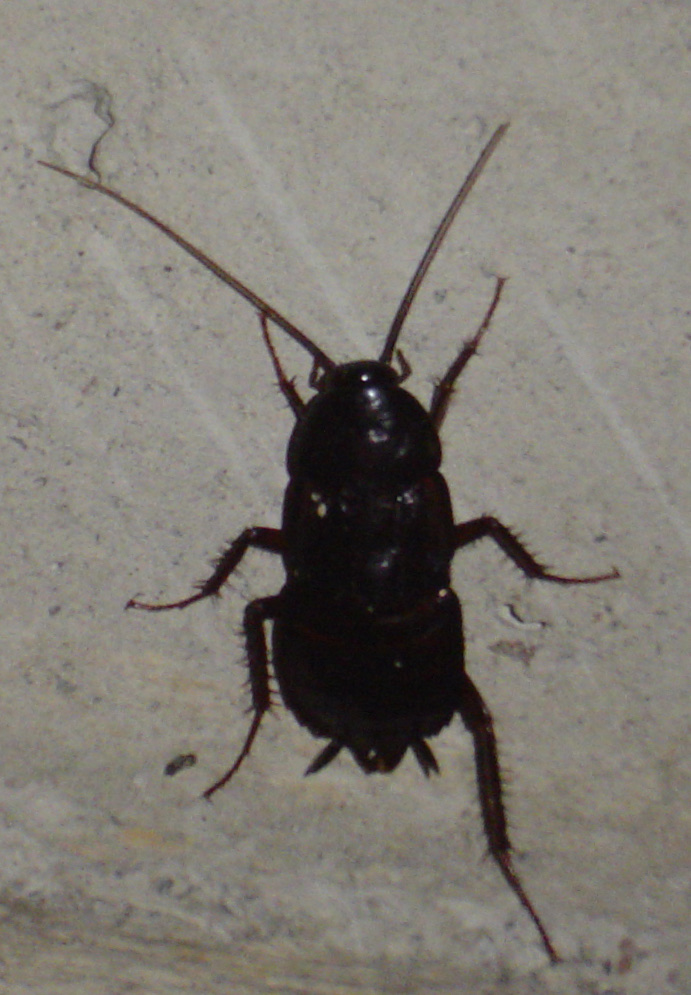
The big dark "water bug" in your bathtub or kitchen is almost always a large cockroach: an American, smokybrown or oriental cockroach. Killing the one you see is easy. Getting rid of them means finding where they're coming from, because these roaches mostly live outside the living space, in sewers, drains, crawl spaces, mulch and trees, and wander in. This guide shows you how to find the source, what actually kills them, which home remedies are worth your time, and how to keep them out in the Carolinas and Virginia.
To get rid of water bugs: find out how they're getting in (plug your drains overnight as a test), keep water in drain traps, seal gaps around pipes and doors, rake mulch back from the foundation, then put gel bait in cracks where they travel. Boric acid dust works in dry, hidden spots.
Skip: boiling water (it can damage plastic drain pipe), bug bombs (the University of Kentucky says they "seldom are effective"), and essential oil sprays (no evidence they keep roaches out of a home).

Which Water Bug Do You Have?
True water bugs are aquatic insects that live in ponds and pools. The ones people find indoors are cockroaches, and knowing which one tells you where to look. If you're not sure what you found, see what a water bug looks like. Clemson Extension says the most common large cockroaches in South Carolina are the American, smokybrown and oriental, and that they're "normally found outdoors, but they can live inside."
| Roach | What it looks like | Where it comes from |
|---|---|---|
| American cockroach | 1½ to 2 inches, red-brown, pale yellow band behind the head | Sewers, floor drains, sump pumps, crawl spaces, boiler and laundry rooms |
| Smokybrown cockroach | 1 to 1½ inches, uniformly dark mahogany, flies on warm evenings | Mulch, log piles, thick plants, roof gutters and, along the coast, palmetto trees |
| Oriental cockroach | 1 to 1¼ inches, shiny black or very dark brown, slow, short wings | Cool, damp places at ground level: floor drains, sump pumps, crawl spaces, under stones and leaf litter |
Sizes and habits are from Clemson Extension and the University of Kentucky. If what you're seeing is small (about half an inch) and tan with two dark stripes behind the head, that's a German cockroach. It lives and breeds indoors and needs a different approach. See how to get rid of a heavy roach infestation.
Step 1: Find Where They're Coming From
This is the step most people skip, and it's why the problem keeps coming back. The University of Kentucky says American cockroaches "often travel long distances from their aggregation sites; long-term relief requires finding and treating these areas."
The overnight drain test
Pima County, Arizona, which deals with a lot of sewer roaches, recommends a simple test: seal every drain in the evening: sinks, tubs, showers and floor drains. Use the stopper, or for a drain without one, the county suggests an upside-down plastic bucket with a weight inside, such as a shampoo bottle. If you still find roaches the next morning, the county says, "they are probably coming in another way than through the sewer system." That one night tells you whether to focus on the plumbing or on gaps, mulch and the crawl space.
If they're coming up the drains
Every drain has a U-shaped pipe called a trap that holds water and blocks the sewer. When a drain isn't used, the water evaporates and the way is open. Pima County's fixes:
- Keep the traps full. Run water in every drain at least once a week in hot weather. A few seconds from the tap is enough. That includes guest bathrooms, basement floor drains and laundry drains.
- Close drains you don't use, or fit them with wire mesh baskets.
- Tape over overflow holes in sinks and tubs until the problem is under control.
- Check the sewer clean-out cap outside. It should be on tight.
Sometimes the problem is a broken pipe. On a YouTube video about roaches coming up drains, the top comment (43 likes) came from a homeowner whose plumber "put a camera down the main line" and found the pipe had burst. The camera showed "lots of cockroaches and mice." If roaches keep showing up near drains after the traps are full and the caps are tight, a sewer camera inspection is worth it. On Reddit (via Google search excerpts), a North Carolina homeowner with bugs coming out of several drains got the same advice as a top answer: "You need a plumber to address HOW the bugs are getting in."
If they're coming from outside
Smokybrown and American cockroaches live in the yard and walk or fly in. Look for:
- Mulch against the foundation. Clemson lists mulch as smokybrown habitat and suggests "raking back mulched areas next to the structure." On Reddit (via Google search excerpts), a Raleigh resident's top tip was the same: remove mulch, because "they breed in the mulch."
- Gutters, log piles, thick plants and palmetto trees near the house.
- Gaps under doors. Pima County says a gap the thickness of a coin is enough, and if you can see daylight around the door edge, roaches can get in.
- Openings around pipes and wires where they go through walls, and around outdoor drain lines and vents.
- Crawl spaces. Damp crawl spaces suit American and oriental cockroaches.
Step 2: What Actually Kills Them
Gel bait. The University of Kentucky says gel bait applied with a syringe is often "more versatile and efficient" than plastic bait stations, because you can put small, pea-sized dabs in cracks, corners and edges where roaches travel. Put it under sinks, behind the toilet, along the edges of cabinets, near floor drains and in the garage. Don't spray insecticide near the bait. North Carolina's agriculture department warns the spray "may repel the cockroaches and prevent the bait from doing its job." On Reddit (via Google search excerpts), a Virginia Beach resident said the syringe gel "will kill them all overnight." It won't always be that fast, but bait is the method the extension services recommend.
Boric acid. The University of Kentucky says boric acid tends to work better than diatomaceous earth for cockroaches. Clemson says to apply it as a thin film, not a pile, in out-of-the-way places such as under the refrigerator, stove and sinks. Use a product labeled for cockroaches.
Outside, along the foundation. Clemson says a perimeter treatment along the base of the foundation wall can help with the larger outdoor cockroaches, and that large-scale outdoor applications are best done by a professional.
Home Remedies: What Works and What Doesn't
| Remedy | Verdict | Why |
|---|---|---|
| Running water in drains | Works | Keeps the trap full so the sewer stays sealed (Pima County) |
| Drain stoppers and mesh baskets | Works | Physically blocks the way in |
| Boric acid | Works | More effective than diatomaceous earth for roaches (University of Kentucky); apply a thin film (Clemson) |
| Bleach in drains | Only as a trap filler | Pima County suggests it for drains you rarely use because it may not evaporate as fast as water. It isn't a way to kill roaches living in the sewer. See will bleach kill a roach |
| Diatomaceous earth | Only in dry spots | The National Pesticide Information Center says it stays effective only "as long as it is kept dry and undisturbed," so it's useless in and around wet drains |
| Vinegar and baking soda | Cleans the drain, nothing more | No extension service recommends it for roaches. Reddit threads swear by it, but it doesn't fix a dry trap, a gap or a broken pipe |
| Boiling water | Don't | Plastic (PVC) drain pipe is rated for 140°F (Charlotte Pipe, Westlake Pipe). Boiling water is 212°F. Use hot tap water |
| Essential oils (peppermint and others) | No proof for homes | A 2022 lab study found a strong 10% oil blend repelled American cockroaches in a choice test, far stronger than a few drops in a spray bottle. EPA doesn't review "minimum risk" natural sprays |
| Soap spray | Kills only the one you hit | A popular Reddit tip. Like any contact spray, it does nothing about where they're coming from |
| Bug bombs (foggers) | Don't | The University of Kentucky says they "seldom are effective" against household pests |
| Plug-in ultrasonic repellers | Don't | See does ultrasonic pest control work |
Water Bugs in the Bathroom
Bathrooms are where most people find them, usually in the tub at night. The University of Florida says American cockroaches can move into homes "from sewers via the plumbing." But a roach in the tub didn't necessarily come up the drain. On Quora (via Google search excerpts), one answer pointed out that roaches are much more likely to have come in another way and be living under the sink. Run the overnight drain test first. Then:
- Keep the tub stopper closed when the tub isn't in use. A YouTube commenter who kept finding roaches in their tub now does exactly this to block the drain.
- Run water in guest bathroom drains every week.
- Seal the gaps around pipes under the sink and behind the toilet with caulk or foam. The University of Kentucky also suggests copper mesh.
- Fix leaks and dry the room out. Quora's top answer on two separate threads was simply "deprive them of water."
- Put gel bait under the sink and behind the toilet, away from where you clean.
Step 3: Keep Them Out
- Seal: caulk around doors and windows, and seal where pipes and wires go through walls and floors (University of Kentucky). Clemson suggests steel wool as a temporary filler until you can caulk.
- Door sweeps and weather stripping: no daylight around the door.
- Screens on floor drains and vents, as North Carolina's agriculture department recommends.
- Mulch and plants: pull mulch back from the foundation and trim plants away from the walls.
- Gutters: keep them clean, especially for smokybrowns.
- Trash: lidded cans, and keep them away from doors.
- Cardboard: swap boxes in the garage and basement for plastic bins.
Be realistic. On Reddit (via Google search excerpts), a Charleston resident said it's "unrealistic to expect zero palmetto bugs." Outdoor roaches will wander in sometimes in the South. The goal is to keep them from living in the house and to stop seeing them regularly. For more, see our cockroach prevention tips.
Why the Carolinas and Virginia Have So Many
These roaches like warmth and humidity, and the Southeast coast has plenty of both. Clemson notes that along the coast smokybrowns live in trees, especially palmettos, which is where the "palmetto bug" name comes from. Rain matters too. The University of Florida says American cockroach infestations "can occur after heavy rain," and on Reddit (via Google search excerpts) Charleston residents have described large numbers forced out of storm drains by heavy rain. If you suddenly see several in a week after a storm, that's usually why. For more on the Lowcountry, see water roaches in Charleston and how to get rid of palmetto bugs. In coastal Virginia, see palmetto bugs in Virginia Beach.

When to Call a Professional
- You still see them regularly after a few weeks of drain care, sealing and bait.
- The overnight drain test points to the plumbing, but the traps and clean-out cap are fine. You may need a plumber and a sewer camera.
- You're seeing them in the crawl space, attic or walls, or seeing young roaches indoors.
- You want the outdoor perimeter treated. Clemson says large-scale outdoor applications are best done by a professional.
Our cockroach control service covers South Carolina, North Carolina and Virginia, including the outside of the house where these roaches live.
Key Takeaways
- Water bugs indoors are usually American, smokybrown or oriental cockroaches that live outside the living space and wander in.
- Find the source first. Plug every drain overnight. Roaches in the morning mean they're getting in another way.
- Keep drain traps full by running water weekly, and check the sewer clean-out cap.
- Use gel bait in cracks and boric acid in dry spots. Don't spray near bait.
- Skip boiling water, bug bombs and essential oil sprays.
- Rake mulch back, seal gaps and fit door sweeps to keep outdoor roaches out.
Frequently Asked Questions
Find where they're coming from and close it off. Plug every drain overnight as a test, keep water in drain traps by running each drain weekly, check that the outdoor sewer clean-out cap is tight, seal gaps around pipes and doors, and rake mulch back from the foundation. Then put gel bait in cracks where they travel. Spraying the ones you see won't stop new ones coming in.
Any contact spray, including soapy water, will kill the one you hit, but that doesn't solve the problem. Gel bait and boric acid are slower but reach the roaches you don't see. Don't use bug bombs: the University of Kentucky says they seldom work against household pests.
Usually because something changed outside. The University of Florida says American cockroach infestations can occur after heavy rain, which floods them out of sewers and storm drains. A drain that hasn't been used and has dried out, new mulch against the house, or a broken sewer pipe can also bring them in.
They can. The University of Florida says American cockroaches move into homes from sewers through the plumbing, and oriental cockroaches often live in floor drains. But many come in another way. Plug every drain overnight: if you still find them in the morning, they're probably getting in through gaps, doors or the crawl space.
Dry conditions. These roaches need moisture, so fixing leaks, drying out crawl spaces and bathrooms, and keeping mulch away from the walls makes your home much less attractive. There's no good evidence that smells like peppermint oil keep them out of a home.
Large cockroaches don't build nests, but they gather in dark, damp places. Check floor drains, sump pumps, under sinks, behind the water heater and washing machine, the crawl space, mulch beds, gutters and woodpiles. Look at night with a flashlight, when they're active.
Not if you have plastic drain pipe. PVC drain pipe is rated for up to 140 degrees Fahrenheit, and boiling water is 212 degrees. Use hot tap water instead, and focus on keeping the drain trap full.
No extension service recommends vinegar for cockroaches. A vinegar and baking soda flush can clean a drain, but it won't fix a dried-out trap, a gap under the door or a broken sewer pipe, which is how the roaches get in.
Sources: University of Kentucky Entomology, "Cockroach Elimination in Homes and Apartments" (EF614); Clemson Cooperative Extension HGIC, "Cockroach (Roach) Control"; University of Florida IFAS, "American Cockroach" (EENY-141); Pima County, Arizona, cockroach prevention; NCDA&CS Structural Pest Control and Pesticides Division, "Cockroach Control and Prevention"; National Pesticide Information Center, "Diatomaceous Earth General Fact Sheet"; U.S. EPA, "Conditions for Minimum Risk Pesticides"; Charlotte Pipe and Foundry, PVC Schedule 40 DWV submittal; Westlake Pipe & Fittings, PVC operating temperature FAQ; M. Soonwera et al., "Ovicidal and repellent activities of several plant essential oils against Periplaneta americana L." (2022); Reddit r/raleigh, r/VirginiaBeach, r/Charleston and r/HomeImprovement (via Google search excerpts); Quora (via Google search excerpts); YouTube comments under water bug and drain cockroach videos.
Photo credits: Sputniktilt, CC BY-SA 3.0; Bestiasonica, CC BY-SA 4.0; Toby Hudson, CC BY-SA 3.0; via Wikimedia Commons.