




There is no single hatch time. A common house spider's eggs hatch in about a week; a brown recluse's take 24 to 36 days. And hatching is only the first of two clocks — black widow spiderlings hatch in roughly eight days, then sit inside the sac for another nine before anything comes out.
So a sac that looks dormant may already be full of live spiders. Vacuum it up, bag it, and put it in an outside bin. Do not reach for a spray — there is a controlled study showing that is close to useless, and it is covered below.
Finding a pale, papery lump tucked into a ceiling corner is unsettling in a way an actual spider somehow isn't. A spider you can deal with. A sac is a countdown.
The good news is that identifying it is easy once you know what separates the species, and most of what you have read about killing them is wrong. Here is what the entomology actually says.
How to tell which spider laid it
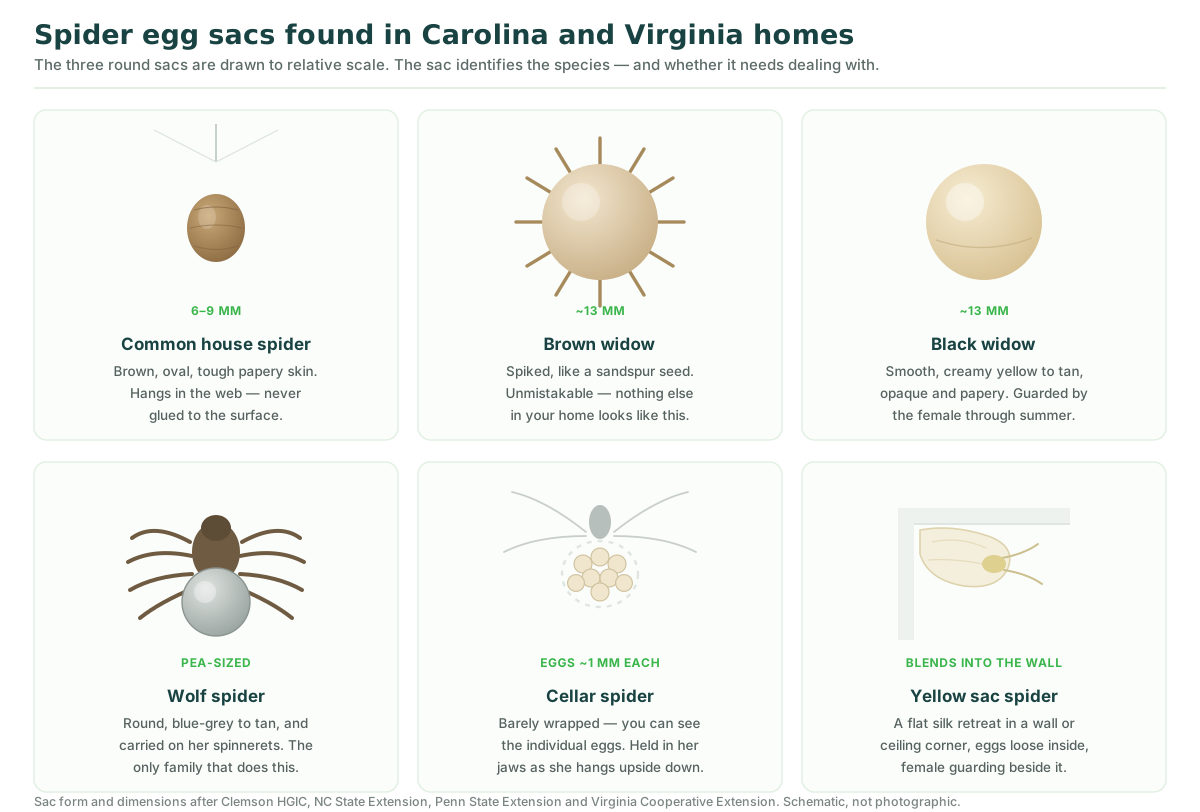
The sac tells you the species, and the species tells you whether you have a problem or a houseguest. Three shortcuts settle most cases before you look at anything else:
- Hanging in a messy web? Common house spider.
- Being carried on the mother's back end? Wolf spider — the only family that does this.
- Held in her jaws while she hangs upside down? Cellar spider. Also the only family that does this.

Neither a wolf spider's nor a cellar spider's eggs are ever stuck to a wall. If you are looking at a sac attached to a surface, you have already ruled both out.
| Spider | What the sac looks like | Size | Eggs per sac | Where you find it |
|---|---|---|---|---|
| Common house spider Parasteatoda tepidariorum | Brown, oval, tough papery cover, hanging in the web | 6–9 mm | 140–380 | Wall and ceiling corners, floor joists, window frames, damp basements |
| Brown widow Latrodectus geometricus | White to tan, covered in pointed spikes like a sandspur — unmistakable | ~13 mm | ~250 | Under eaves, porch railings, upturned flowerpots, outdoor furniture, firewood |
| Black widow Latrodectus mactans | Creamy yellow to light tan, opaque, tough and papery | ~13 mm | 200–800 | Garages, barns, woodpiles, crawl spaces, undisturbed cavities |
| Wolf spider Lycosidae | Round, blue-gray to tan, attached to the mother's spinnerets | Pea-sized | 100+ | Carried — behind doors, houseplants, closets, behind furniture |
| Cellar spider Pholcidae | Barely wrapped — you can see the individual eggs through the silk, held in her jaws | Eggs ~1 mm each | 13–60 | Damp cellars, basements, crawl spaces, corners |
| Yellow sac spider Cheiracanthium mildei | Eggs loosely deposited inside a silk retreat, female guarding nearby | Retreat blends into the wall | No reliable published figure | Wall and ceiling corners, under windowsills and siding |
The one worth learning by sight
If you live anywhere near the coast — Charleston, Beaufort, and increasingly well inland — learn the brown widow sac. Clemson describes it as covered with pointed projections, much like the seed of a sandspur. Nothing else in a Carolina home looks remotely like it, so you can identify it from across the room.

That matters, because brown widow venom is as toxic as a black widow's. The species is far less inclined to bite and does not defend its web aggressively, so the practical risk is lower — but a spiky sac under your porch railing means an adult female is somewhere within a meter of it.

How long before they hatch
Almost every page on this subject says 14 to 21 days. That number is real, but it belongs to one species — the brown widow. It has been copied so widely that it now reads as a general spider fact. It isn't.
| Species | Eggs hatch in | Then spiderlings stay inside the sac for |
|---|---|---|
| Common house spider | About 7 days at 25 °C | Not established |
| Black widow | About 8 days | About 9 more days, molting once |
| Brown widow | 14–21 days | 4 days to a month |
| Brown recluse | 24–36 days from egg to emergence | |
The column most articles omit is the second one. There are two clocks running: the eggs hatch, and then the spiderlings stay put and molt before chewing their way out. A black widow sac reaches the halfway point in about eight days while still looking completely inert from the outside.
Warmth speeds both clocks up. That 7-day house spider figure comes from lab colonies held at a constant 25 °C — which, in February, describes the inside of your house far better than it describes your yard. An egg sac in a heated basement is not waiting for spring.
Do not judge a sac by whether it looks "active." There is nothing to see from the outside until the moment spiderlings emerge, and by then the decision has been made for you. If you find one, deal with it that day.
Where they turn up indoors, and why
Every documented location shares the same three qualities: undisturbed, sheltered from moving air, and close to something to eat. Spiders are not choosing corners for the aesthetics — a corner gives a web two anchor points, and windows deliver a steady supply of insects to it.
- Wall and ceiling corners, window frames, floor joists — house spiders and yellow sac spiders. Anchor points plus insect traffic.
- Basements and crawl spaces — house spiders and cellar spiders. Damp and thermally stable year-round.
- Garages, barns, woodpiles, undisturbed cavities — black widows. Dark, dry, and nobody goes in there.
- Under eaves, porch railings, upturned flowerpots, outdoor furniture — brown widows. Rain-sheltered and rarely moved.
- Behind stored boxes and along baseboards in closets — clutter is harborage, and it is the first thing every extension service tells you to remove.
Cellar spiders deserve a note of their own: they thrive in heated structures all year, so a basement population is not seasonal and will not clear out on its own. If you keep finding loose, haphazard webs down there, see where spiders like to hide for the full list of spots worth checking.
Why spraying an egg sac does not work
This is the part that contradicts most of the internet, including the older version of this page, so it is worth being precise about the evidence.
In 2016, researchers published a controlled test in the Journal of Economic Entomology — Vetter and colleagues, volume 109, pages 267–272. They treated widow egg sacs with six water-based sprays and four oil-based aerosols, then used a dye tracer to measure how much actually reached the eggs inside.
The water-based products reached less than 0.1 percent of the eggs. Spiderlings emerged from treated sacs at essentially the same rate as from untreated ones. The oil-based aerosols reached more than 99 percent and stopped emergence in 94 to 100 percent of sacs.
The mechanism is the carrier, not the poison. Silk repels water; petroleum solvents pass straight through. So the household spray under your sink — water-based, almost without exception — beads on the outside of the sac and does nothing to what is inside. The authors concluded that control relying on perimeter water-based sprays may not satisfactorily control widow eggs.
Two honest caveats. The study was run on brown widows, so the direct data cover one species, though the mechanism is general. And this says nothing about sprays against adult spiders, where they work fine. It is specifically the sac that defeats them.
Diatomaceous earth and vinegar fare no better, for the same reason: neither penetrates silk. Extension entomologists are blunt about the alternative. Iowa State states plainly that insecticide fogs and sprays are not recommended indoors for spider management. Clemson's guidance is to remove webs, sacs and spiders with a broom or vacuum, and treats insecticides as no substitute for sanitation.
How to remove one properly
- Vacuum it, using the hose attachment. A vacuum is the recommended tool, not a fallback. Soft-bodied spiders rarely survive the trip through the hose, and the suction takes the web and the sac together.
- Seal the bag or empty the canister immediately. Into a plastic bag, tied shut. This is Clemson's stated step and it is the one people skip.
- Put it in an outdoor bin. Not the kitchen bin. Not the garage.
- Check within a meter of where it was. A house spider female may build twelve or more sacs in her life, roughly one every four to six days. Finding one means looking for the others.
- Take away the reason it was there. Vacuum the baseboards and corners, clear the clutter, cut the humidity in the basement, and seal the gaps that let the prey insects in. Spraying without this is temporary by definition.
What happens if you miss one
It depends entirely on the species, and this is the nuance that decides whether you have an ongoing problem or a one-off.
Some spiders genuinely live indoors. House spiders, cellar spiders and Cheiracanthium mildei breed and persist inside; that last species lays its eggs almost exclusively indoors. These populations sustain themselves without any help from outside.
Most of what wanders in does not. Outdoor species that blunder through a door typically survive a day or two indoors and cannot reproduce there. The big spider that sprinted across your living room in September was almost certainly a mature male looking for a mate, not a settler.
That also disposes of the usual autumn explanation. Spiders are cold-blooded and are not drawn to warmth — most temperate species carry enough natural antifreeze to survive well below freezing. The late-summer surge is the mating season, not a migration indoors. Which means the sacs you find in the basement in October were built by spiders that were already living there.
When spiderlings do emerge, most disperse on foot and by dragline over a short distance. Ballooning — releasing silk to ride air currents — needs open air and updrafts, so indoors you get a scatter of tiny spiders in that room rather than a house-wide event. Worth knowing anyway: ballooning is not purely a wind trick. Spiders detect atmospheric electric fields through sensory hairs and can take off with no wind at all.
About brown recluse, since somebody always asks
Nearly every spider article aimed at Southern homeowners leans on the brown recluse. The verified record does not support it.
South Carolina physicians diagnosed 478 recluse bites in 1990 and 738 in 2004. The number of verified specimens collected in the state, dating back to 1953, is 44, from six locations. The species' actual range is the Midwest and south-central states, reaching only the very tip of southwestern Virginia; confirmed finds further east are typically individuals transported in furniture or firewood.
They do turn up here occasionally, and a real one deserves professional treatment. But diagnosed bites outrun verified spiders by more than ten to one, and the odds are strongly against a recluse being what you found.
When it is worth calling someone
- You find a widow sac — smooth and creamy, or spiky like a sandspur — anywhere children or pets go.
- Sacs keep reappearing in the same room after you have removed them and cleared the clutter.
- You are finding them in a crawl space or basement you cannot easily reach or keep dry.
- Tiny spiders keep showing up despite regular vacuuming, which usually means a breeding population rather than wanderers.
Our spider control service covers South Carolina, North Carolina and Virginia, and the work is mostly what the research points to: locating and physically removing sacs, cutting off harborage and prey, and sealing the gaps. If you are seeing widows specifically, how common black widows are around Charleston is worth a read first.
The short version
- "14 to 21 days" is a brown widow figure, not a spider figure. The real spread runs from about a week to over a month.
- Two clocks, not one. Eggs hatch, then spiderlings stay inside and molt before emerging. A dormant-looking sac can already be full of live spiders.
- The sac identifies the species. Spiky like a sandspur means brown widow. Carried on her back end means wolf spider. Held in her jaws means cellar spider.
- Water-based sprays reach under 0.1 percent of the eggs. Vacuum, bag, bin — that is what the entomologists actually recommend.
- Brown recluse is rare here, despite how often it is diagnosed.
Further reading: Clemson Cooperative Extension's Home & Garden Information Center publishes free, non-commercial fact sheets on the species covered here, including removal guidance — Brown Widow Spiders (Clemson HGIC).
Frequently Asked Questions
It depends on the species, and there are two stages. Common house spider eggs hatch in about a week at room temperature and black widow eggs in about eight days, but black widow spiderlings then stay inside the sac another nine days before emerging. Brown widow eggs take 14 to 21 days, and brown recluse spiderlings emerge 24 to 36 days after the eggs are laid. Warmth speeds the process up, so a sac in a heated house does not wait for spring.
Almost certainly not. A 2016 study in the Journal of Economic Entomology tested sprays on widow egg sacs and found that water-based products reached less than 0.1 percent of the eggs inside, with spiderlings emerging at the same rate as from untreated sacs. Silk repels water, so the spray beads on the outside. Oil-based aerosols did penetrate, but the standard household spray under your sink is water-based.
Most are round or oval and cream, tan or brown, ranging from about 6 mm to 13 mm across. The details identify the species: a common house spider's sac is papery and hangs in the web, a brown widow's is covered in pointed spikes like a sandspur, a wolf spider carries hers attached to her spinnerets, and a cellar spider holds a loose bundle in her jaws with the individual eggs visible through the silk.
Yes, and it is what extension entomologists recommend over spraying. Use the hose attachment to take the sac and the web together, then seal the bag or canister contents in a plastic bag and put it in an outdoor bin straight away. Vacuuming also works on the spiders themselves, since soft-bodied spiders rarely survive the trip through the hose.
Some do and most do not. House spiders, cellar spiders and the yellow sac spider Cheiracanthium mildei genuinely live and breed indoors, so their offspring stay. Outdoor species that wander in usually survive only a day or two inside and cannot reproduce there. Indoors, emerging spiderlings mostly disperse a short distance on foot, so you get a scatter of tiny spiders in one room rather than throughout the house.
Rarely. The brown recluse range is the Midwest and south-central states, reaching only the tip of southwestern Virginia. South Carolina physicians diagnosed 738 recluse bites in 2004, but only 44 specimens have ever been verified in the state since 1953. Individuals do occasionally arrive in shipped furniture or firewood, so a confirmed one is worth treating, but the odds are strongly against it.
Photo credits: Richhoyer99, CC BY 3.0, via Wikimedia Commons; supertiger, CC BY 4.0, via Wikimedia Commons.