Centipede & Millipede Control
Eliminate centipedes and millipedes from your home with professional treatment





Centipedes, Millipedes & Other Crawling Pests
House centipedes and millipedes are moisture pests, when you see them indoors, it usually means there's a humidity problem somewhere in the structure. They're not dangerous, but they're alarming, and large numbers indicate conditions that also support more harmful pests.
Treating centipedes and millipedes effectively means addressing both the insects themselves and the moisture conditions that draw them inside.
Why Centipedes and Millipedes Thrive in Our Area
The Charleston, Columbia, Greenville, Raleigh, and Virginia Beach areas all share conditions that support strong centipede populations:
- High Humidity: Our subtropical climate is ideal for moisture-dependent arthropods
- Crawl Spaces: Damp crawls are a primary entry point and harborage area
- Mulched Landscaping: Heavy mulch beds adjacent to foundations support outdoor populations
- Leaf Litter: Decaying organic matter near the home provides food and cover
- Slab Penetrations: Plumbing penetrations and expansion joints offer indoor access
Our Treatment Process
Vinx Pest Control uses a step-by-step approach to eliminate centipedes and millipedes and prevent their return:
Inspection
We identify entry points, harborage zones, and moisture sources.
Perimeter Treatment
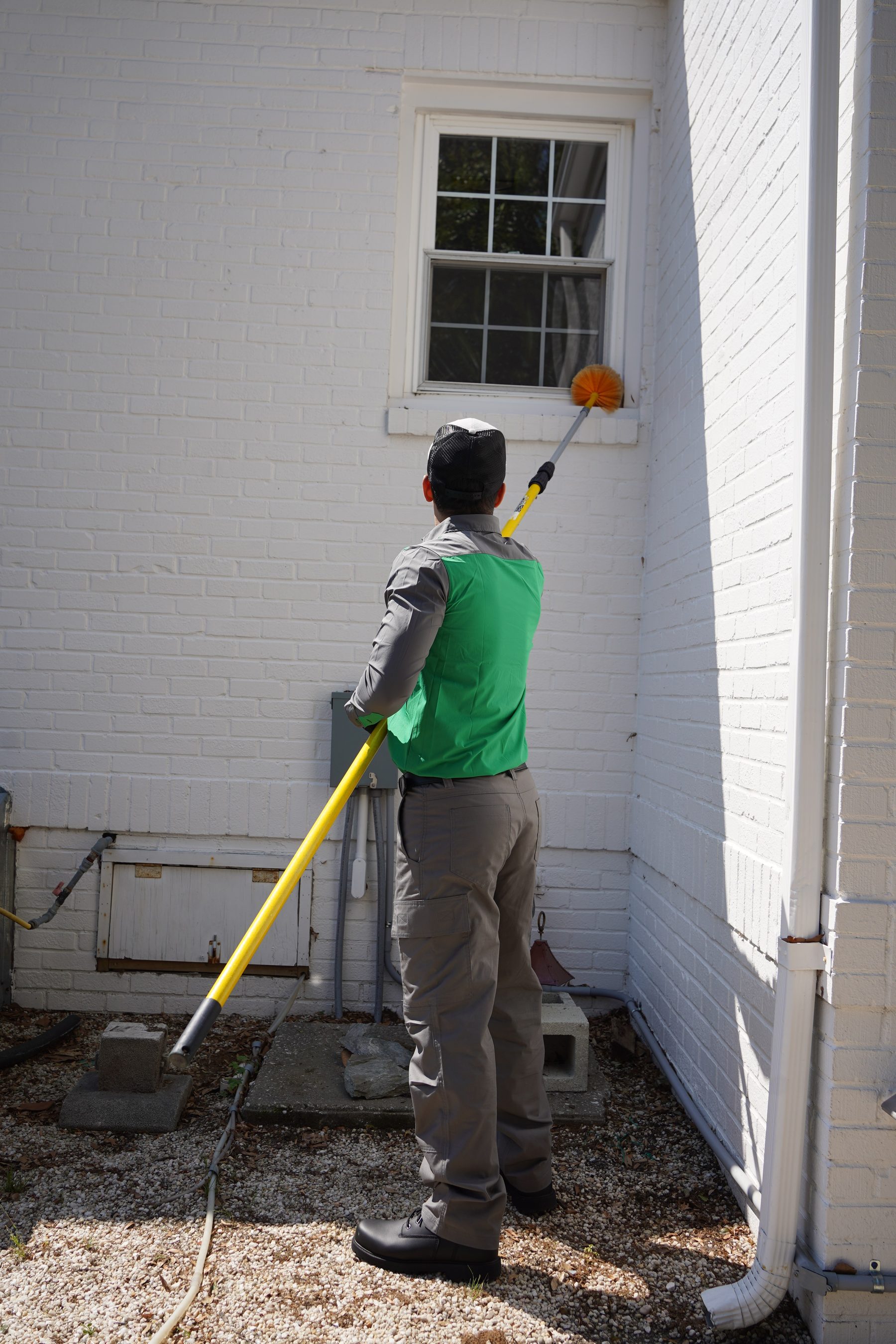
A residual barrier is applied around the foundation and at every entry point.
Crack & Crevice Application
Plumbing penetrations, baseboards, and slab joints are treated.
Granular Yard Treatment
Mulch beds and leaf litter zones receive targeted granular product.
Moisture Recommendations
We flag conditions to correct, drainage, ventilation, dehumidification.
Ongoing Protection
Quarterly service keeps populations from re-establishing.
Signs of a Centipede or Millipede Infestation
Watch for these warning signs that you may have a centipede problem:
- Centipedes seen in basements, bathrooms, or laundry rooms
- Millipedes curled into spirals along garage walls or in entryways
- Mass migrations of millipedes after heavy rain
- Persistent sightings near sinks, drains, or plumbing fixtures
- Other moisture pests (silverfish, sowbugs) appearing alongside
- Damp or musty odor in crawl space or basement
Results You Can Expect
Indoor activity drops sharply within a week of treatment. Long-term success depends on correcting the moisture conditions we identify during inspection.
Our Guarantee
If centipedes and millipedes return between scheduled treatments, we'll come back and re-treat at no additional charge. That's our satisfaction guarantee.
How Centipedes and Millipedes Behave Across Our Service Area
House centipedes (Scutigera coleoptrata) are the fast-moving, long-legged species that startle people in bathrooms and basements. Their distribution in our service area is heavily influenced by construction type. Piedmont NC and Upstate SC (Raleigh, Greenville, Spartanburg) have a much higher proportion of older housing stock with true basements and below-grade rooms. These environments stay damp, cool, and dark year-round, which is exactly what house centipedes need. In contrast, coastal SC structures are predominantly slab-on-grade or elevated pier construction, which gives centipedes fewer interior humid zones to colonize. House centipede complaints in Charleston and Myrtle Beach are almost always traced to crawl spaces, not basements.
Millipede mass migrations are a phenomenon that heavily affects the SC and NC Coastal Plain and Midlands. After significant rainfall events, particularly the kind of multi-inch rain that coastal SC and the Sandhills region see in late summer and early fall, North American millipedes (Narceus americanus, among others) emerge by the thousands from forest duff and leaf litter. These migrations are triggered by soil saturation; the millipedes are not seeking food indoors, they are fleeing waterlogged soil. Structures adjacent to wooded lots, pine plantations, or low-lying areas with heavy organic matter are most vulnerable. In Tidewater VA, similar migrations occur after tropical weather systems push significant rain inland.
Stone centipedes and soil centipedes round out the local fauna and are primarily outdoor species that occasionally enter via foundation gaps. The Piedmont red centipede (Scolopocryptops species) is found across all three states and is the species most commonly encountered under bark, rotting logs, and landscape timber, a reminder that organic mulch piled against foundations is a direct invitation for these arthropods to bridge into the structure.
Preparation Checklist
- Identify and address any active moisture sources before treatment, dehumidify crawl spaces, repair dripping pipes, and fix gutters that overflow near the foundation; chemical treatment without moisture reduction produces only temporary results
- Pull mulch back at least 6 inches from the foundation perimeter, thick mulch beds directly against siding are the primary outdoor harborage for millipedes staging to enter
- Remove leaf piles, decaying wood, and ground cover within 10 feet of the house foundation before the technician arrives
- Ensure crawl space vents are open and functional; blocked vents are a leading cause of chronic centipede and millipede pressure in pier-and-beam homes
- Clear items stored on concrete garage floors, centipedes and millipedes shelter under boxes, tarps, and stored equipment
- Seal visible gaps around plumbing penetrations at the base of cabinets and under sinks, these are the most common interior entry routes
- If you have a sump pump or standing water issue in a crawl or basement, note this for the technician, it directly affects product selection and placement
What Doesn't Work: DIY Centipede and Millipede Pitfalls
The fundamental problem with DIY centipede and millipede control is treating a symptom that is actually a building condition problem. Every approach that does not address moisture and harborage is fighting the visible result while the underlying cause continues.
- Surface sprays alone: Over-the-counter contact sprays kill centipedes and millipedes on the spot but leave the moisture environment intact, new individuals migrate in within days from outdoor populations
- Ignoring the crawl space: Applying product inside the living space while leaving a damp, unventilated crawl untreated means the source population is never disrupted
- Pesticide-treated mulch: Consumer insecticide granules in mulch beds break down quickly in moist organic material and do not provide the sustained barrier needed to intercept mass millipede migrations
- Dehumidifiers alone without treatment: Reducing interior humidity is necessary but rarely sufficient for already-established centipede populations that are entering from outside
- Glue boards as a primary strategy: Sticky traps help monitor population levels but cannot capture enough individuals to reduce a large outdoor source population
Frequently Asked Questions
House centipedes can technically bite if handled, they use modified front legs called forcipules to inject venom, but the bite is rarely medically significant, producing localized pain and mild swelling similar to a bee sting. They are not aggressive and will flee rather than confront a person. The bigger concern is what their presence indicates: they feed on silverfish, cockroaches, moths, and other insects, so a house centipede indoors suggests there is a broader insect population sustaining them.
Millipedes live in and feed on decomposing organic matter in the soil. When soil becomes saturated after heavy rain, millipedes are driven out of their habitat and begin moving, typically en masse, away from the flooded areas. Structures are not their destination; they are simply in the way. The migrations tend to follow the same routes (low spots, gaps in the foundation, door sweeps) which is why the same properties get hit year after year and why sealing those entry points makes a meaningful difference.
Centipedes have one pair of legs per body segment, move fast, are predatory, and can bite. Millipedes have two pairs of legs per body segment, move slowly, are detritivores (they eat decaying plant matter), and do not bite, but some species excrete a defensive chemical that can irritate skin or eyes on contact. Both are arthropods, not insects, and both are moisture-dependent. Control strategies differ: centipede management focuses on reducing the insect prey they eat, while millipede management focuses heavily on eliminating the damp organic matter they breed in.
Permanent reduction requires three parallel actions: chemical treatment to knock down the current population, structural correction to eliminate the moisture that sustains outdoor populations near the home, and exclusion to seal entry routes. Encapsulating a damp crawl space with a vapor barrier and proper ventilation is often the single most impactful step for homes in the Piedmont and Upstate that have chronic centipede problems. Without that structural fix, even the best chemical treatment is a temporary measure.
Millipedes primarily eat dead and decaying plant material, so in most cases they are decomposers rather than plant pests. However, during mass migrations and in high populations, some species will feed on seedlings, strawberries, and other soft fruits or vegetables at ground level. If you have a vegetable garden adjacent to wooded areas, a granular perimeter treatment around the garden zone during peak migration season (usually late August through October in the Carolinas) can provide meaningful protection.
A vapor barrier reduces ground moisture but does not eliminate it entirely, and older barriers degrade, tear, or leave gaps at seams and penetrations. Centipedes also enter from outside (through foundation vents, gap around pipes, and gaps in the sill plate) regardless of what the crawl humidity level is. The barrier helps but typically needs to be combined with a perimeter treatment and exclusion work at the foundation line to be fully effective.

Centipede Control Near You
We provide professional centipede control across South Carolina, North Carolina, and Virginia. Select your city for local service details:
Related Pest Control Services
Pest problems rarely travel alone. If you're dealing with more than one pest, we have you covered:
Trusted Resources
Learn more about centipede control from authoritative sources:
Ready to Eliminate Centipedes and Millipedes?
Get your free quote and take back your home today.
Get Free QuoteCustomer Reviews
What Our Customers Are Saying
"Tony's inspection highlighted several issues. With a good explanation of solutions, he's getting my house back on track."
Verified Google Review"I called at 1pm on a Friday and they squeezed me in the same day, amazing. Mike and Jonathan did a fantastic job explaining the treatment plan."
Verified Google Review"Jonathan is very thorough, friendly and professional. He kept me informed about finding the termites, showing pictures and video."
Verified Google Review