Flea & Tick Exterminator & Yard Treatment
Eliminate fleas and ticks from your home with professional treatment





Fleas, Ticks & the Diseases They Carry
Ticks in our region carry Lyme disease, Rocky Mountain spotted fever, ehrlichiosis, and alpha-gal syndrome. Fleas spread tapeworm and bartonella. Both can take over a property fast, fleas can lay 50 eggs a day per female, and a single deer or dog brings ticks home from every walk.
Yard treatment is the key. Indoor flea or tick infestations almost always trace back to populations established outside, in the yard, on pets, or on wildlife.
Why Fleas and Ticks Thrive in Our Area
The Charleston, Columbia, Greenville, Raleigh, and Virginia Beach areas all share conditions that support strong tick populations:
- Wildlife Activity: Deer, raccoons, opossums, and rodents bring ticks onto residential property
- Tall Grass & Brush: Both fleas and ticks need shaded, humid harborage to survive
- Pet Access to Yards: Dogs and outdoor cats are the primary indoor vector
- Mild Winters: Tick activity now extends into months that used to be safe
- Wooded Lot Lines: Properties bordering woods or greenspace see the highest pressure
Our Flea & Tick Extermination Process
Vinx Pest Control uses a step-by-step approach to eliminate fleas and ticks and prevent their return:
Inspection
We walk the property and identify high-risk zones, wood lines, tall grass, shaded harborage.
Yard Treatment
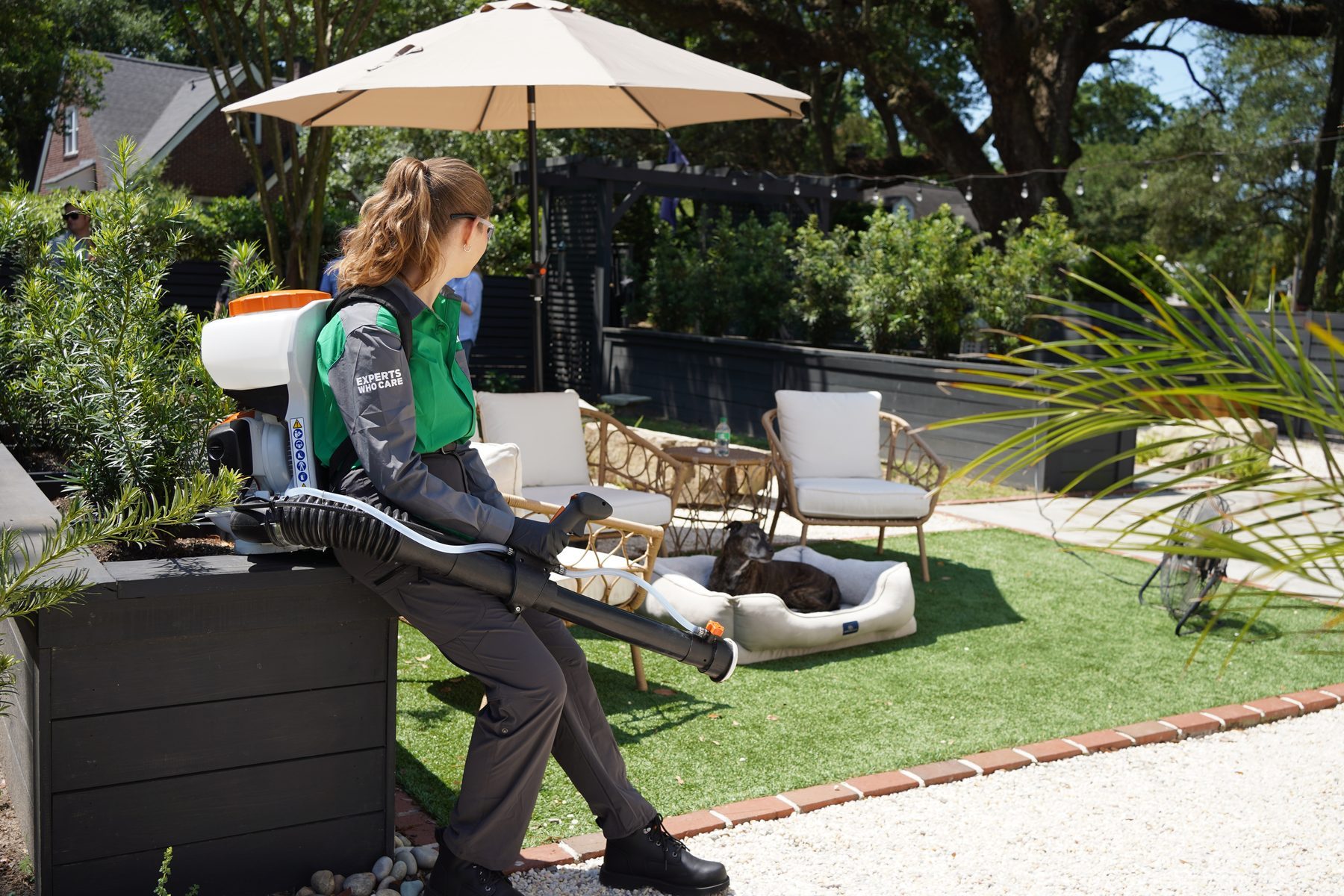
Both liquid and granular products are applied to known tick and flea harborage areas.
Perimeter Barrier
A treated buffer is established between wooded areas and the home.
Indoor Treatment
If pets are affected, we treat carpets, baseboards, and pet rest areas.
Pet Coordination
We coordinate with your veterinarian's flea/tick prevention for pets.
Follow-Up
Re-treatment timing is calibrated to the flea/tick life cycle (every 21–30 days during peak season).
Signs of a Flea or Tick Infestation
Watch for these warning signs that you may have a tick problem:
- Ticks found on pets, family members, or clothing after time outdoors
- Tiny black 'pepper' specks (flea dirt) in pet bedding
- Pets scratching, biting, or losing fur in patches
- Bites on ankles or lower legs after walking through grass
- Visible ticks on screen doors, decks, or outdoor furniture
- Increased rodent or wildlife activity on the property
Results You Can Expect
Outdoor flea and tick populations drop sharply within 7 days of yard treatment. Re-treatment every 3–4 weeks during spring and summer is critical for full-season protection.
Our Guarantee
If fleas and ticks return between scheduled treatments, we'll come back and re-treat at no additional charge. That's our satisfaction guarantee.
How Fleas and Ticks Behave Across Our Service Area
The Lone Star tick (Amblyomma americanum) now covers all three states in our service area and is the dominant tick species in terms of volume and bite complaints across SC, NC, and VA. It is aggressive (unlike the deer tick, it actively pursues hosts) and all three life stages (larva, nymph, adult) bite humans. The Lone Star tick is the primary vector of ehrlichiosis, tularemia, and Southern tick-associated rash illness (STARI), and is the species most associated with alpha-gal syndrome, a red meat allergy triggered by tick salivary compounds. Cases of alpha-gal are concentrated in a belt running from central NC through southern VA and into the Piedmont, tracking almost exactly with dense Lone Star tick habitat in oak-scrub and mixed forest environments.
The black-legged tick (Ixodes scapularis), also called the deer tick, is the Lyme disease vector. Its distribution in our service area is distinctly uneven: it is substantially more common in Piedmont NC and throughout Virginia than in coastal SC, where habitat conditions are less favorable for the white-footed mouse (Peromyscus leucopus), its primary wildlife reservoir. Lyme disease diagnoses in SC are relatively rare; most confirmed cases in Carolinians are acquired during travel to the Northeast. In contrast, NC's mountain-adjacent Piedmont and the entire Tidewater VA region have legitimate Lyme pressure that warrants tick management as a genuine health measure, not just comfort.
Flea pressure follows a climate gradient. The SC coast (Charleston, Beaufort, Hilton Head) has the highest flea load in our service area because mild winters prevent the hard frosts that knock back flea populations. The cat flea (Ctenocephalides felis), which infests both cats and dogs, can complete its life cycle year-round in coastal SC with essentially no winter interruption. Move to the Upstate or into NC and VA, and there is at least a partial winter suppression, but flea problems can still establish quickly in any structure with pets that spend time outdoors, even at colder latitudes. Indoor infestations persist regardless of outdoor temperature because the home environment is climate-controlled.
Preparation Checklist
- Coordinate with your veterinarian to ensure pets are on a current flea and tick prevention product before yard treatment, without pet-side prevention, pets immediately reintroduce ticks from the yard
- Mow the lawn short before treatment, ticks quest for hosts from grass blades and low vegetation, and cutting the lawn exposes them to product and UV degradation
- Rake and remove leaf litter from the yard perimeter, particularly along wooded edges and fence lines where tick populations are highest
- Wash all pet bedding on the hottest cycle before indoor flea treatment and keep pets off untreated areas until product has dried
- Vacuum all carpeted areas and upholstered furniture thoroughly before indoor flea treatment, vacuuming stimulates flea larvae to hatch and removes eggs and pupae from the environment
- Identify and note any areas where wildlife (deer, raccoons, opossums) regularly cross or rest on the property, tick pressure is almost always highest along those travel corridors
- Create a buffer zone between lawn and any adjacent wooded areas using wood chips or gravel, ticks rarely cross dry, sun-exposed surfaces
- Keep children and pets off treated lawn areas for the time specified on the product label, typically 30 to 60 minutes after the application has dried
What Doesn't Work: DIY Flea and Tick Control Pitfalls
Flea and tick management fails far more often than it should because of a fundamental mismatch: homeowners treat indoors and ignore the yard, or treat the yard without addressing the pet. Each of those gaps preserves the population cycle.
- Indoor-only flea treatment without yard treatment: A treated house re-infests within days if pets continue bringing fleas in from the yard, outdoor populations can produce thousands of new adults per week during summer
- Yard treatment without pet prevention: Killing ticks in the yard means nothing if a dog wearing no preventive carries ticks back inside after every walk
- Ultrasonic plug-in devices: Multiple peer-reviewed studies have found ultrasonic repellers have no measurable effect on fleas, ticks, or any other pest insect or arthropod
- Flea bombs (total release foggers) alone: Foggers cannot penetrate under furniture, in carpet fibers, or into the base of furniture legs, exactly where flea larvae and pupae concentrate. Foggers kill adults on open surfaces but leave the next generation intact
- Single yard treatment with no follow-up: Flea pupae can remain dormant for up to 5 months inside a cocoon that is resistant to all insecticide products. A single treatment does not break the cycle, properly timed retreatment at 3-to-4-week intervals during peak season is required
- Diatomaceous earth as primary tick yard control: DE can kill soft-bodied insects by abrasion but is largely ineffective on ticks, which have a tougher cuticle, and loses all effectiveness when wet
Frequently Asked Questions
Check within 2 hours of coming inside, the sooner, the better. Black-legged ticks generally need to be attached for 36 to 48 hours to transmit Lyme disease, so prompt removal matters. Run your hands through your hair and check the scalp, behind the ears, under the arms, in the belly button, around the waist, between the legs, and behind the knees, ticks migrate to warm, sheltered skin. Shower within 2 hours of outdoor activity; studies show showering reduces tick attachment rates. Use a hand mirror or ask someone to check hard-to-see areas of your back.
Alpha-gal syndrome is an acquired allergy to alpha-gal, a sugar molecule found in mammalian meat (beef, pork, lamb, venison). It is triggered by Lone Star tick bites, the tick's saliva contains alpha-gal, which sensitizes the immune system. After sensitization, eating red meat can cause hives, GI distress, or in severe cases, anaphylaxis, typically 3 to 6 hours after eating. The reaction is delayed, which causes many people to not connect it to food. Diagnosis requires a specific blood test. Cases are concentrated in the mid-Atlantic and Southeast, tracking directly with Lone Star tick range, which includes all of our service area.
When applied correctly, tick yard treatments have minimal impact on pollinators. Products are applied to grass, leaf litter, and shaded border zones, not to flowering plants. We avoid treating blooming ornamentals and recommend scheduling treatments in the early morning or evening when bees are least active. If you keep managed hives, let us know their location before treatment so we can establish appropriate buffer distances and application timing.
Pet-side prevention kills adult fleas on the animal, but it does not kill the immature stages already in your environment, and up to 95 percent of a flea infestation is in the environment, not on the pet. Flea eggs fall off the animal wherever it rests; larvae develop in carpet, bedding, and furniture; pupae are sealed in cocoons that resist all chemical products for weeks. Treating the pet alone addresses 5 percent of the problem. Indoor and yard treatment addresses the remaining 95 percent.
SC has a lower confirmed Lyme rate than NC or VA, primarily because the black-legged tick (the Lyme vector) is less abundant in coastal SC habitat. That said, the black-legged tick is present in SC, particularly in the Upstate and Midlands near wooded areas, and SC residents do contract Lyme. More pressing in SC is Lyme look-alike illness: Rocky Mountain spotted fever (which is actually more common in NC and SC than in the Rockies), ehrlichiosis, and STARI, all transmitted by ticks present throughout our service area. Any tick bite that produces a rash, fever, or flu-like illness within 30 days deserves prompt medical evaluation.
Use fine-tipped tweezers. Grasp the tick as close to the skin surface as possible and pull upward with steady, even pressure, do not twist or jerk. Do not use petroleum jelly, heat, nail polish, or other folk remedies; these methods can cause the tick to regurgitate saliva into the wound, increasing transmission risk. After removal, clean the bite site and your hands with rubbing alcohol or soap and water. Save the tick in a sealed bag with the date noted, some labs offer tick testing if you develop symptoms.
Yard and perimeter flea and tick control, backed by an elimination guarantee, is included in the Vinx Plus residential plan starting at $75 per month. The Platinum plan, starting at $109 per month, adds interior flea and tick coverage. A stand-alone flea treatment for an active indoor infestation is quoted after an inspection based on the size of the home, the number of pets and how many follow-up visits it will take to break the flea life cycle.

Tick & Flea Control Near You
We provide professional tick & flea control across South Carolina, North Carolina, and Virginia. Select your city for local service details:
Related Pest Control Services
Pest problems rarely travel alone. If you're dealing with more than one pest, we have you covered:
Trusted Resources
Learn more about tick & flea control from authoritative sources:
Ready to Eliminate Fleas and Ticks?
Get your free quote and take back your home today.
Get Free QuoteCustomer Reviews
What Our Customers Are Saying
"Tony's inspection highlighted several issues. With a good explanation of solutions, he's getting my house back on track."
Verified Google Review"I called at 1pm on a Friday and they squeezed me in the same day, amazing. Mike and Jonathan did a fantastic job explaining the treatment plan."
Verified Google Review"Jonathan is very thorough, friendly and professional. He kept me informed about finding the termites, showing pictures and video."
Verified Google Review