Wasp Exterminator & Hornet Nest Removal
Eliminate wasps and hornets from your home with professional treatment





Wasps, Hornets & Yellow Jackets
Stinging insects are among the most dangerous pests we treat. Paper wasps, hornets, and yellow jackets all build nests around homes, under eaves, inside soffits, in shrubs, and in the ground. A nest near a doorway or play area is an active hazard, especially for anyone with allergies.
Removing a stinging insect nest is not a DIY project. Disturbing a colony without professional protection and equipment can trigger a defensive swarm involving hundreds of stings.
Why Wasps and Hornets Thrive in Our Area
The Charleston, Columbia, Greenville, Raleigh, and Virginia Beach areas all share conditions that support strong wasp populations:
- Long Warm Season: Colonies build from spring through late fall in our region
- Suitable Nesting Sites: Eaves, soffits, sheds, and ground voids all attract different species
- Abundant Food: Garbage, fruit trees, and outdoor dining draw scavenging yellow jackets
- Mature Trees & Shrubs: Provide aerial nest anchors for hornets and paper wasps
- Lawn Activity: Ground-nesting yellow jackets often go undetected until disturbed
Our Wasp Nest Removal & Extermination Process
Vinx Pest Control uses a step-by-step approach to eliminate wasps and hornets and prevent their return:
Inspection
We locate active nests and identify the species, treatment varies significantly.
Protective Setup
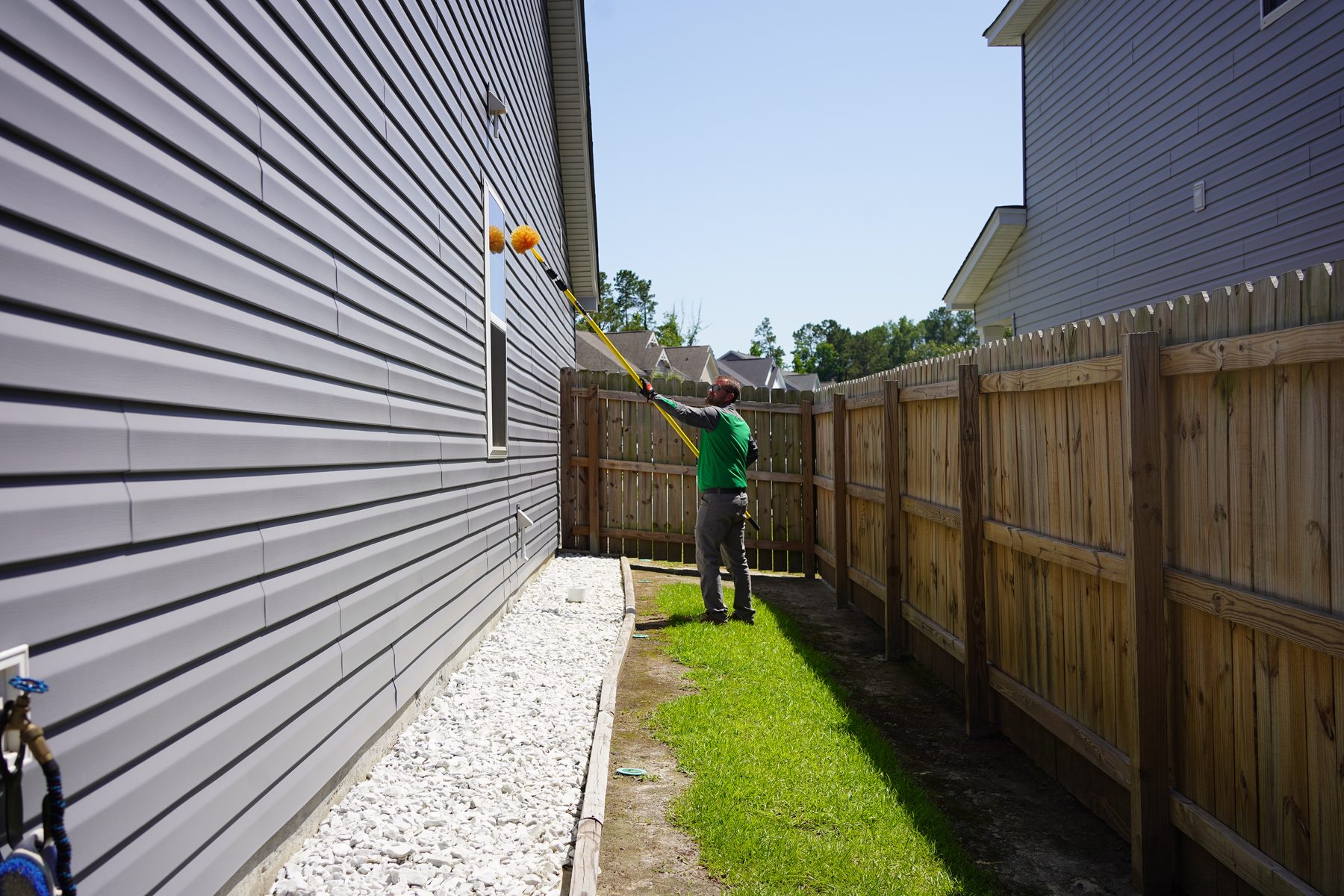
Technicians arrive in full protective gear with appropriate ladders and equipment.
Direct Nest Treatment
A residual dust or aerosol is applied directly into the nest entrance.
Nest Removal
Once activity stops, the nest is physically removed when safe and accessible.
Perimeter Application
Eaves, soffits, and overhangs are treated to deter rebuilding.
Follow-Up
We re-check the area to confirm no resurgence before closing the work.
Signs of a Wasp or Hornet Infestation
Watch for these warning signs that you may have a wasp problem:
- Visible nests under eaves, in shrubs, or hanging from branches
- Wasps repeatedly entering the same gap in siding or soffit
- Ground-level holes with steady wasp traffic (yellow jackets)
- Heavy wasp presence around trash cans or outdoor eating areas
- Aggressive flying insects near specific areas of the yard
- Audible buzzing inside walls or attic spaces
Results You Can Expect
Active nests are typically silent within 24 hours of direct treatment. We do not recommend any DIY removal, call us before approaching the nest.
Our Guarantee
If wasps and hornets return between scheduled treatments, we'll come back and re-treat at no additional charge. That's our satisfaction guarantee.
How Wasps and Hornets Behave Across Our Service Area
Paper wasps (Polistes species) are the most universally encountered stinging insect throughout our entire service area, every region from the SC coast to Tidewater VA sees them building open-faced umbrella nests under eaves, inside grill lids, behind shutters, and in garage door tracks from early spring onward. Coastal SC's long warm season means paper wasp colonies have more time to grow before their fall decline; a nest that starts in March on a Charleston porch can reach 100 or more individuals by August. In the Midlands and Upstate SC, the cooler Greenville and Spartanburg winters shorten the colony season somewhat, but spring establishment happens just as fast.
Yellow jackets (Vespula and Dolichovespula species) are the pest most likely to cause a surprise stinging event. Ground-nesting yellow jackets are a consistent problem in lawn-heavy Piedmont NC and Midlands SC neighborhoods, they nest in abandoned rodent burrows, beneath concrete slabs, and under mulch, and a colony can go completely unnoticed until someone mows over the entrance. By late summer a mature ground nest may hold 3,000 to 5,000 workers, all of which emerge to defend the colony when disturbed. Aerial yellow jackets also build in wall voids and attics, especially in older housing stock in the Raleigh-Durham area and the Hampton Roads region of VA.
Bald-faced hornets (Dolichovespula maculata) are the large black-and-white stinging insects that build the distinctive gray football-shaped aerial nests often seen in trees, on utility poles, or under roof overhangs in wooded Upstate SC and Piedmont NC. Their colonies can exceed 700 individuals by late summer and they are among the most aggressively defensive stinging insects we treat. European hornets (Vespa crabro), the only true hornet in North America, have expanded their range into the NC Piedmont and Tidewater VA and are increasingly common in hollow trees adjacent to residential properties.
Preparation Checklist
- Locate and observe nests from a safe distance before your appointment, do not approach within 10 feet, and be able to describe the location clearly to the technician
- Secure all pets indoors on the day of treatment, especially dogs that may approach the nest site out of curiosity
- Notify the technician of any household member with a known venom allergy so emergency protocols can be confirmed in advance
- Do not block or fill a suspected yellow jacket ground entrance before treatment, this traps the colony inside and can cause them to emerge through interior walls
- Clear the area around the nest of lawn furniture, children's toys, and other items that will need to be moved during treatment
- If you have aerial nests in trees, let the technician know the height and approximate size so they bring appropriate ladder equipment
- Close windows and doors near the treatment area during and for 30 minutes after nest treatment
What Doesn't Work: DIY Wasp and Hornet Pitfalls
Consumer stinging-insect products are sold for small, early-season nests, typically fewer than 20 to 30 workers, and do not work reliably on established midsummer or fall colonies. Attempting to treat a large nest without professional equipment and training is the primary cause of serious multiple-sting emergency room visits.
- Spray-can foam or jet spray on mature nests: A pressurized can agitates the colony immediately; worker wasps emerge faster than the product can knockdown the entrance, and the person spraying is typically standing within striking range
- Nighttime treatment of ground yellow jackets: This is commonly recommended online, but foragers return at first light and the entrance is typically not fully sealed by spray foam, the colony is disrupted, not eliminated, and remaining workers become extremely defensive
- Covering the nest with a bag or trash can: This triggers immediate mass defense from workers still inside the nest and from foragers returning to find the entrance blocked
- Burning nests: Ineffective and a fire hazard; heat agitates but does not reliably kill the colony, and paper wasp nests are not combustible enough to destroy the comb structure
- Waiting for frost to kill them: In the SC Coastal Plain and lower Piedmont, first killing frost can arrive as late as November, and a colony of 4,000 yellow jackets is a genuine threat to anyone near the site every day until then
Frequently Asked Questions
Paper wasp nests are open, umbrella-shaped combs with visible hexagonal cells, no outer envelope, small enough to hold in one hand in early season. Yellow jacket nests are inside cavities (ground, wall voids, attics) so you usually see only the entrance hole, not the nest itself. Bald-faced hornet nests are the large, gray, papery footballs enclosed in a multi-layered outer shell, these are the nests you see hanging in trees or under eaves. European hornet nests are similar but built in hollow trees or structural voids and have a slightly coarser texture.
A very early-season nest with fewer than 10 workers, roughly the size of a golf ball, can be knocked down with a stream of aerosol wasp spray at dusk when workers are clustered on the comb. Wait 24 hours before removing the physical nest. However, any nest you cannot confidently count the workers on, or any nest in an enclosed space where you cannot back away quickly, should be handled professionally. The risk calculus changes completely if anyone in the household has a venom allergy.
Colony size peaks in August and September, thousands of workers are now protecting a nest that has been building all summer. Simultaneously, their preferred food sources (caterpillars, other insects) decline, so yellow jackets shift toward scavenging sugars: soft drinks, garbage, fruit, and food at outdoor gatherings. Hungry, numerous, and defending a large investment, they are far more likely to sting than in June when the colony was small and food was abundant. This is also why fall outdoor events near yellow jacket pressure are disproportionately dangerous.
Not the same nest, paper wasp and yellow jacket colonies die off each winter, and new queens start fresh nests each spring. However, queens that emerge from a nest near your home in fall will overwinter nearby and are highly likely to establish new nests in the same structural features (same eave, same wall void, same ground entrance) the following spring. Treating eaves and common nest sites with a residual product in early spring discourages re-establishment before colonies get large.
Yes, in appropriate contexts, paper wasps are effective predators of caterpillars and other soft-bodied pest insects, and they pollinate flowers incidentally. A nest in an out-of-the-way location away from human activity does not necessarily need to be removed. The calculus changes when a nest is near a door, play area, or anywhere people regularly walk past, or when a household member is allergic to stings. We can assess whether a given nest poses genuine risk versus leaving it alone.
Call 911 immediately if the person shows signs of anaphylaxis: difficulty breathing, throat tightening, swelling of the face or tongue, dizziness, or a rapid drop in blood pressure. Use an epinephrine auto-injector (EpiPen) if one is available, do not wait to see if symptoms worsen. Multiple stings without allergic reaction should still be monitored for at least an hour; a large venom load can cause systemic reactions even in people without a known allergy. Get out of the area first, additional stings will continue as long as you remain near the nest.
Wasps and hornets are covered under every Vinx residential plan, which starts at $49 per month and includes free re-services if a new nest appears between scheduled visits. A one-time nest removal is quoted by the type and location of the nest: a paper wasp comb under an eave is a quick job, while a yellow jacket colony inside a wall void or a bald-faced hornet nest thirty feet up a tree takes more time, equipment and protective gear. Anyone in the household with a venom allergy should mention it when booking so we can prioritize the visit.

Wasp & Hornet Control Near You
We provide professional wasp & hornet control across South Carolina, North Carolina, and Virginia. Select your city for local service details:
Related Pest Control Services
Pest problems rarely travel alone. If you're dealing with more than one pest, we have you covered:
Trusted Resources
Learn more about wasp & hornet control from authoritative sources:
Ready to Eliminate Wasps and Hornets?
Get your free quote and take back your home today.
Get Free QuoteCustomer Reviews
What Our Customers Are Saying
"Tony's inspection highlighted several issues. With a good explanation of solutions, he's getting my house back on track."
Verified Google Review"I called at 1pm on a Friday and they squeezed me in the same day, amazing. Mike and Jonathan did a fantastic job explaining the treatment plan."
Verified Google Review"Jonathan is very thorough, friendly and professional. He kept me informed about finding the termites, showing pictures and video."
Verified Google Review