




Argentine ants are famous for "supercolonies": one giant, cooperative colony stretching for miles. That's true in California and southern Europe. It isn't what researchers found in the Carolinas. So why do the trails in your kitchen keep coming back? The real reasons are less dramatic and more fixable.
In the Southeast, Argentine ants don't form the giant supercolonies they're known for in California. An NC State genetic study found our colonies are smaller and fight each other. They still keep coming back because each colony has many queens spread across several shallow nests, they move nests easily, and sprays only kill the workers you see.
What works is slow-acting sweet liquid bait, placed where they trail, and left alone long enough. UC IPM says to expect fewer ants in 5 to 10 days. Add fixes to the moisture and mulch near the foundation.
Supercolonies: True in California, Not Here
The "one colony covering the whole neighborhood" picture comes from studies in places like California, southern Europe and Chile, where Argentine ants from different nests don't fight and behave as one huge colony.
Much of the supercolony story people know comes from Kurzgesagt's animated YouTube video "The Billion Ant Mega Colony and the Biggest War on Earth" (about 22 million views). It describes one intercontinental megacolony with sister populations in California, Europe, Japan, New Zealand and Australia, all in Mediterranean climates. The same video says the ants reached the U.S. as stowaways at New Orleans, yet the humid Southeast isn't on its list. That matches the research.
In 2004, NC State entomologists Grzegorz Buczkowski, Ed Vargo and Jules Silverman compared California Argentine ants with ants from the southeastern United States. They titled the paper The diminutive supercolony: the Argentine ants of the southeastern United States. Their findings:
- In California, ants from different colonies showed no aggression toward each other, and genetic diversity was low (23 gene variants across seven markers).
- In the Southeast, aggression between colonies was high and genetic diversity was double (47 variants). The authors suggest our ants may descend from several separate introductions, not one.
- Why the difference? The authors pointed to colder Southern winters and competition from red imported fire ants.
So the ants in your kitchen are probably not part of a single colony that spans your street. They're more likely one colony living in your own yard and foundation, and perhaps a neighbor's (southeastern colonies have been measured at up to about 0.6 acre), which is good news, because that's a scale you can actually treat.
Why They Keep Coming Back Anyway
- Many queens. Clemson Extension reports colonies are about 10% queens and 90% workers. Killing workers, or even one nest, leaves plenty of queens.
- Several nests, and they move easily. Colonies spread by budding, when queens walk off with workers to start a new nest nearby, and the University of Florida notes that multiple queens let colonies "grow and spread rapidly." Clemson lists nest sites under mulch, slabs, logs and debris, and UF reports nests 30 to 40 cm down in soil.
- Sprays only kill the ants you can see. UC IPM says spraying ants indoors "will not prevent more ants from entering". It kills the trail but not the queens out in the yard.
- Weather pushes them indoors. UF reports they come inside "during rainy, cold weather", and Clemson notes they look for moisture around pipes and dishwashers.
- Disturbance moves them. Clemson notes they nest under and even inside homes, "especially if their outdoor habitat is disrupted".
Make Sure They're Argentine Ants
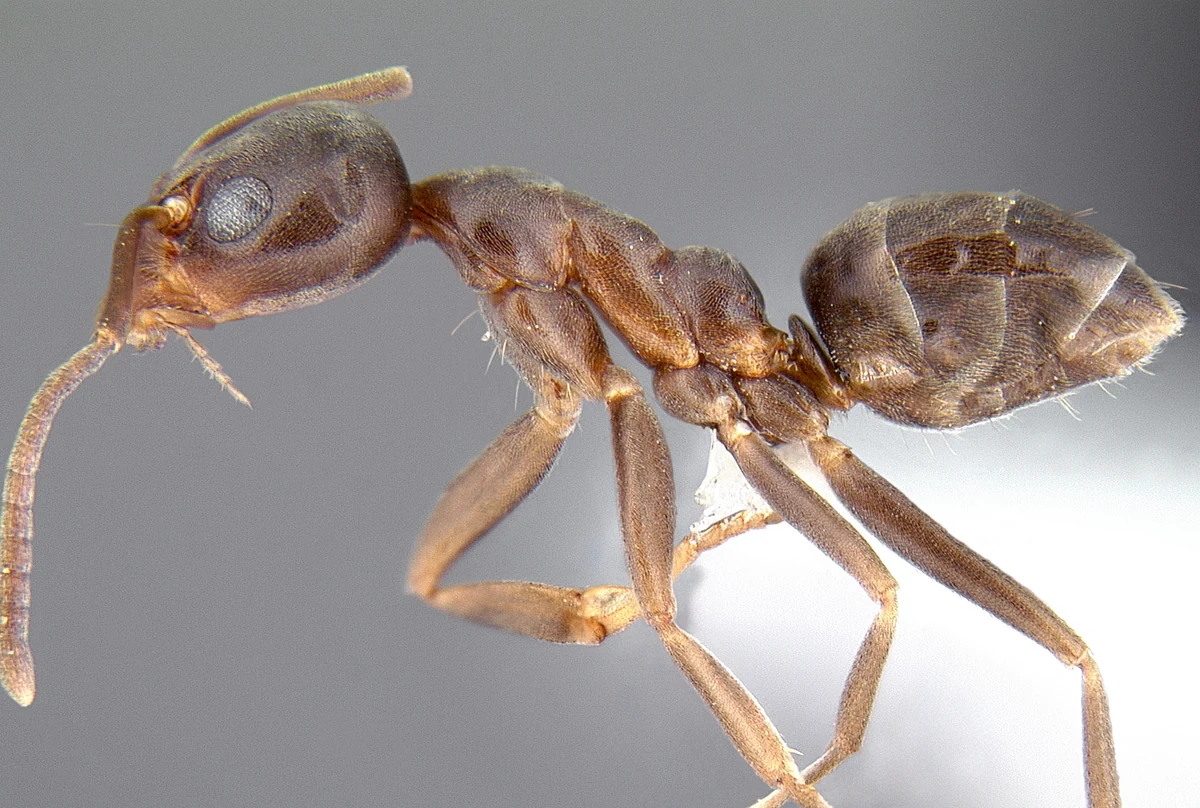
Several small brown ants trail into Southern kitchens, and they don't all respond to the same treatment. Here's how to tell the common ones apart.
| Argentine ant | Odorous house ant | Pavement ant | |
|---|---|---|---|
| Waist | One upright node | One node, hidden under the abdomen | Two nodes |
| Color and size | Uniform light to dark brown, about 1/16 in | Dark brown to black, about 1/8 in | Dark brown to black, about 1/8 in |
| When crushed | A "musty odor" (Clemson) | Smells like rotten coconut | No strong smell |
| Trails | Steady, often wide trails along foundations, pipes and mulch edges | Trails, often after heavy rain | Often from cracks in slabs and sidewalks |
The crush test is the quickest field check. A musty smell points to Argentine ants, and a rotten-coconut smell points to odorous house ants. For more on kitchen trails, see should I be worried about a trail of ants in my kitchen?
What Actually Works: Bait, Placed Right

Argentine ants love sweets and the honeydew from aphids and scale insects (Clemson), so a sugar-based bait matches what they're already looking for. Workers carry it home and share it with the queens. That's why it must be slow-acting. UC IPM explains that "the pesticide must be slow-acting so workers won't be killed before they get back to the nest."
- Use liquid sugar bait. UC IPM calls liquid borate bait (0.5% to 1% borate in sugar water) in refillable stations "best for severe Argentine ant infestations."
- Put it on the trail, both inside and outside where the trail leads. Don't put it across the trail where you'd crush ants.
- Don't spray near the bait. A spray kills the workers that would have carried the bait home.
- Expect more ants first. On Reddit, a widely discussed thread has a homeowner alarmed that there were "more of them each day" three days in. The top answer: that's recruitment, and it means the bait is working.
- Give it time and keep it full. UC IPM says it can take 5 to 10 days to see fewer ants. Reddit users report "up to a week or more". If they ignore the bait, move it or try a different product.
What about perimeter sprays?
Some sprays drive ants away instead of killing them, which can just push the trail somewhere else. One commenter in Reddit's pest control forum put it bluntly: "Bifenthrin is a repellent and the absolute worst choice for Argentine ants." Regularly sprayed foundations also cause runoff. A University of Georgia review notes that routine fipronil and bifenthrin perimeter treatments have caused "significant water contamination", leading the EPA to restrict how they can be used. UC IPM advises asking a pest control company for "baits and spot treatments rather than perimeter treatments or monthly sprays."
Do home remedies work?
Mostly no. In two 2024 laboratory trials, University of Georgia researchers placed common home remedies in a moist harborage Argentine ants like to nest in. Tansy, cucumber peel and soybean extract did nothing, even at 4 to 10 times the normal amount. Fresh rosemary and spearmint leaves did deter them, and 1% peppermint oil worked best. That's useful for keeping them out of one spot, but repelling ants doesn't kill the queens.
Yard Changes That Help
- Fix the water. In a California field study, irrigation increased Argentine ant numbers, and turning it off led to declines and withdrawal. Fix leaky spigots, misdirected sprinkler heads and downspouts that soak the foundation.
- Pull mulch back from the foundation. Clemson lists mulch, slabs, logs and debris as typical nest sites. Keep a strip of bare ground or gravel next to the house.
- Trim plants touching the house, and remove clutter along the walls (Clemson).
- Control aphids and scale on shrubs near the house. The honeydew feeds the colony.
- Seal entry points around pipes, windows and siding where you see trails.
When to Call a Professional
- You've baited correctly for two to three weeks and still have steady trails
- Ants are nesting in a wall, under a slab or inside the house
- Trails come from several sides of the house at once
- You're not sure which ant you have
Our ant control service uses bait-first treatment with targeted spot treatments, not blanket spraying. See also why your ant problem keeps coming back.
Key Takeaways
- Southeastern Argentine ants aren't giant supercolonies. NC State found our colonies fight each other, unlike California's.
- They come back because of many queens and several shallow nests, not because the whole neighborhood is one colony.
- ID tip: one upright waist node and a musty smell when crushed. Coconut smell means odorous house ants.
- Use slow-acting sweet liquid bait on the trail, don't spray near it, and give it 5 to 10 days.
- Fix moisture and mulch at the foundation. Wet soil feeds Argentine ant populations.
Sources: G. Buczkowski, E. L. Vargo and J. Silverman, "The diminutive supercolony: the Argentine ants of the southeastern United States", Molecular Ecology 13:2235 (2004); J. S. Nauman, P. A. Zungoli and E. P. Benson, "Argentine Ants", Clemson HGIC; K. Carroll and A. Dale, "Argentine Ant", UF/IFAS EENY-767; M. K. Rust and D.-H. Choe, "Pest Notes: Ants", UC IPM Publication 7411; J. B. Holloway, D. R. Suiter, J. W. Davis and W. A. Gardner, "Common Home Remedies Do Not Deter Argentine Ants … from a Preferred Harborage", Insects 15:768 (2024); D. R. Suiter et al., "Alternative Methods of Ant Control with Emphasis on the Argentine Ant", Insects 12:487 (2021); S. B. Menke and D. A. Holway, "Abiotic factors control invasion by Argentine ants at the community scale", Journal of Animal Ecology (2006); Kurzgesagt, "The Billion Ant Mega Colony and the Biggest War on Earth", YouTube; homeowner and technician accounts from Reddit (via Google search excerpts).
Frequently Asked Questions
Not the giant ones they're known for elsewhere. A 2004 NC State study found Argentine ants in the southeastern US have high genetic diversity and strong aggression between colonies, unlike California's single cooperative supercolony. Our colonies still have many queens and several nests, but they are smaller.
Each colony has many queens spread across several shallow nests, and they bud off new nests easily. Sprays kill the workers you see but not the queens. Rain, cold weather and disturbance outside also push them indoors toward moisture and food.
They're small (about 1/16 inch), uniformly light to dark brown, with a single upright node at the waist. When crushed they give off a musty odor. Odorous house ants smell like rotten coconut instead.
A slow-acting, sugar-based liquid bait. UC IPM says liquid borate bait (0.5 to 1% borate in sugar water) in refillable stations is best for severe Argentine ant infestations. Place it on the trail and keep it full.
UC IPM says it can take 5 to 10 days to see fewer ants. Activity often increases for the first few days as workers recruit nestmates to the bait. That's a sign it's working, so don't spray them.
The workers that find the bait lay a trail and recruit more workers to carry it back to the nest. A crowd at the bait in the first few days is normal and means the colony is taking it.
Spraying the trail kills the ants you see but not the queens, and UC IPM notes indoor spraying won't stop more ants from entering. Repellent perimeter sprays can push trails elsewhere and cause runoff. Use bait, and avoid spraying near it.
A 2024 University of Georgia study found cucumber peel, tansy and soybean extract did not deter Argentine ants. Fresh rosemary and spearmint leaves did, and 1% peppermint oil worked best. Repellents may keep ants off one spot, but they don't kill the colony.
The University of Florida reports they enter homes during rainy, cold weather, looking for food and shelter. Clemson notes they also seek moisture inside, around water pipes and dishwashers.
Fix moisture at the foundation, such as leaky spigots, sprinklers and downspouts. Pull mulch back from the walls, trim plants touching the house, control aphids and scale on nearby shrubs, and seal entry points. Then bait any trails that remain.
Photo credits: Alex Wild / AntWeb, CC BY 4.0; R1bonpnk, CC0; via Wikimedia Commons.