Mosquito Control in Virginia Beach, VA
Yard Treatment for Asian Tiger Mosquitoes & Backyard Breeding Sites
Virginia Beach has two mosquito problems: the ones breeding in your yard, and the ones flying in off the marsh. We treat the first and we’ll tell you straight when it’s the second. Recurring service May through October with a free re-treatment guarantee.
Get Started in 60 Seconds
Choose what’s easiest for you
Request a Quote
We usually respond in 2 minutes
Call 757-900-8469
Get a Live Person (no AI agents here!)
Sign Up Online
Get pricing and schedule now





Welcome to Vinx Pest Control
A Company That Actually Backs What It Says
At Vinx, we combine professional-grade treatments with a level of service most pest control companies don't offer. Local technicians, fast response times, and a guarantee that actually means something.
Get a Free Quote"I'm not passionate about killing bugs. I'm passionate about customer service. At Vinx, you get experts who show up, do the job right, and stand behind every visit. No runaround, no fine print."
PROTECTION PLANS
Mosquito Plans for Virginia Beach Homeowners
100% money-back guarantee on every plan.

Standard Residential Protection
- 4 Seasonal Treatments Per Year
- 50+ Covered Pests
- Interior, Exterior & Yard Treatment
- Unlimited Free Re-Services
- 100% Money-Back Guarantee
- Fire Ant Yard Guarantee
- Flea & Tick Coverage
- Mosquito Treatments

Upgraded Yard Protection
- 6 Home & Yard Treatments Per Year
- 50+ Covered Pests
- Interior, Exterior & Yard Treatment
- Unlimited Free Re-Services
- 100% Money-Back Guarantee
- Fire Ant Yard Elimination Guarantee
- Flea & Tick Elimination Guarantee
- Mosquito Treatments

Most Comprehensive Protection
- 9 Treatments Per Year
- 50+ Covered Pests
- Interior, Exterior & Yard Treatment
- Unlimited Free Re-Services
- 100% Money-Back Guarantee
- Fire Ant Yard Elimination Guarantee
- Interior Flea & Tick Coverage
- 8 Mosquito Treatments (Mar–Nov)
- Free Bed Bug Treatments if Needed*
*Starting rates vary by home size and area. All plans billed monthly.
Request Your Free Mosquito Control Quote
Fill out the form below and a Vinx team member will reach out within 2 minutes during business hours.
Prefer to talk? Call 757-900-8469 for a live person, no AI agents.
Our Process
How Vinx Treats Mosquitoes in Virginia Beach: Step by Step

Find the Water First
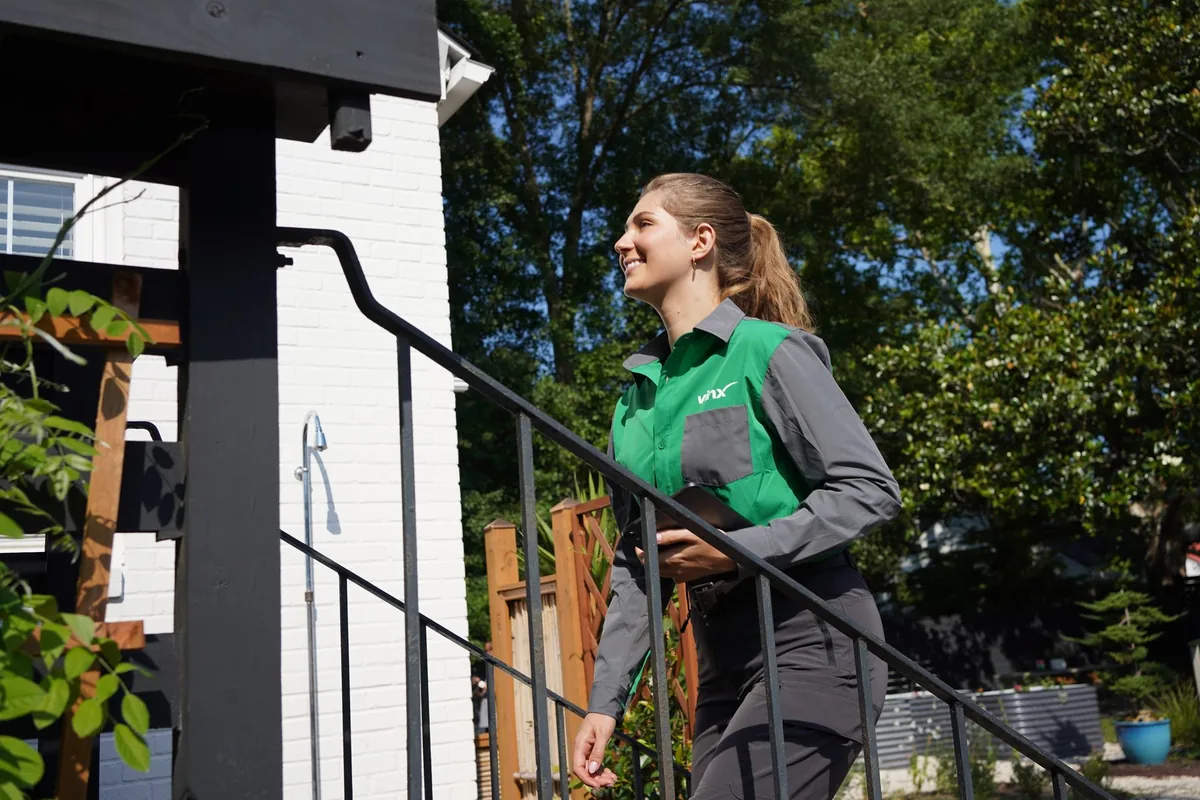
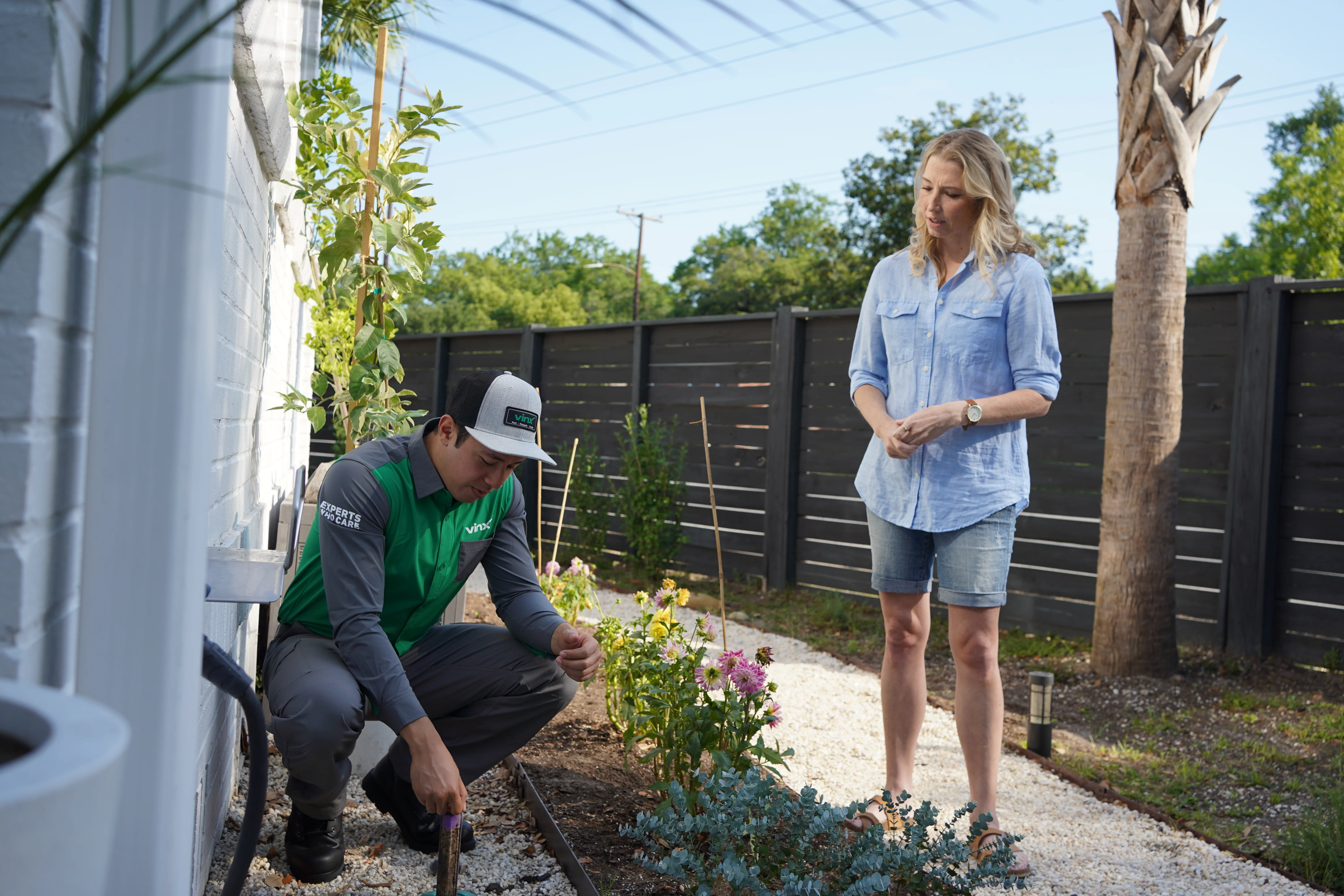
Every visit starts on foot, not with a sprayer. A tiger mosquito needs only a few ounces of standing water, so we walk the property looking for it: plant saucers, clogged gutters, tarp and boat-cover folds, corrugated downspout extensions, the tray under the AC condenser, buckets, wheelbarrows, kids’ toys, low spots that hold after a storm. We empty what can be emptied and note what cannot. This is the least glamorous part of the visit and it does more good than anything else we do, because it removes the mosquitoes before they hatch instead of chasing them after.
Treat the Resting Sites
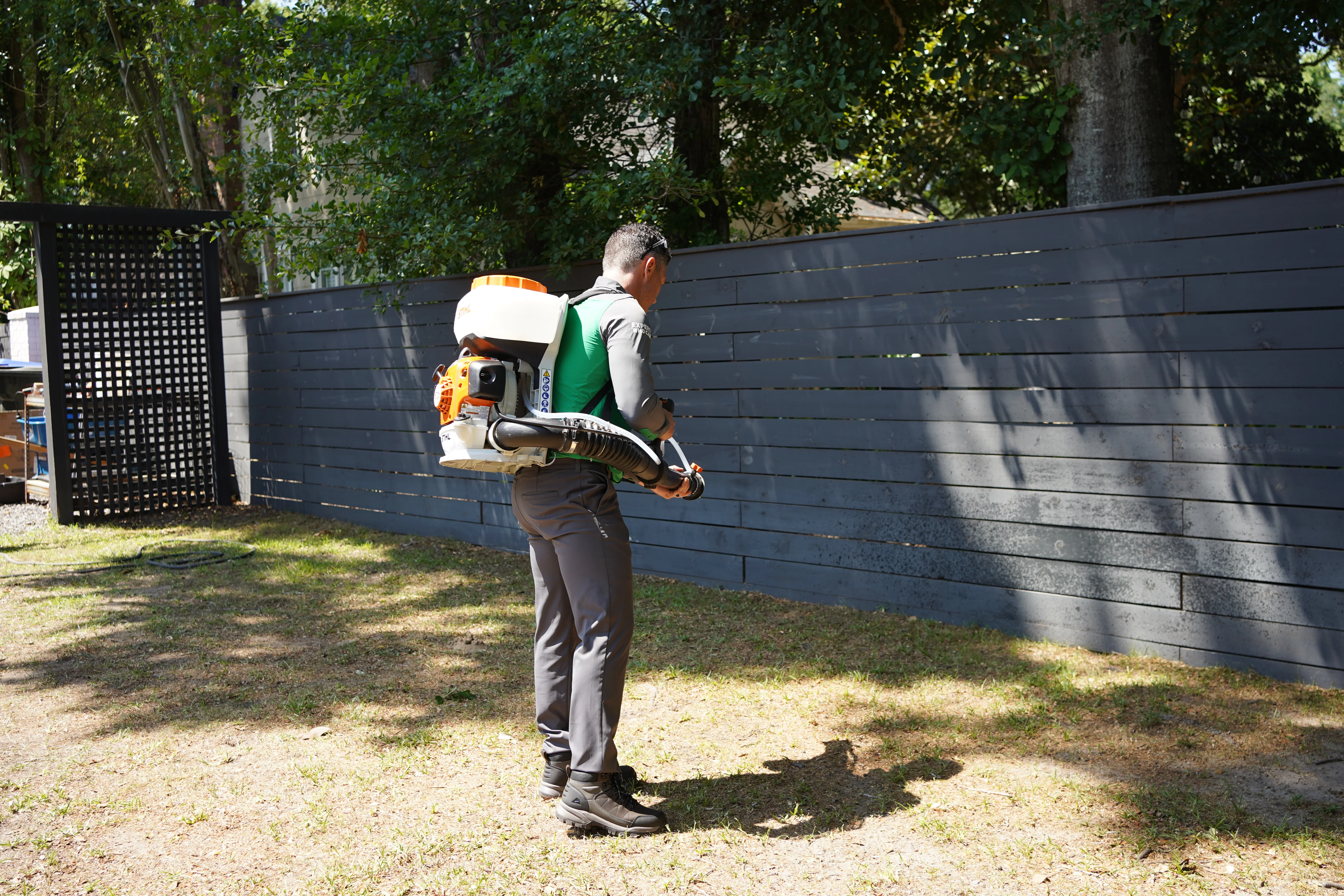
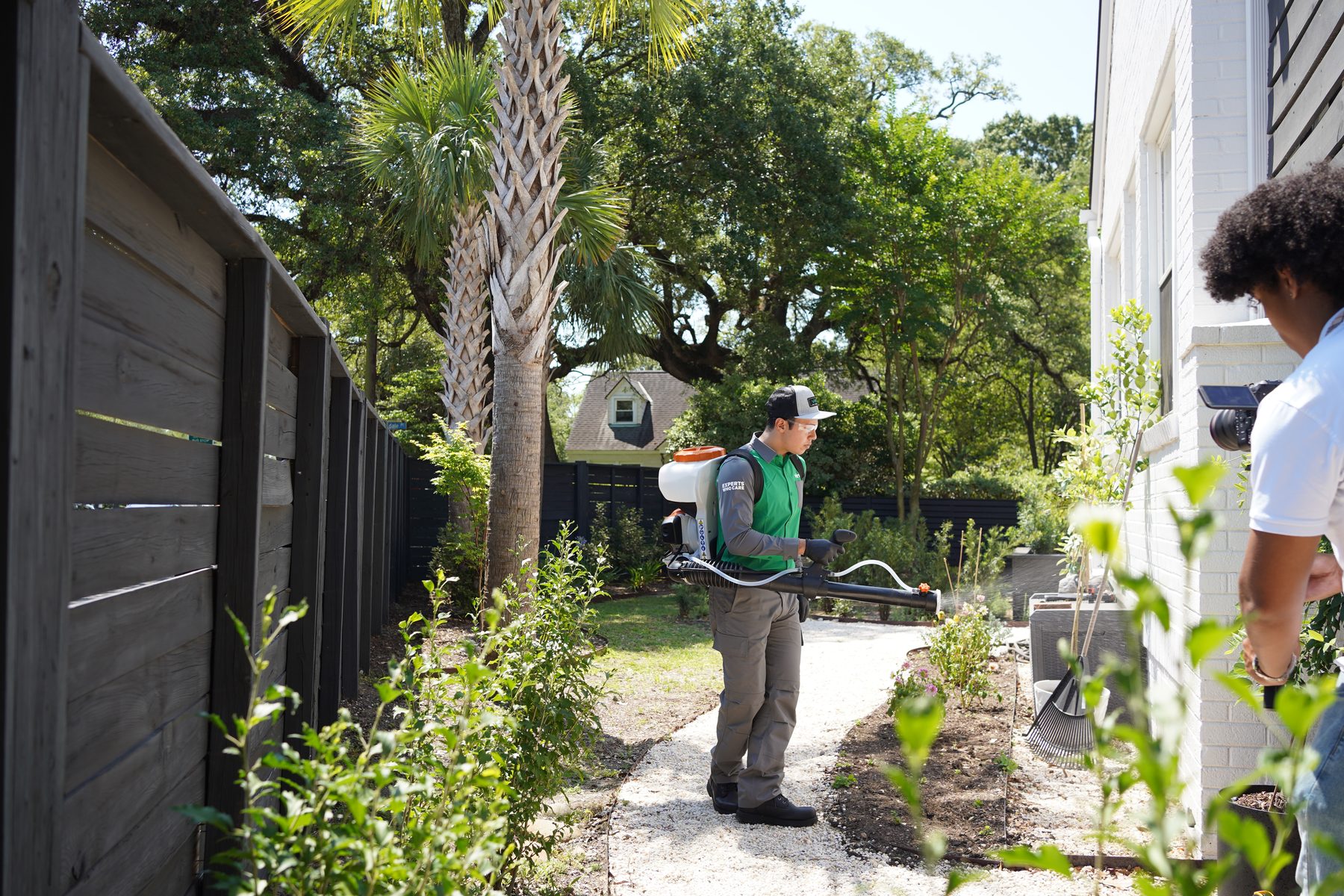
Adult mosquitoes do not spend the day in open sun. They rest in cool, shaded, humid vegetation and wait, under decks, in dense shrub lines, along tree lines, on the north side of the house, in ivy and tall ground cover. That is where the residual application goes. Treating those resting sites is what produces the drop you actually notice when you go outside. It is suppression rather than elimination: the best randomized trial of a professional barrier spray measured around 62.5 percent average reduction in adult female tiger mosquitoes over 25 days, which is a real difference and is not the same as zero.
Larvicide What Cannot Be Dumped
Some water cannot simply be tipped out, a rain barrel you want to keep, an ornamental pond edge, a drainage swale that stays wet, a low corner of the yard after a wet week. Those get a larvicide rather than being written off. Killing larvae where they sit is more reliable than trying to catch the adults they would have become, and it is the part of the job that keeps working between visits.
Sweep Eaves & Shaded Harborage
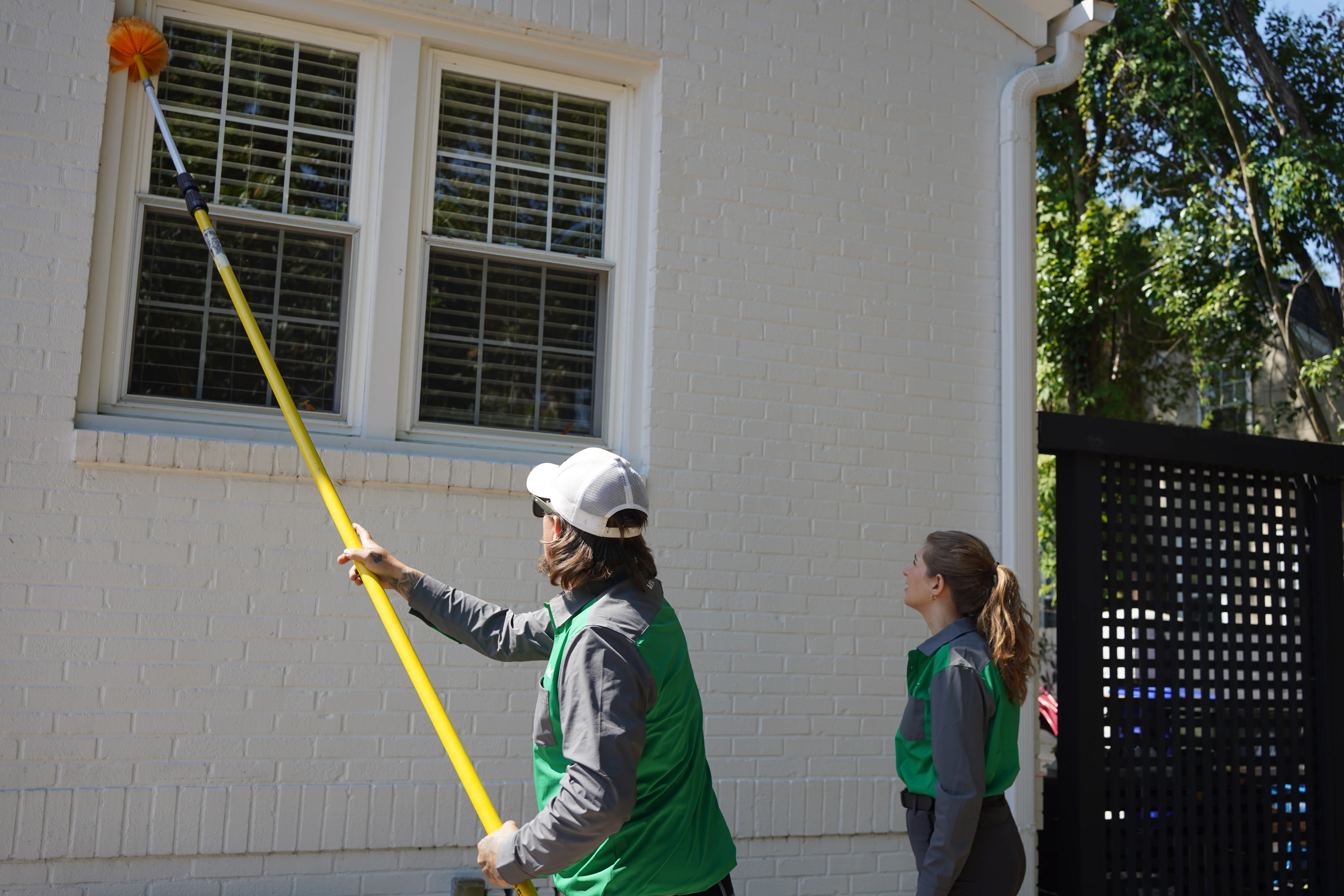
We sweep first and second-story eaves on every visit and clear the cobwebs and nests, then spot treat those areas. On a mosquito program this matters for a specific reason: shaded eaves, soffit returns and the overhang on the shaded side of the house are resting harborage, and Virginia Beach’s humidity keeps them attractive. Clearing and treating them removes places adults sit out the heat of the day close to your doors and windows.
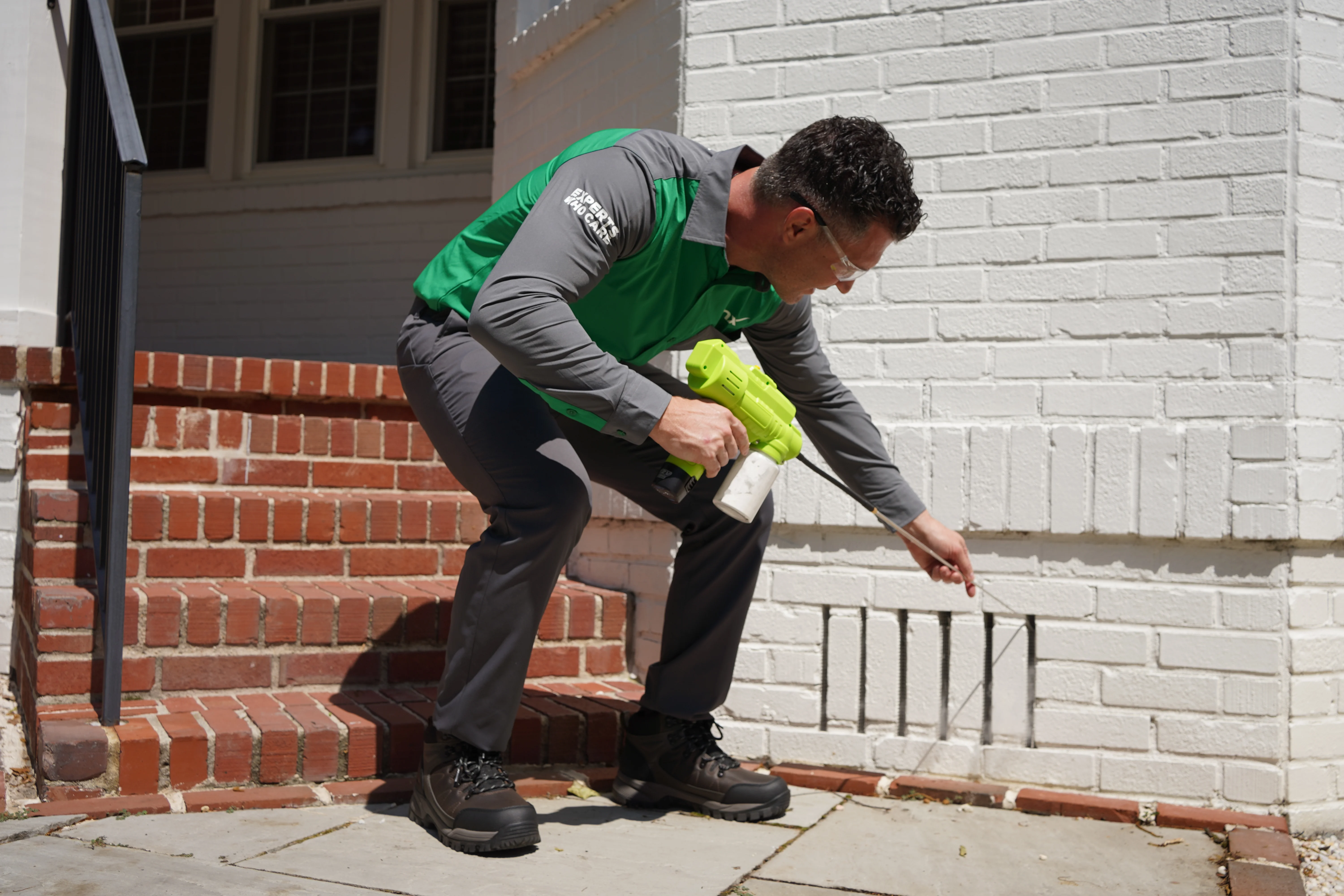
Power Dust Injection
Where standing water sits in structural voids and hard-to-reach gaps, weep holes, expansion joints, utility penetrations, we use a handheld compressor to place product deep into those spaces. In coastal construction these gaps hold moisture long after the surface dries, and they give both mosquitoes and other pests a protected place to shelter within a few feet of your living space.
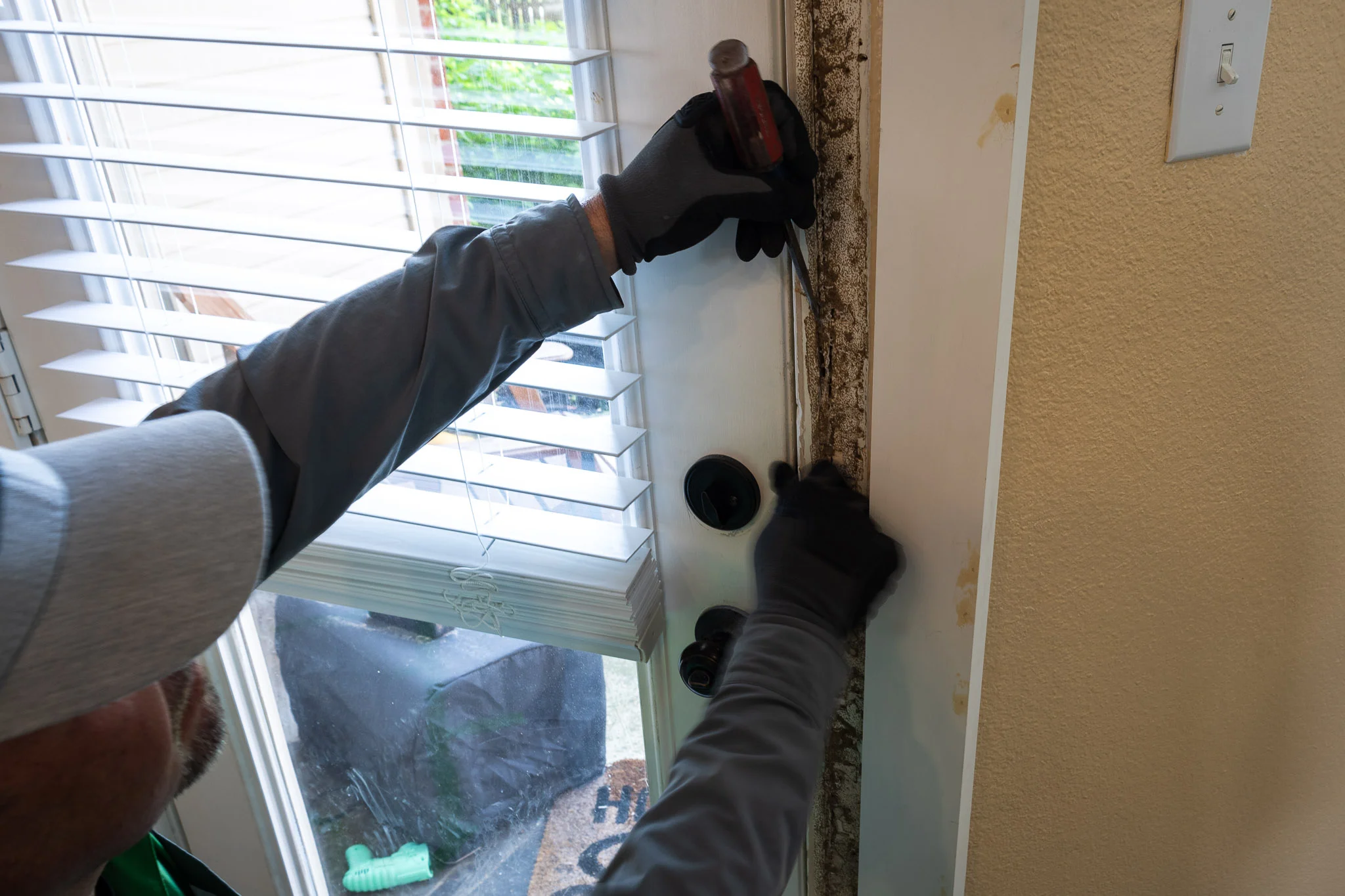
Interior Treatment (If Needed)
Mosquito work is almost entirely an outdoor job, and that is by design, we would rather stop them in the yard than meet them in your living room. If mosquitoes are getting inside, that usually points at a screen, a door sweep or a gap rather than a treatment failure, and we will tell you which. Interior service stays covered under your guarantee at no extra charge if you need it.
Customer Reviews
What Customers Say About Vinx in Virginia Beach
Kennard was incredible! Extremely detailed in his work stayed and serviced for well over an hour. Took videos of concerns. I never felt rushed when asking questions. He is the best!!!!
Brad was fantastic and worked with us around our dogs and handled our property with care. Very happy to be with Vinx
Brandon always does a great job spraying our yard every month in the summer. We have very minimal mosquitoes and he is always willing to come back if we do have any mosquitoes. Highly recommend.
I’ve been using Vinx for over a year and I couldn’t be happier. The mosquitos are all gone which was my main concern because they seem to love me, lol. Daniel is the tech who’s sprayed my house a few times and he’s always polite and professional, so I wanted to give a compliment here.
Our tech today was Cameron, he was so polite, patient and helpful. He answer all our questions and concerns.
Tristan was wonderful! He was so professional. He explained everything he was doing and treated all the issues I was having. Great Job!
Cameron was wonderful. He was very polite and respectful. I had an appointment and called so he came earlier to accommodate me.
Will was awesome and had a quick turnaround and squeezed us in after servicing our neighbors house!
Mosquito Control in Virginia Beach Starts With a Free Inspection
Season runs May into early November, peaking in July and August. A single treatment does not cover six months, and no yard treatment stops a marsh hatch. What consistent service does buy you is control of what breeds on your own property, backed by a guarantee that puts the risk on our side.
May Through Early November
Why Virginia Beach Has Two Mosquito Problems, Not One
Almost every mosquito company in Hampton Roads sells you one thing: a barrier spray around the yard. That treatment genuinely works on one of your two mosquito problems and does almost nothing about the other. Knowing which one you have is the difference between a season of relief and a season of paying for disappointment.
The first problem is breeding in your yard. The Asian tiger mosquito lays eggs in containers holding as little as a few ounces of water, a plant saucer, a tarp fold, a clogged gutter, a kid’s toy left out after a storm. It bites in daylight, and it does not travel far from where it hatched. If your bites happen in your own back yard in the afternoon, this is almost certainly your mosquito, and it is the one a yard program controls well.
The Three That Matter Here
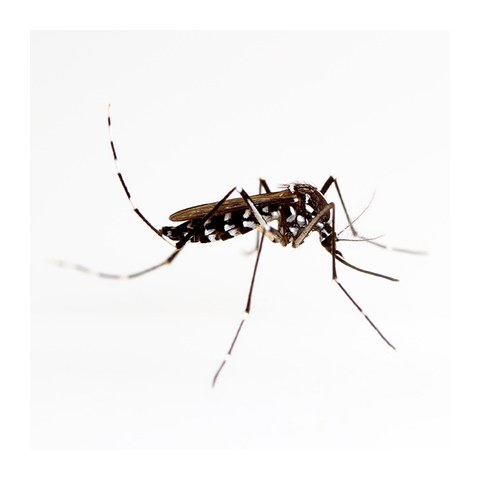
Asian Tiger Mosquito
Virginia Cooperative Extension describes Aedes albopictus as a day-biting nuisance mosquito common in urban areas of Virginia, and in a field study across the Hampton Roads area it was the most abundant human-biting species collected. It breeds in containers, not marsh, and it stays close to home. This is the mosquito a yard program is genuinely good at suppressing, because the breeding sites are on your property where we can find and empty them.
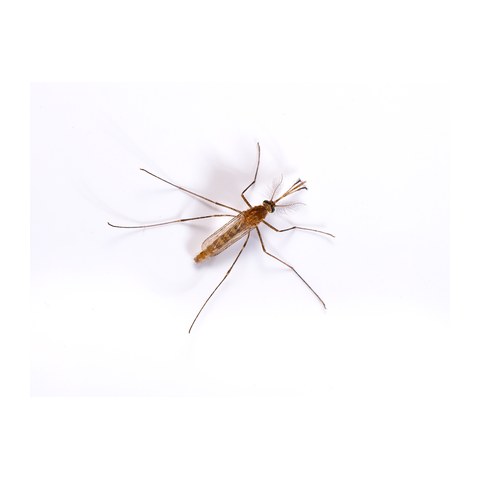
House Mosquito (Culex)
Virginia Tech’s extension publication on Virginia arboviruses states plainly that the main mosquito vector responsible for West Nile transmission in Virginia is Culex pipiens. CDC notes adult Culex are most active dusk to dawn. Here is the honest part: Culex breeds heavily in organically rich standing water including storm drains and catch basins, much of which sits on public right-of-way. That is city infrastructure, not your yard, and neither your dumping nor our barrier spray reaches into it.
Eastern Saltmarsh Mosquito
Aedes sollicitans breeds in pools and puddles left on grassy saltmarsh by exceptional high tides and heavy rain, and under good conditions it goes from egg hatch to emerged adult in four to five days. That is why a quiet week can turn into a bad week overnight after a storm or a spring tide. It is a serious nuisance biter on the eastern seaboard and can act as a bridge vector for eastern equine encephalitis, though human EEE cases in Virginia are vanishingly rare. On range: a brood is carried inland by prevailing wind, but the distance is generally less than five miles. You will see “20 to 40 miles” on plenty of pest control websites; that figure does not come from the entomological literature. Five miles is still far enough that the marsh producing your mosquitoes is nowhere near your property line. If you back onto marsh, expect suppression, not elimination.
The second problem flies in off the marsh. The eastern saltmarsh mosquito breeds in tidal marsh pools that fill on an exceptional high tide or a heavy rain, and it can go from egg to biting adult in as little as four to five days. That habitat is not on your property. It is Back Bay, the Lynnhaven system, and the marsh behind Sandbridge, and no yard treatment on earth eliminates it. A barrier spray still knocks down the adults that land in your yard, but anyone who tells you they can stop a marsh hatch is selling you something they cannot deliver.
It is worth knowing how much the City already does, because it is a lot and most homeowners have no idea. Virginia Beach’s Mosquito Control Bureau larvicides roughly 1,000 acres of standing water a season and adult-sprays somewhere between 500,000 and 700,000 acres each summer. That is a genuinely large public program, and it is free to you. What it does not do is solve the container problem in your own yard, and you do not have to take our word for that: the City of Hampton, running its own program next door, states plainly that the Asian tiger mosquito is not affected by spraying because it breeds in containers and stays close to home. Truck-mounted spraying works on what is flying over the street at night. It does not reach the water in the plant saucer behind your shed.
Season here runs roughly May into early November, peaking in July and August. That is about six months of pressure, which matters when you are weighing what a single treatment can realistically cover.
Mosquito Pressure by Neighborhood
Which Mosquito Problem Does Your Street Have?
Oceanfront & Resort Area: Container Breeding, Mostly Fixable
Dense lots, small yards, and a lot of hard surface. The mosquito biting you on a resort-area patio in the afternoon is usually an Asian tiger mosquito that hatched within a few dozen yards, often in something on your own property or the one next door. This is the best-case scenario for a yard program: find the containers, empty them, treat the resting vegetation. Rental turnover works against you, because every new tenant leaves out something new that holds water.
Shore Drive & Lynnhaven: Both Problems at Once
The hardest corridor in the city to promise results in, because you get container breeding in the yard and saltmarsh emergence off the Lynnhaven system. This is not a waterfront niche either: the Lynnhaven watershed covers 64 square miles and is home to roughly half of everyone in Virginia Beach. A treatment plan here should be honest about the split: we can meaningfully reduce what breeds on your lot, and we can knock down adults resting in your landscaping, but a spring tide followed by a warm week will still produce a hatch we did not create and cannot prevent.
Kempsville & Centerville: Container Breeding and Storm Drains
Inland, away from tidal marsh, so the saltmarsh species is much less of a factor. What you get instead is Asian tiger mosquito breeding in yards and Culex breeding in the neighborhood storm drain network. The yard half we handle well. The storm drain half is city infrastructure on public right-of-way, and it is worth calling the city about rather than paying anyone to pretend to treat it.
Pungo & Sandbridge: Marsh-Dominated, Manage Expectations
The most mosquito-intensive residential areas in Virginia Beach, and the ones where we are most careful about what we promise. Back Bay and the surrounding tidal wetlands produce saltmarsh mosquitoes on a schedule set by tide and rainfall, not by anything happening in your yard. The refuge also manages a complex of ten connected water impoundments whose levels are deliberately raised and lowered through the season for waterfowl habitat, so a meaningful share of the standing water next door is engineered and is not going anywhere. A program here buys you meaningful relief in your outdoor living space between hatches. It does not buy you a mosquito-free property, and you should be skeptical of anyone who says otherwise.
Great Neck & Bayside: Wooded Lots, Shaded Resting Sites
Mature canopy and heavy landscaping give adult mosquitoes cool, shaded, humid places to rest during the heat of the day, which is exactly where a barrier treatment does its work. Lynnhaven tributary drainage adds Culex pressure. Large wooded lots also hide more container habitat than people expect, tarps, boat covers, corrugated downspout extensions, and old plant saucers under the deck.
Military Corridor (NAS Oceana, Little Creek, Dam Neck): Shared-Yard Container Breeding
Dense multi-unit housing means the container producing your mosquitoes is frequently not on your side of the fence. Tiger mosquitoes do not travel far, so a treated yard next to an untreated one with a full recycling bin under a downspout will keep getting bitten. This is the corridor where a walk of the whole shared space, rather than a spray of one unit, makes the biggest difference.
Princess Anne: Open Lots, Rain-Driven Pressure
Open suburban lots inland of the marsh line. Pressure here tracks rainfall closely, since the breeding is happening in containers and low spots that fill during a storm and dry out afterward. A week of rain in July is followed by a noticeable rise about a week later. This is the pattern where consistent container removal between visits does as much good as the treatment itself.
What You Actually Get
What a Vinx Mosquito Visit Includes
And, just as importantly, what it does not do

Breeding-Site Walk
We walk the property and empty or treat what is holding water: plant saucers, gutters, tarps, boat covers, toys, downspout extensions, low spots. This is the part that does the most good on tiger mosquitoes, and it is the part most companies skip because spraying is faster.
Every Visit
Barrier Treatment
A residual application to the shaded, humid vegetation where adult mosquitoes rest during the day: under decks, dense shrub lines, the north side of the house, tree lines. Reapplied through the season as the residual breaks down.
Every Visit
Larvicide Where Water Stays
Standing water that cannot simply be dumped, a rain barrel, an ornamental pond edge, a drainage low spot, gets treated rather than ignored. Killing larvae in place beats chasing the adults they turn into.
As Needed
A Straight Answer on the Source
If the mosquitoes biting you are coming off the marsh or out of a public storm drain, we will tell you that, and tell you what the city does about it. You are paying us for judgment, not just a tank of product.
Every Visit
What It Will Not Do: Marsh
No residential treatment eliminates a saltmarsh hatch. That habitat is off your property and can produce adults four to five days after a tide or storm floods it. We reduce what lands in your yard. We do not stop the hatch.
Be Skeptical
What It Will Not Do: Storm Drains
Culex, the West Nile vector in Virginia, breeds heavily in catch basins and storm drains on public right-of-way. That is city infrastructure. A residential barrier spray does not reach it, and we will not pretend otherwise.
Call the CityKid & Pet Safe
Our Treatments Are Safe for Your Whole Family: Including the Furry Members
Every product we use is EPA-registered and applied strictly at labeled rates by licensed technicians. We take the guesswork out of safety so you can feel confident letting kids and pets back into treated areas quickly.

EPA-Registered Products Only
All products we apply are EPA-registered and used strictly per label requirements. Our licensed technicians are trained to apply the right product in the right place at the right rate, every time.
Dry Time Before Re-Entry
Exterior spray treatments dry in 30–60 minutes. Once dry, treated surfaces are safe for children and pets to contact. Your technician will confirm the all-clear before leaving your property.
Interior Treatment On Request
We treat only what’s needed, where it’s needed. Gel baits in cabinets and crack-and-crevice applications keep products away from areas pets and children frequent most.
Botanical Options Available
Have specific sensitivities? Ask your technician about our plant-derived treatment options. We offer botanical alternatives for households that prefer a more natural approach.
Have a concern about products used near your pets or children? Call 757-900-8469 and we’ll walk you through exactly what we use and why it’s safe.
Explore More
More Pest Control Services in Virginia Beach
Ant Control Virginia Beach
Household ants & others

Bed Bug Control Virginia Beach
Heat & liquid treatments
Cockroach Control Virginia Beach
American & German roaches
Rodent Control Virginia Beach
All rodents covered
Spider Control Virginia Beach
All spider species covered
Termite Control Virginia Beach
Bait systems & liquid treatment

Wasp Control Virginia Beach
Nest removal & prevention

Tick & Flea Control Virginia Beach
Yard & pet protection
Exterminator Virginia Beach
Same-day local exterminators

Pest Control Virginia Beach
General pest protection
Frequently Asked Questions
Mosquito Control FAQ for Virginia Beach Homeowners
Start there, honestly. The City’s Mosquito Control Bureau will send someone to inspect your yard for breeding sites and treat it, free. Call 757-385-1470. It is a real treatment, not just a look around, and the staff know what they are doing. The limits are that it is one application per residence between May and October, you have to be home and sign a consent form, and treatment happens if they find active adults or breeding sites. The City also runs area-wide larviciding, ditch maintenance and nighttime truck spraying on its own schedule, and posts nightly spray locations on 757-385-1590, updated daily at 3 p.m. If one visit across a six-month season handles your problem, you genuinely do not need us.
Because a six-month season needs more than one application, and because the walk-the-property-and-empty-the-containers work has to happen repeatedly, not once. If your bites are happening in your own yard in the afternoon, you have container-breeding tiger mosquitoes, and recurring service on your specific breeding sites is what moves the needle. If your bites are coming off the marsh, be honest with yourself about what you are buying: reduction between hatches, not a mosquito-free yard.
Suppression, not elimination. The best randomized yard-scale trial we can point to measured roughly a 62.5 percent average reduction in adult female Asian tiger mosquitoes over the 25 days after a professional barrier application. That is a real, noticeable difference when you are sitting outside. It is not zero mosquitoes, and anyone quoting you a 90 or 99 percent figure should be asked where it comes from.
Roughly May into early November, peaking in July and August. That is about six months. Pressure is driven by rainfall and tide as much as by the calendar, so a wet July week is usually followed by a noticeable rise about a week later, and a spring tide that floods marsh can produce biting adults in four to five days.
It is worth taking seriously and not worth panicking about. Virginia reported 5 West Nile neuroinvasive cases statewide in 2024, an incidence of about 0.06 per 100,000, which is roughly one-seventh the national rate and lower than Maryland, North Carolina and South Carolina. Virginia also recorded zero neuroinvasive cases of eastern equine encephalitis, La Crosse, Powassan, Jamestown Canyon and St. Louis encephalitis that year. Bear in mind those are the severe cases that get reported; milder infections are undercounted. Nationally, about 80 percent of West Nile infections cause no symptoms and fewer than 1 percent become neuroinvasive.
Not a local yard risk in Virginia Beach. Those are travel-associated here. Virginia’s first documented locally acquired dengue case was announced by the Virginia Department of Health in August 2026 in a Northern Virginia resident, roughly 200 miles away, and VDH stated there was no evidence of continued transmission and that risk in Virginia remains low. If a company is using Zika to sell you a yard spray in Hampton Roads, that is a marketing choice, not an epidemiological one.
Human cases are extremely rare in Virginia, one reported in the entire decade from 2011 to 2020, and zero neuroinvasive cases in 2024. The virus does circulate in birds in southeastern Virginia, and the saltmarsh mosquito can act as a bridge vector, but the human risk is very low. We would rather tell you that than use it to sell a plan.
If it is daytime and you are in your own yard, it is almost certainly the Asian tiger mosquito, a container breeder that does not travel far. If it is dusk or dawn, Culex is more likely, and Culex breeds heavily in storm drains and catch basins on public right-of-way. If it is a sudden surge a few days after a storm or an exceptional high tide and you live near marsh, that is the eastern saltmarsh mosquito arriving from off your property.
Less far than the internet claims. The eastern saltmarsh mosquito is carried inland by prevailing wind after a brood emerges, but the distance is generally less than five miles. You will find plenty of pest control sites asserting 20 to 40 miles; that number does not come from the entomological literature and we are not going to repeat it. Five miles is still more than enough to matter, because it means the marsh producing your mosquitoes can be well out of sight of your property, and nothing you do to your own yard will touch it. The Asian tiger mosquito is the opposite case: it has a very short flight range, so if you are being bitten in daylight in your back garden, that one was almost certainly made on your property or your neighbor's.
No, and neither can anyone else. Saltmarsh mosquitoes breed in tidal marsh pools that fill on a high tide or heavy rain, and they can go from egg to biting adult in as little as four to five days. That habitat is not on your property. A barrier treatment still knocks down adults resting in your landscaping, which helps, but if you back onto marsh you should expect relief between hatches rather than a mosquito-free yard.
Source reduction, and it is the first thing Virginia Cooperative Extension recommends. Walk your property once a week during season and empty anything holding water, containers holding only a few ounces are enough to breed tiger mosquitoes. Plant saucers, gutters, tarp folds, boat covers, corrugated downspout extensions, kids’ toys, buckets, the tray under the AC condenser. It is necessary and it is genuinely effective on container breeders. It does nothing about marsh species or public storm drains, which is where a service and the City come in.
Ultrasonic mosquito repellers do not work. Bug zappers kill very few mosquitoes while killing large numbers of harmless and beneficial insects. Both are widely sold and both are documented failures. Save your money and spend the time on emptying standing water instead.
Our applications are made outdoors to vegetation and resting sites, and the treated areas are safe once dry. We will tell you the dry time on the day and we work around pets, play equipment and vegetable gardens. If you keep bees or have a pollinator garden, tell us before we start so we can adjust placement and timing.
Recurring visits through the season, because a residual application breaks down and a six-month season cannot be covered by one treatment. Frequency depends on your property and what we find on the breeding-site walk. If your pressure is coming from off-property marsh rather than your own yard, we will say so rather than quietly selling you more visits.
Pricing depends on lot size, how much standing-water habitat is on the property, and whether you need season-long recurring service or a one-off before an event. Call 757-900-8469 and we will quote it after we have actually looked at the yard. We would rather give you a real number than a headline price that changes at the door.
Service Coverage
Mosquito Control Across Virginia Beach & Hampton Roads
Serving every neighborhood in the Virginia Beach metro area
Serving the Greater Virginia Beach Area