




Most people go looking for bed bug eggs after they find something they can't name: a pale speck in a mattress seam, a few bites in a row, a dark smear on the sheet. The eggs are hard to spot. One is about the size of the period at the end of this sentence, it's glued to whatever it was laid on, and it's close to the same color as most mattress fabric.
This guide shows what the eggs and every later stage actually look like, drawn to scale. It also covers how long the eggs take to hatch at the temperatures inside a real house, and which methods kill them. Every number comes from university entomology research, because a lot of the figures repeated online (500 eggs per female, adults in 21 days) don't match what researchers measured.
Bed bug eggs are about 1 mm long (1/25 inch), pearl white, slightly curved, with a small cap at one end. After about five days a red eye spot shows through the shell. Females glue them into seams, cracks and screw holes near where people sleep, singly or in small groups.
At normal indoor temperatures, about 60% hatch by day 6 and more than 90% by day 9. The nymph that comes out molts five times, and needs a blood meal before each molt. In a warm home it reaches adulthood in roughly 37 days. Many sprays don't kill eggs. That's why professional treatment includes a follow-up visit.
What Bed Bug Eggs Look Like
Under an electron microscope, Virginia Tech researchers measured bed bug eggs at 0.95 to 0.98 mm long and about 0.42 mm wide at the widest point. Some fact sheets still say 1/16 inch, which is about 60% too big. If you're searching for something the size of a sesame seed, you'll look right past them. The EPA's comparison is closer: "the size of a pinhead."
- Color: pearl white to creamy. A fresh egg can look slightly shiny.
- Shape: a stubby, slightly curved cylinder, narrower at the front end. Think of a grain of rice, shrunk to about one-sixth the length.
- The cap: one end carries a lid (the operculum). The nymph pushes it open to get out, and the egg breathes through it.
- The eye spot: once an egg is more than about five days old, the EPA notes a red eye spot showing through the shell. That egg is close to hatching.
- The glue: the female coats each egg with a cement as she lays it. That cement picks up dust and lint, so eggs in a used mattress often look grayish or dirty, not clean white.

Empty shells matter too. After hatching, the shell usually stays glued in place, collapsed and see-through, with the cap missing. A cluster of empty shells means at least one generation has already hatched. Shells and cast nymph skins are often the first thing an inspector finds.

Where Bed Bugs Lay Their Eggs
Females lay on rough surfaces close to where they hide and feed: wood and fabric more than metal or plastic. That's why bed bug eggs on a mattress turn up in the seams, piping and tags, not out on the open surface. Virginia Tech notes they lay "singly or in groups," and a wandering female can drop an egg almost anywhere in a room. Clusters build up where many bugs share one hiding spot. University of Kentucky entomologists list the places worth checking first:
- Mattress and box spring seams, piping and tags, especially the upper seams of the box spring
- The underside of the box spring where it rests on the frame, and under the dust cover
- Cracks, joints and screw holes in wooden bed frames and headboards (take a wall-mounted headboard down to check behind it)
- Along and under carpet edges, baseboards and wood molding
- Behind outlet covers, pictures and loose wallpaper near the bed
- In heavy infestations, folded clothing and clutter in closets
A flashlight held at a low angle and a credit card run along the seams helps. A magnifying glass helps more. Eggs are very hard to see on light fabric without one.
How Long Bed Bug Eggs Take to Hatch
Temperature decides the timing. Many pages give a flat "6 to 10 days" without saying that this only holds in a warm room. Here's what the research shows at different temperatures:
| Temperature | What happens to eggs | Source |
|---|---|---|
| Above 70°F (a normal home) | About 60% hatch by day 6, more than 90% by day 9. About 97% hatch successfully. | Virginia Tech ENTO-8 |
| Around 50°F | Hatching is delayed by several days | Virginia Tech ENTO-8 |
| Below about 55°F (13°C), held steady | Eggs don't complete hatching, but they don't die quickly either. At 54°F it took about 80 days to kill 99.99% of them. | Johnson, Parasitology, 1940 |
| About 99°F (37°C), held steady | Eggs fail to hatch | Johnson, Parasitology, 1940 |
In the Carolinas and Virginia, a lived-in home is heated in winter and air-conditioned in summer, so the bedroom stays above 70°F most of the year. That's the fastest hatching range, so an infestation in a lived-in bedroom doesn't slow down in January. Cold only matters in unheated spaces: a storage unit, a detached garage, a cabin closed for the winter. Even there, eggs can wait out weeks of chill and hatch when it warms up. Our guide on whether bed bugs die in the cold covers the numbers for adults.
Bed Bug Life Cycle: All 7 Stages, From Egg to Adult
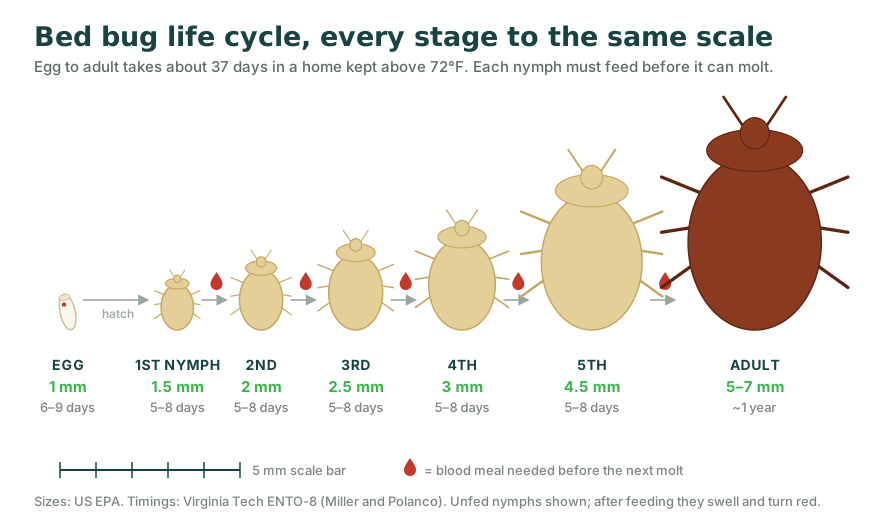
Bed bugs don't have a larva or pupa stage. The baby bed bug that hatches, called a nymph, looks like a small, pale adult. It grows through five nymph stages (instars), shedding its skin each time. The rule that drives the whole cycle: a nymph has to take a blood meal before it can molt to the next stage. Without one, it stays put until it feeds or dies. Virginia Tech notes a first-stage nymph that hatches too far from a person can dry out and die before it ever feeds.
| Stage | Length | What it looks like | Time in stage (warm home) |
|---|---|---|---|
| Egg | 1 mm | Pearl white, cap at one end, red eye spot after day 5 | 6 to 9 days |
| 1st nymph | 1.5 mm | Nearly clear to straw colored; almost invisible until it feeds | 5 to 8 days after feeding |
| 2nd nymph | 2 mm | Pale straw to yellowish white; red after a blood meal | 5 to 8 days |
| 3rd nymph | 2.5 mm | Pale straw to yellowish white; red after a blood meal | 5 to 8 days |
| 4th nymph | 3 mm | Pale straw to yellowish white; red after a blood meal | 5 to 8 days |
| 5th nymph | 4.5 mm | Pale straw to yellowish white; red after a blood meal | 5 to 8 days |
| Adult | 5 to 7 mm | Reddish brown, flat and oval like an apple seed; swollen, longer and redder after feeding | Up to about a year |

Sizes are from the EPA. Timing is from Virginia Tech's bed bug lab: most nymphs molt within about 5 days of feeding and spend 5 to 8 days in each stage. From egg to adult takes about 37 days above 72°F. A 2011 Virginia Tech life-table study measured 35 to 40 days at about 79°F. The "as little as 21 days" claim on several pest control websites is faster than any figure we found in the research. Cooler rooms and fewer meals stretch the cycle toward four months.
Adults live up to about a year with regular meals. How long they last without one is often exaggerated. At room temperature, starved bed bugs at any stage died within about 70 days on average in Virginia Tech's work. The year-plus figures come from cool conditions, 55°F or below. There's more on that in how long bed bugs can live without feeding.
How Many Eggs Does One Bed Bug Lay?
You'll often read "up to 500 eggs." That number appears in several older extension fact sheets, but none of them cite a study for it. When researchers actually counted, the total was much lower:
- Virginia Tech's 2024 extension guide: a female lays 1 to 7 eggs a day for about 10 days after a single blood meal, 5 to 20 eggs per meal, and about 140 in her lifetime.
- In a 2011 Virginia Tech life-table study, females laid 1 to 3 eggs on 79% of the days they laid at all.
The lower number doesn't make an infestation slower than you'd fear. The same 2011 study found a population doubles about every 13 days. At any moment, roughly 34% of an infestation is eggs, 54% is nymphs and only 12% is adults. The adults you can see are the smallest part of the problem.
One egg produces one nymph. Eggs aren't laid on people: bed bugs feed and go back into hiding, and University of California entomologists note they lay on rough surfaces like wood and paper near where people sleep or rest, not in hair or on skin.
Bed Bug Egg, or Something Else?
Plenty of specks in a bed aren't eggs. These checks sort most of them out:
| What you found | Size and look | The tell |
|---|---|---|
| Bed bug egg | About 1 mm, white, slightly curved, capped at one end | Glued down. It won't brush or blow off, and sits in a seam, crack or screw hole. |
| Empty bed bug shell | Same size, see-through, flattened, open at one end | Still glued in place. Means eggs have already hatched. |
| Flea egg | About 0.5 mm, pearly white, smooth oval | Not sticky. Rolls off fabric and collects where pets sleep (Kansas State University). |
| Bed bug droppings | Black or rust dots, often in clusters on seams | Smears red-brown when wiped with a damp cloth. Cockroach droppings don't (University of Tennessee). |
| Lint, dust or fabric pilling | Irregular shape, no cap, no consistent size | Lifts off easily with tape or a fingernail. |
If you have bugs and aren't sure they're bed bugs, they may be bat bugs, a close relative that lives in attics with bats. Under magnification, bat bugs have longer hairs on the plate behind the head. A pest professional or your county extension office can confirm it. Bites alone can't confirm bed bugs; our guide to identifying bed bug bites explains why.
What Actually Kills Bed Bug Eggs
Eggs are the hardest stage to kill. Researchers have measured exactly what it takes:
| Method | Effect on eggs | Source |
|---|---|---|
| Washing at 140°F (60°C), 30 minutes | 100% killed | Naylor & Boase, 2010 |
| Washing at 104°F (40°C) | All adults and nymphs died, but only about 25% of eggs | Naylor & Boase, 2010 |
| Soaking in cold water for 24 hours | No eggs killed | Naylor & Boase, 2010 |
| Dryer on high, at least 30 minutes | Kills all stages. 10 minutes on hot was not enough in testing. | Naylor & Boase, 2010 |
| Heat at 113°F (45°C) | Eggs survived 7 hours. 99% of adults died in about 95 minutes. | Kells & Goblirsch, 2011 |
| Heat at 118°F (48°C) | 99% of eggs dead after 71.5 minutes | Kells & Goblirsch, 2011 |
| Heat at about 131°F (55°C) | Eggs die almost immediately | Kells & Goblirsch, 2011 |
| Freezer at 0°F (-18°C) | At least 3.5 days needed. The old "a few hours" advice leaves survivors. | Olson et al., 2013 |
| Steam | Kills eggs it touches, but doesn't penetrate fabric or wood, and leaves nothing behind | University of Kentucky |
| Rubbing alcohol spray (50 to 91%) | 63 to 100% of sprayed eggs still hatched. It's also a fire hazard. | Ohio State University, 2014 |
| Most insecticide sprays | Often don't kill eggs, so hatchlings appear afterward | UF/IFAS, NPIC |
Two of these results surprise people. Eggs can survive more heat for longer than adults can. And a household freezer is often not cold enough: the freezers in the 2013 Minnesota study averaged about 7°F, not 0°F. If you freeze items, bag them, put a thermometer in with them, and give it four days. For the full breakdown of home remedies, see whether vinegar kills bed bugs and whether rubbing alcohol works.
The hatch timing explains how bed bug treatment is scheduled. Because most products don't kill eggs, a single visit leaves the eggs alive. More than 90% of them hatch within nine days, and those nymphs need about five weeks to become adults that can lay. A follow-up about two weeks after the first treatment catches the new nymphs after they hatch and before any can breed. Resistance makes it harder still: Virginia Tech reports that practically every wild bed bug population collected in Virginia is at least somewhat resistant to pyrethroids, the class behind most consumer bed bug sprays. This is why our bed bug treatment includes scheduled follow-up visits and doesn't count on one spray day.
The short version
- Eggs are about 1 mm, white and glued down, with a cap at one end and a red eye spot when they're close to hatching.
- Look in seams, box spring edges, wood joints and screw holes near the bed, with a flashlight and a magnifier.
- In a heated or air-conditioned home, 90% hatch within 9 days, and egg to adult takes about 37 days.
- Each nymph needs a blood meal to grow, five times before it becomes an adult.
- The 500-egg figure has no source behind it. Researchers counted about 140, but the population still doubles every 13 days.
- Heat kills eggs; cold water, alcohol and most sprays don't. Wash at 140°F or dry on high for 30 minutes, or freeze at 0°F for at least 3.5 days.
Sources: US EPA, Bed Bugs: Appearance and Life Cycle; D. Miller, A. Polanco and others, Bed Bug Biology, Virginia Cooperative Extension ENTO-8; M. Potter, Bed Bugs, University of Kentucky ENTFACT-636; A. Polanco, C. Brewster and D. Miller, "Population Growth Potential of the Bed Bug", Insects, 2011; S. Kells and M. Goblirsch, "Temperature and Time Requirements for Controlling Bed Bugs under Commercial Heat Treatment Conditions", Insects, 2011; J. Olson and others, "Cold Tolerance of Bed Bugs and Practical Recommendations for Control", Journal of Economic Entomology, 2013; R. Naylor and C. Boase, "Practical Solutions for Treating Laundry Infested with Cimex lectularius", Journal of Economic Entomology, 2010; C. G. Johnson, "Development, Hatching and Mortality of the Eggs of Cimex lectularius", Parasitology, 1940; B. Delong, bed bug egg morphology thesis, Virginia Tech, 2014; O. Ferguson, S. Jones and J. Bryant, Ohio State University, alcohol trial presented to the Entomological Society of America, 2014.
Frequently Asked Questions
Bed bug eggs are about 1 mm long, pearl white and slightly curved, with a small cap at one end where the nymph comes out. After about five days a red eye spot shows through the shell. Because the female glues each egg down with a cement that picks up dust, eggs in a used mattress often look grayish rather than clean white.
Baby bed bugs, called nymphs, look like small, pale versions of the adult. They measure about 1.5 mm at the first stage and about 4.5 mm by the fifth. Before feeding they are nearly clear to straw colored and very hard to see; after a blood meal they swell and turn bright red. They molt five times, feeding before each molt, before they reach adult size.
Yes, but barely. An egg is about the size of a pinhead, and it is hard to spot on light fabric without magnification. Use a flashlight held at a low angle and a magnifying glass along mattress seams, box spring edges, wood joints and screw holes near the bed.
In a home above 70°F, about 60% hatch by day 6 and more than 90% by day 9, according to Virginia Tech. Around 50°F hatching takes several days longer, and eggs held below about 55°F do not complete hatching but can survive for weeks.
Virginia Tech researchers put it at 1 to 7 eggs a day for about 10 days after each blood meal, 5 to 20 eggs per meal, and about 140 over a female's life. The often repeated figure of 500 has no published study behind it. Even so, an infestation can double in about 13 days.
On rough surfaces close to where people sleep or rest: mattress and box spring seams, the underside of the box spring, cracks and screw holes in wooden bed frames and headboards, carpet edges, baseboards and behind outlet covers. In heavy infestations eggs also turn up in clothing and clutter.
About 37 days from egg to adult in a home kept above 72°F. The nymph passes through five stages and must take a blood meal before each molt, spending roughly 5 to 8 days in each stage. Cooler rooms and fewer meals can stretch the cycle to about four months.
In heat studies, 99% of eggs died after 71.5 minutes at 118°F and almost immediately at about 131°F, while eggs survived 7 hours at 113°F. For laundry, a 140°F wash for 30 minutes or 30 minutes in a dryer on high kills all stages. In a freezer, eggs need at least 3.5 days at 0°F.
Not reliably. In an Ohio State University trial, 63 to 100% of eggs sprayed with 50%, 70% or 91% isopropyl alcohol or with ethanol still hatched within three weeks. Alcohol is also flammable, and University of Kentucky entomologists advise against using it.
Photo credits: OH-BugMan, CC BY-SA 4.0, via Wikimedia Commons; Alexander Klepnev, CC BY 4.0, via Wikimedia Commons; CDC / Piotr Naskrecki, Public domain, via Wikimedia Commons.