
Exterminator in Fountain Inn, SC
Fountain Inn’s pest pressure shifts across a fast-growing city that straddles the Greenville and Laurens county line and mixes a historic stagecoach-stop downtown, a booming I-385 commercial corridor, older established neighborhoods, brand-new suburban subdivisions, and a rural agricultural fringe. The historic Main Street area carries decades of established construction dating back to the city’s 19th-century inn-and-fountain origins, the I-385 Golden Strip corridor brings the pressure that comes with new commercial and industrial growth, and the Laurens County edge of town brings a more rural, farmland-adjacent set of conditions the newer subdivisions don’t see. Vinx treats each part of Fountain Inn according to what it actually needs.
Get Started in 60 Seconds
Choose what’s easiest for you
Request a Quote
We usually respond in 2 minutes
Call (855) 800-8469
Get a live person (no AI agents here!)
Sign Up Online
Get pricing and schedule now





Welcome to Vinx Pest Control
A Company That Actually Backs What It Says
At Vinx, we pair professional-grade treatment with a level of follow-through most pest control companies skip. Local technicians, fast response, and a guarantee that holds up after the invoice is paid.
Get a Free Quote"I'm not passionate about killing bugs. I'm passionate about customer service. At Vinx, you get experts who show up, do the job right, and stand behind every visit. No runaround, no fine print."
PROTECTION PLANS
Fountain Inn Exterminator Pricing
100% money-back guarantee on every plan.

Standard Residential Protection
- 4 Seasonal Treatments Per Year
- 50+ Covered Pests
- Interior, Exterior & Yard Treatment
- Unlimited Free Re-Services
- 100% Money-Back Guarantee
- Fire Ant Yard Guarantee
- Flea & Tick Coverage
- Mosquito Treatments

Upgraded Yard Protection
- 6 Home & Yard Treatments Per Year
- 50+ Covered Pests
- Interior, Exterior & Yard Treatment
- Unlimited Free Re-Services
- 100% Money-Back Guarantee
- Fire Ant Yard Elimination Guarantee
- Flea & Tick Elimination Guarantee
- Mosquito Treatments

Most Comprehensive Protection
- 9 Treatments Per Year
- 50+ Covered Pests
- Interior, Exterior & Yard Treatment
- Unlimited Free Re-Services
- 100% Money-Back Guarantee
- Fire Ant Yard Elimination Guarantee
- Interior Flea & Tick Coverage
- 8 Mosquito Treatments (Mar–Nov)
- Free Bed Bug Treatments if Needed*
All plans include a $329 initial treatment and a 12-month agreement. Termite protection (Termite TotalDefense, starting at $35/mo standalone) is quoted separately after a free inspection. *Starting rates vary by home size and area. All plans billed monthly.
Get Your Free Fountain Inn Pest Inspection
Fill out the form below and a Vinx team member will reach out within 2 minutes during business hours.
Prefer to talk? Call (855) 800-8469 for a live person, no AI agents.
Our Process
How Vinx Exterminators Work a Fountain Inn Property: Step by Step

Inspection & Reporting
Every extermination job in Fountain Inn starts with identification — and here that includes confirming which side of the Greenville–Laurens county line your parcel sits on, because public mosquito provision runs county by county and the two programs need not match. A technician names the pest to species, separating the native eastern subterranean termite from any Formosan sales pitch and imported fire ants from nuisance ants, traces it to harborage, and gives you plain findings with a firm price before anything is applied.

Exterior Foundation Treatment
With the problem identified, the exterior gets its defensive line. We apply a micro-encapsulated barrier around the foundation, three feet up and three feet out, intercepting insects at the slab gaps, weep holes and thresholds they actually use. The work is era-appropriate: on the 1880s–1930s stock around North Main it means the sill line and moved masonry joints; on a 2015 slab build off Fairview Road it means the slab edge and expansion joints where the original pre-treatment has aged.
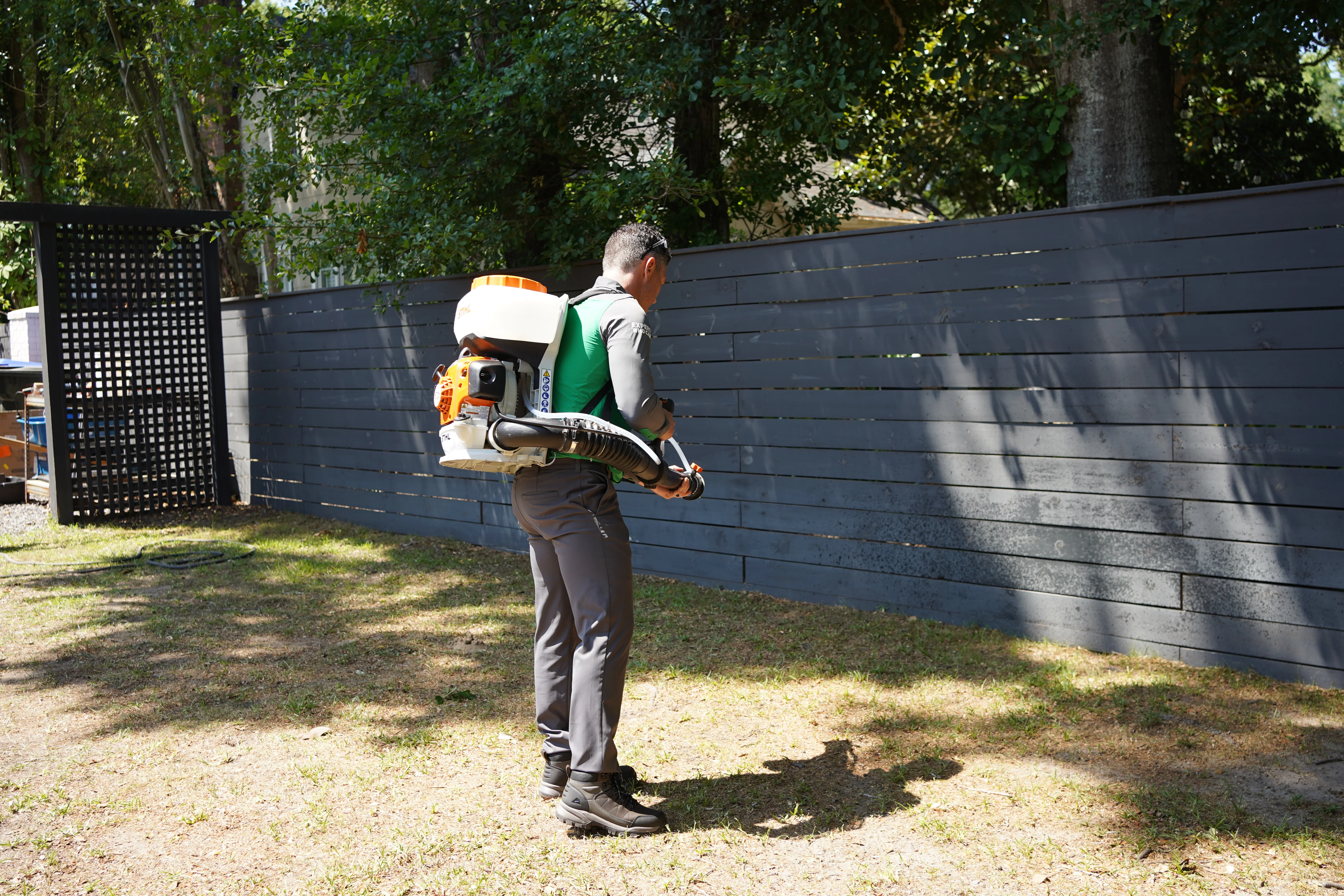
Yard Treatment
The yard gets treated up to 30 feet out, because most of what ends up indoors staged in the lawn first. In a town that has grown by roughly a third in a decade, that often means the boundary facing new construction — clearing and grading displaces established fire ant and rodent populations into adjacent occupied streets, so we treat the side the pressure comes from rather than assuming the problem started indoors.
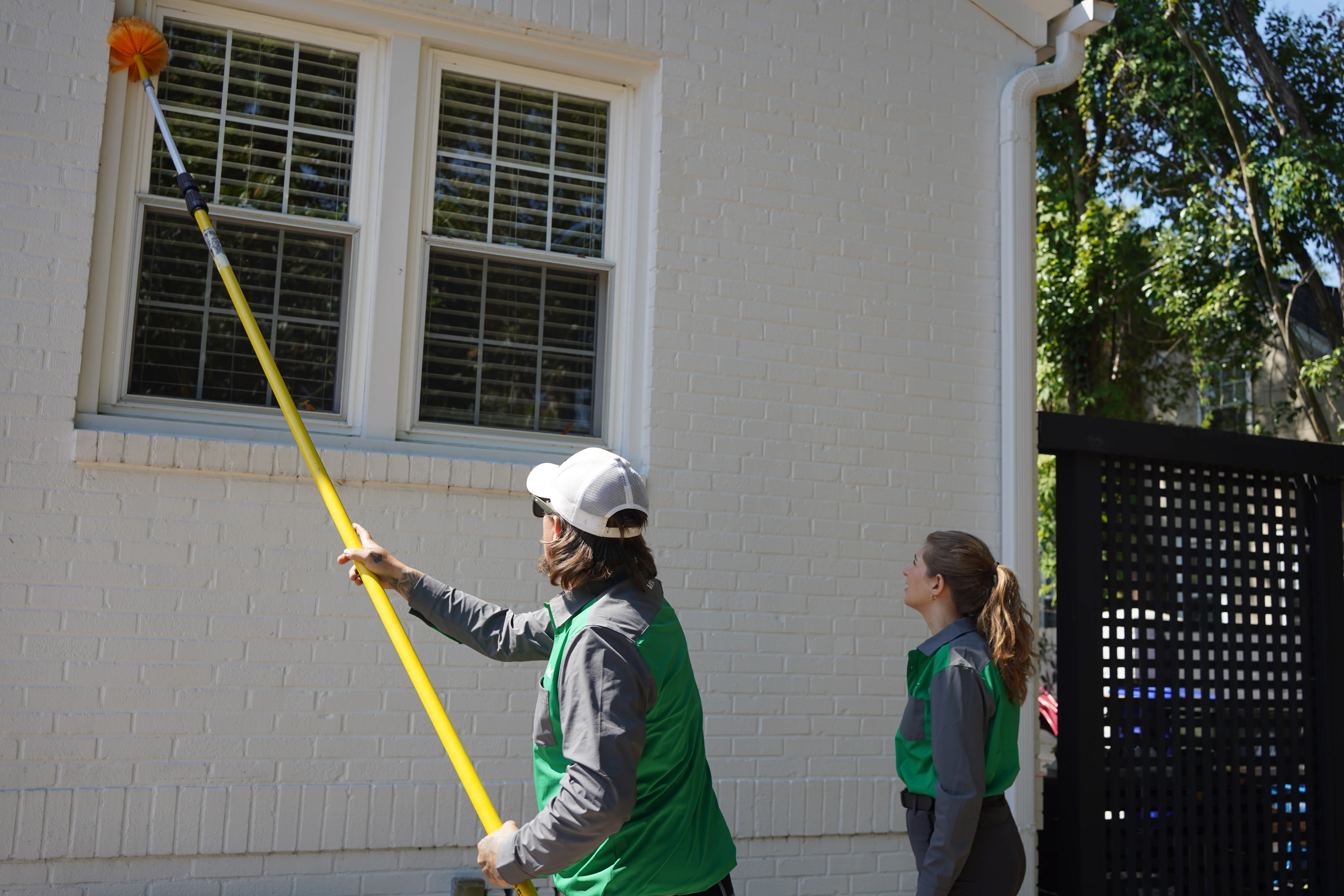
Sweep & Treat Eaves
Rooflines are swept clear of webs and early wasp nests on every visit, then spot-treated with a residual product so returning insects contact treatment instead of rebuilding. On the older wood-frame buildings clustered along North Main — construction that has been altered for decades — that eaves pass doubles as an inspection of the overhead routes where carpenter ant activity shows first.
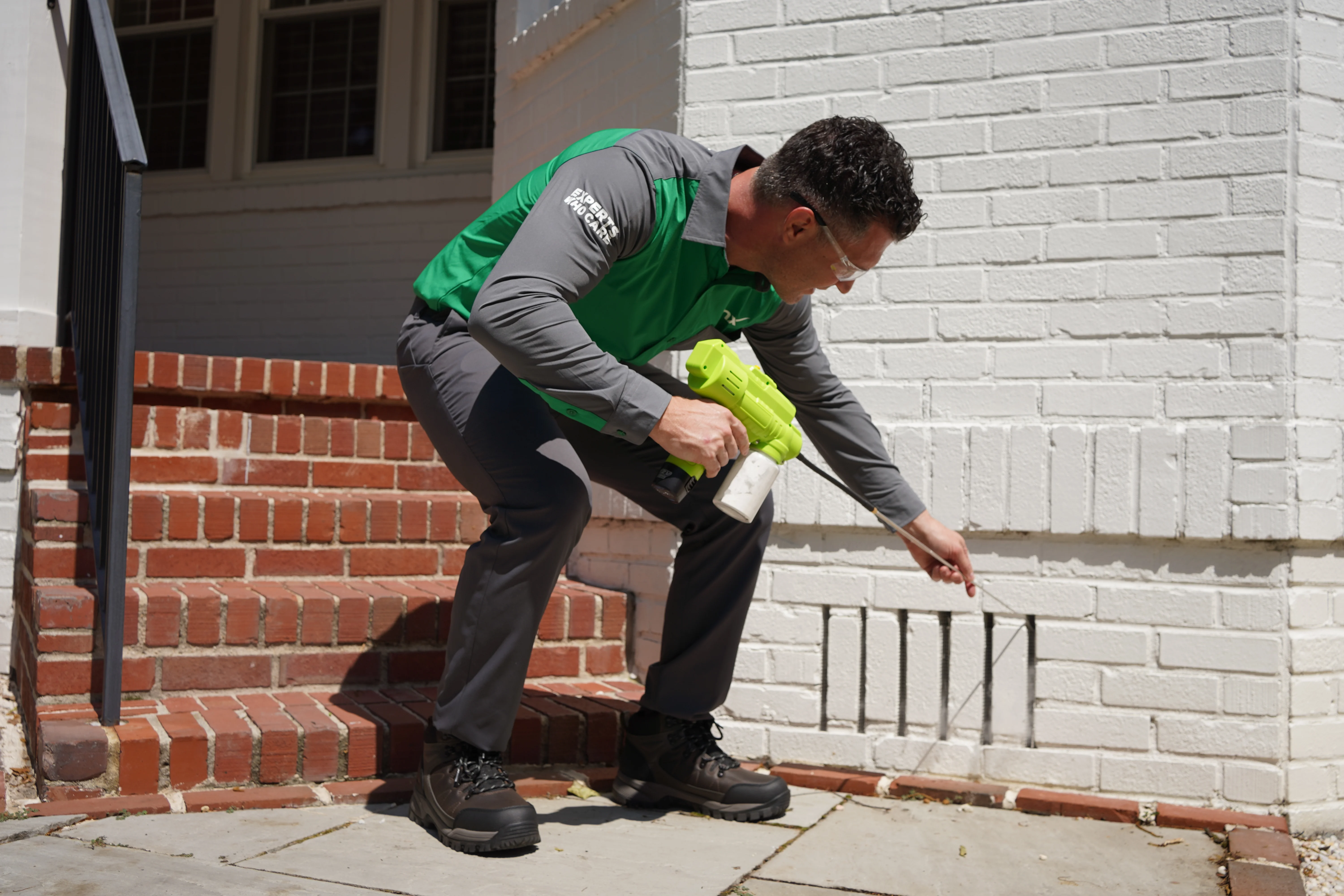
Power Dust Injection
Cracks, weep holes, pipe penetrations and expansion joints get a dust product driven deep with a compressor tip. That is the treatment that reaches wall voids, which matters on buildings from the 1880s to the 1930s where masonry has moved and penetrations have been reworked repeatedly — an exclusion problem no surface spray covers. Protected from rain and heat, the dust keeps working long between visits.
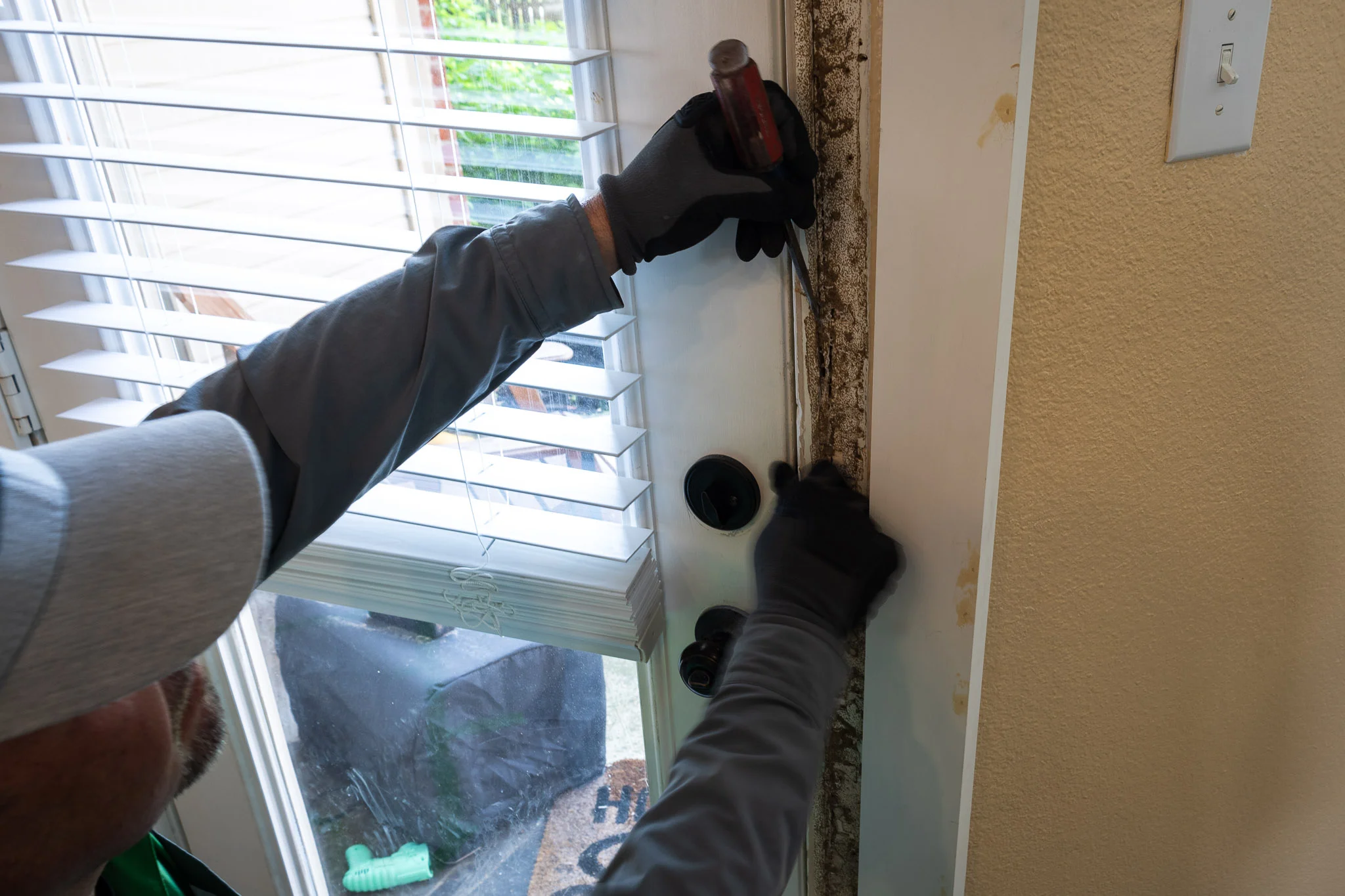
Interior Treatment (If Needed)
Where an infestation is already established indoors, we treat the harborage directly — gel bait and a growth regulator for roaches, exclusion first and then trapping for rodents — rather than misting a room and hoping. Commercial accounts around the Younts Center and along I-385 run on a documented schedule with service records for health inspections. Interior work and re-services between visits are covered at no extra charge on every plan.
What Customers Say
Real Reviews from Fountain Inn Homeowners
Alex was through, friendly and patient with my dog. Thanks Alex.
Came out next day. Very professional company, went thoroughly through everything I asked. Answered questions without any problem! Noah was great and very professional with the service and was so nice to my children even when they were in the way! I will definitely recommend this company.
Whole family uses Vinx. They're affordable to start and quickly bring pest problems under control. When you enroll in their service it's a set it and forget it feeling as they come on a schedule. But my favorite part is that they'll come out anytime between scheduled visits free of charge if issues or concerns arise. Over all they've done right by ours and do an awesome job.
Brandon always goes above and beyond, he’s excellent to work with!! I Highly recommend him!
Nothing but professionalism! Explained my service and gave me the opportunity to ask questions. I feel confident my tech went above and beyond!
Vinx mosquito does good work. I'm sitting outside right now and not a single bug bite. Mosquitoes normally just swarm to me. The guys at at Vonx are professional and efficient at their jobs. I recommend their service and they are conscientious of pets.
Local Knowledge
Two Counties, Old Bones and Fast Growth: Why Fountain Inn Is Different
Last updated: September 4, 2026
Fountain Inn straddles Greenville County, which holds roughly three-quarters of its population, and Laurens County, which holds the rest — at the same 68.7-mill rate in each. Chartered on Christmas Eve 1886 and incorporated in 1912, the town has grown from around 7,800 residents to roughly 10,400 in a decade. The county line matters twice: public mosquito provision is organized county by county and the two programs need not match, and Clemson’s tracking of the sixteen counties with documented Formosan colonies includes neither Greenville nor Laurens — so a Formosan-led pitch here is not describing your risk. The species that damages houses here is the native eastern subterranean termite.
6 Reasons Fountain Inn Calls an Exterminator
Ants
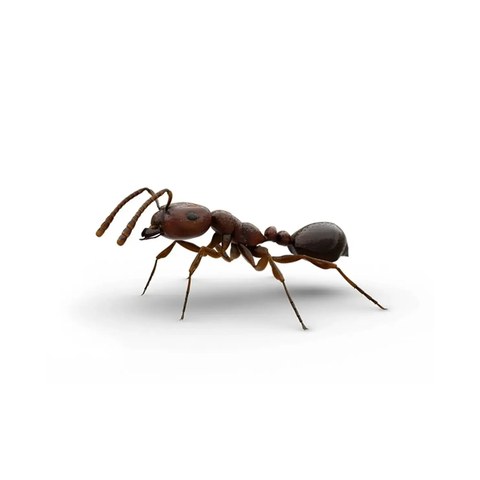
Fire ant calls track Fountain Inn’s growth: freshly disturbed soil in the new subdivisions, open farmland on the rural Laurens County fringe, and — predictably — the streets next to active construction, where grading displaces established colonies into yards that were quiet for fifteen years. We treat mounds directly, bait the whole yard, and put a treated boundary on the construction side. In the decades-old homes near Main Street, carpenter ants and odorous house ants are the other steady call.
Termites
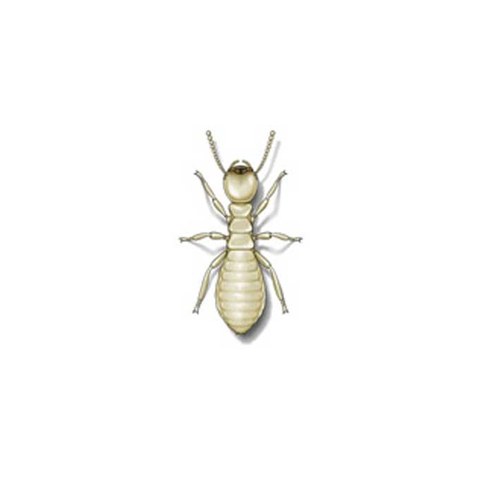
Termite work here starts with an honest identification. Neither Greenville nor Laurens County appears on Clemson’s list of sixteen counties with documented Formosan colonies, so the job is the native eastern subterranean termite — ordinary, established, and entirely capable of taking a house apart if nobody looks. On the 1880s–1930s crawl-space stock we inspect the sill line and masonry; on newer slab builds we check the slab edge and the age of the original pre-construction treatment.
Mosquitoes
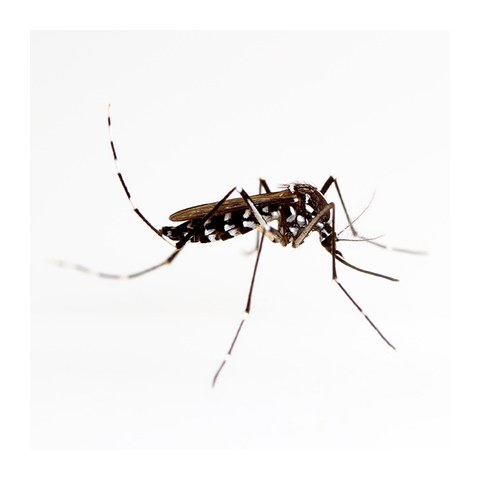
Mosquito calls in Fountain Inn come with a jurisdictional wrinkle: public provision is organized county by county, and Greenville and Laurens are not obliged to run matching programs. The productive targets are never Durbin Creek itself — running water is poor habitat — but the still pockets nearby: clogged gutters, plant saucers, low corners that hold water since a neighboring lot was paved. We larvicide standing water and run barrier treatment monthly through the warm season.

Rodents
Rodent pressure splits between the retail and commercial buildings along the I-385 Golden Strip corridor and the established homes near downtown, where long-settled construction provides entry points and harborage as temperatures drop each fall. Construction disturbance adds a third source, pushing displaced rodents into adjacent streets for a season. Extermination that lasts runs exclusion first, then trapping and secured bait, with documented records for commercial accounts.
Spiders
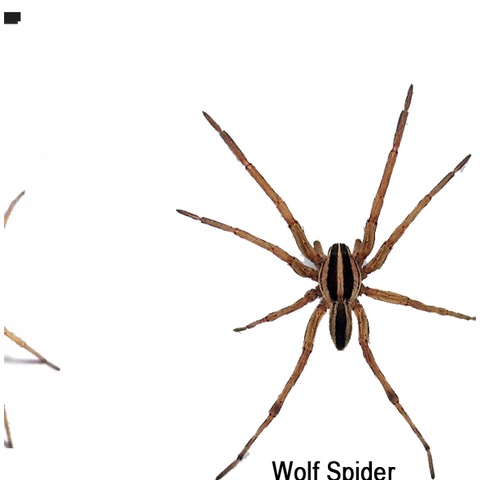
Black widows are found throughout Fountain Inn in garages, sheds and storage areas, and wolf spiders wander in from the open farmland of the Laurens County fringe and the fresh landscaping of the newer subdivisions. A spider call is usually a prey problem — the spiders are there because the insects are — so we treat the insect population and harborage together and clear webbing at the eaves on every visit.
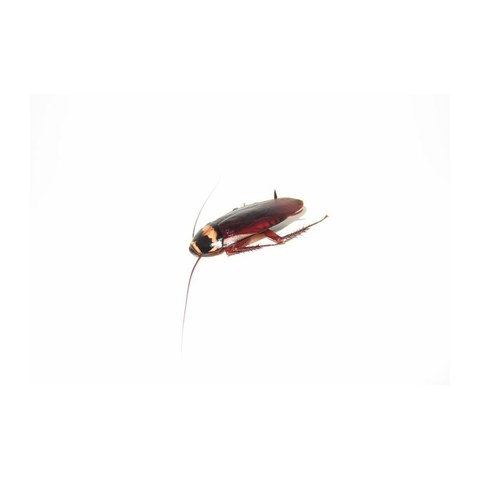
Cockroaches
American cockroaches — palmetto bugs — are the common sight in the older buildings and utility areas near historic Main Street, where ventilated crawl spaces and reworked penetrations give them routes and harborage. German cockroaches are the persistent call from restaurants and commercial kitchens along the I-385 Golden Strip, and those need a real protocol: gel bait and a growth regulator in the harborage itself, dust in the wall voids, not a surface spray.
Fountain Inn has no downtown historic district; what it has is a dense cluster of individually listed buildings along North Main Street — the 1939 PWA-era Younts Center in New Deal Moderne style, the 1935 Principal’s House and Teacherage, the Cannon Building of around 1880, the McDowell House, the Robert Quillen Office and Library and others. Buildings of the 1880s to 1930s here are wood frame over ventilated crawl spaces, with masonry that has moved, original penetrations and decades of alteration. That is an inspection-and-exclusion problem more than a spraying one, and it deserves its own schedule, not a 2015 subdivision template.
Growth of this speed produces its own pattern: clearing and grading displaces established fire ant and rodent colonies into adjacent occupied streets, and new impervious surface changes where water sits on neighboring lots. Along Durbin Creek and its tributaries the constraint is Clemson’s: standing water lasting five days or more can breed mosquitoes, and some species need no more than a tablespoon. Vinx works Fountain Inn on both sides of the county line, on next-day appointments, with a free inspection, a firm price first and a guarantee behind the work.
The state’s historic survey of Fountain Inn divides the old town into three distinct fabrics, and they behave differently. There is the Woodside Mill Village — Woodside Avenue, Fairview Street and the numbered streets First through Sixth — which is worker housing built as a single batch and therefore ageing as one. There is the central business district, which the survey dates to the late 1890s and the early decades of the twentieth century. And there is the North Main Street corridor, where the oldest buildings in town, the houses, predate the railroad’s arrival in the 1880s. Add the post-2010 subdivisions that now account for well over a third of the city’s homes and you have four building eras inside one small city.
Pest Pressure by Neighborhood
Where Fountain Inn Exterminator Calls Come From
North Main Street: Old-Stock Termites & Carpenter Ants
The cluster of individually listed buildings around the 1880 Cannon Building and the Younts Center is wood frame over ventilated crawl spaces, with moved masonry and decades of reworked penetrations. That aging construction drives Fountain Inn’s steadiest termite, carpenter ant and palmetto bug calls, and it gets inspected on its own schedule.
I-385 Corridor: Commercial Roaches & Rodents
The booming commercial and mixed-use growth near Exits 22, 23 and 26 brings the food-service and dumpster-driven pressure typical of a fast-growing corridor — German cockroaches in the kitchens, rodents in the back-of-house. Commercial jobs here run on a documented schedule with the service records a health inspection expects.
Near Downtown & the Younts Center: Entry-Point Pests
The older residential streets near downtown and the historic Younts Center carry the steady, entry-point pressure of long-settled homes — rodents finding harborage as temperatures drop each fall, odorous house ants working established construction, and mature landscaping holding moisture against foundations. Exclusion and a maintained perimeter do more here than repeat spraying ever will.
Growth Edges: Fire Ants & Displaced Pests
The subdivisions built to keep pace with a population that grew more than 30% between 2010 and 2020 bring irrigated landscaping, freshly disturbed soil and construction disturbance — which displaces fire ants and rodents into neighboring streets. Yard-wide baiting plus a treated boundary on the construction side holds these lots.
Laurens County Side: Farmland Pests & Mosquito Gaps
The rural, agricultural side of town runs on wells, septic systems and open farmland — fire ant and wolf spider country. It also sits in a different county than most of Fountain Inn, and since public mosquito provision is organized county by county, plans here assume the yard is your responsibility.
Prevention Tips
6 Ways to Reduce Pest Pressure Around Your Fountain Inn Home
Complete Coverage
What Our Fountain Inn Exterminators Treat
Every common Fountain Inn pest covered under one quarterly service plan

Ants
Ants, Argentine ants, carpenter ants, and odorous house ants. Perimeter bait, mound treatment, crack and crevice application.
All Plans
Cockroaches & Palmetto Bugs
American, Asian, and German cockroaches. Gel bait in harborage areas, exterior perimeter spray, drain treatment.
All Plans
Spiders
Web removal from eaves, exterior perimeter targeting harborage. Black widow identification and targeted treatment.
All Plans
Wasps & Hornets
Nest removal from eaves, soffits, structural voids. Preventative treatment of common nesting sites on each quarterly visit.
All Plans
Fleas & Ticks
Yard treatment targeting grassy and shaded areas. Interior treatment of active infestation areas.
Plus & Platinum
Bed Bugs
Inspection, heat treatment assessment, and targeted chemical treatment. Steady commercial and lodging turnover along the I-385 Golden Strip corridor creates consistent exposure risk.
Platinum (12mo)
Rodents
Exterior bait station monitoring included in Plus and Platinum. Active infestation and full exclusion quoted separately after inspection.
Plus & Platinum
Mosquitoes
Monthly barrier spray and larvicide. Year-round service adjusted seasonally. Up to 90% population reduction per visit.
Platinum Only
Occasional Invaders
Silverfish, earwigs, centipedes, stink bugs, ladybugs, pillbugs. Crack and crevice treatment, perimeter spray, entry point ID.
All PlansWhat to Expect
Fountain Inn Pest Activity by Season
Most pest companies in Fountain Inn treat when you call. Vinx’s recurring plans keep your home protected through every seasonal shift, before the pressure peaks.
| Season | Active Pests | What to Watch For |
|---|---|---|
| Spring (Mar–May) | Termite swarmers, ants, mosquitoes, spiders | Termite swarmer wings on windowsills; ant mounds appearing after rain |
| Summer (Jun–Aug) | Mosquitoes, cockroaches, ants, stinging insects | Palmetto bug activity through drains; mosquito pressure near standing water |
| Fall (Sep–Nov) | Rodents, spiders, cockroaches, stink bugs | Brown recluse spiders moving indoors; mice entering through foundation gaps |
| Winter (Dec–Feb) | Rodents, German cockroaches, cockroaches | Rodent droppings in attics; roaches active near HVAC and water heaters |
Kid & Pet Safe
Our Treatments Are Safe for Your Whole Family: Including the Furry Members
Every product we use is EPA-registered and applied strictly at labeled rates by licensed SC technicians. We take the guesswork out of safety so you can feel confident letting kids and pets back into treated areas quickly.

EPA-Registered Products Only
All products are EPA-registered and applied per strict label requirements by our licensed South Carolina technicians on every visit.
Safe Re-Entry After Drying
Exterior spray treatments dry in 30–60 minutes. Once dry, treated surfaces are safe for children and pets. Your technician confirms before leaving.
Interior Treatment On Request
We treat only what’s needed, where it’s needed. Gel baits placed in areas inaccessible to pets and children for maximum safety.
Botanical Options Available
Ask your technician about our plant-derived treatment options for households that prefer a more natural approach to pest control.
Have a concern about products near your pets or children? Call (855) 800-8469 and we’ll walk you through exactly what we use and why it’s safe.
Explore More
More Pest Control Services in Fountain Inn

Termite Control Fountain Inn
Bait systems & liquid treatment
Ant Control Fountain Inn
Fire ants & all ant species
Mosquito Control Fountain Inn
Monthly barrier treatments
Tick & Flea Control Fountain Inn
Yard & interior treatments
Rodent Control Fountain Inn
All rodents covered
Cockroach Control Fountain Inn
American & German roaches
Bed Bug Control Fountain Inn
Heat & liquid treatments
Spider Control Fountain Inn
All spider species covered

Pest Control Fountain Inn
Year-round protection plans
Frequently Asked Questions
Exterminator Fountain Inn SC: Frequently Asked Questions
Recurring plans start at $49 a month, with one-off treatment priced by pest and property. An 1890s house with a full crawl space and a 2015 slab build are genuinely different jobs. Inspection is free and the price is firm before work starts. Call 855-800-8469.
No, and it is worth knowing. Clemson’s county tracking lists sixteen South Carolina counties with documented Formosan colonies, and neither Greenville nor Laurens County is among them. The species that actually damages houses here is the native eastern subterranean termite.
It matters for mosquitoes. The town straddles Greenville and Laurens counties, public mosquito provision is organized county by county, and the two are not obliged to run matching programs. Worth confirming once, then planning on the basis that your yard is your responsibility.
Very often because something nearby was cleared or graded. Construction displaces established fire ant and rodent populations into adjacent occupied streets. The productive response is a treated boundary on that side rather than more product indoors.
Different rather than harder. Buildings from the 1880s to the 1930s here sit over ventilated crawl spaces with masonry that has moved and penetrations that have been reworked repeatedly. That is an inspection-and-exclusion problem more than a spraying one.
Quarterly for most properties, weighted toward the warm months. If your lot has taken on new standing water because of nearby development, the drainage fix matters more than extra visits.
Yes, residential and commercial both. Commercial work runs on a documented schedule with service records for health inspections.
We cover the whole town in both counties, plus Simpsonville, Gray Court and the Fairview Road corridor. Most calls get a next-day appointment. Call 855-800-8469.
Service Coverage
Pest Control Across Fountain Inn & the Greater Golden Strip Area
Serving every neighborhood in and around Fountain Inn.