
Pest Control in Cary, NC
Full-Service Pest Control from Crabtree Creek to Swift Creek: Ants, Termites, Mosquitoes, Rodents & More
Cary is North Carolina’s seventh-largest municipality, with 183,582 residents as of July 1, 2025 (Census Bureau, Vintage 2025), and its 3,375 acres of mapped wetlands, Piedmont clay, mature landscaping, and pond-heavy stormwater design keep ants, termites, roaches, and mosquitoes active most of the year. Vinx provides recurring residential pest control across Cary from $49/mo, backed by free re-services for covered pests and a 4.8-star rating across 3,600+ reviews.
Get Started in 60 Seconds
Choose what’s easiest for you
Request a Quote
We usually respond in 2 minutes
Call (984) 600-8469
Get a Live Person (no AI agents here!)
Sign Up Online
Get pricing and schedule now





Welcome to Vinx Pest Control
A Company That Actually Backs What It Says
At Vinx, we combine professional-grade treatments with a level of service most pest control companies don’t offer. Local technicians, fast response times, and free re-services for covered pests between visits.
“I’m not passionate about killing bugs. I’m passionate about customer service. At Vinx, you get experts who show up, do the job right, and stand behind every visit. No runaround.”

Founder & Owner, Vinx Pest Control
PROTECTION PLANS
Pest Control Plans for Cary Homeowners
Unlimited free re-services on every plan.

Standard Residential Protection
- 4 Seasonal Treatments Per Year
- 40+ Covered Pests
- Interior, Exterior & Yard Treatment
- Unlimited Free Re-Services
- Guaranteed Coverage for Common Household Pests
- Flea & Tick Coverage
- Mosquito Treatments

Upgraded Yard Protection
- 6 Home & Yard Treatments Per Year
- 40+ Covered Pests
- Interior, Exterior & Yard Treatment
- Unlimited Free Re-Services
- Guaranteed Coverage for Common Household Pests
- Exterior Flea & Tick Warranty
- Mosquito Treatments

Most Comprehensive Protection
- 9 Treatments Per Year
- 40+ Covered Pests
- Interior, Exterior & Yard Treatment
- Unlimited Free Re-Services
- Guaranteed Coverage for Common Household Pests
- Interior Flea & Tick Warranty
- 8 Mosquito Treatments (Apr–Nov)
- Free Bed Bug Treatment After 12 Months on Platinum
*Starting rates vary by home size and area. All plans billed monthly.
Request Your Free Pest Control Quote
Fill out the form below and a Vinx team member will reach out within 2 minutes during business hours.
Prefer to talk? Call (984) 600-8469 for a live person, no AI agents.
Our Process
How Vinx Treats Your Cary Home: Step by Step

Inspection & Reporting
Each visit starts with a full walk-around rather than a quick spray. Technicians check crawl space vents and foundation grade on the older housing inside the Cary Historic District, then look for unsealed penetrations on the newer construction through Green Level and West Cary. Whatever turns up, you get a plain account of it.
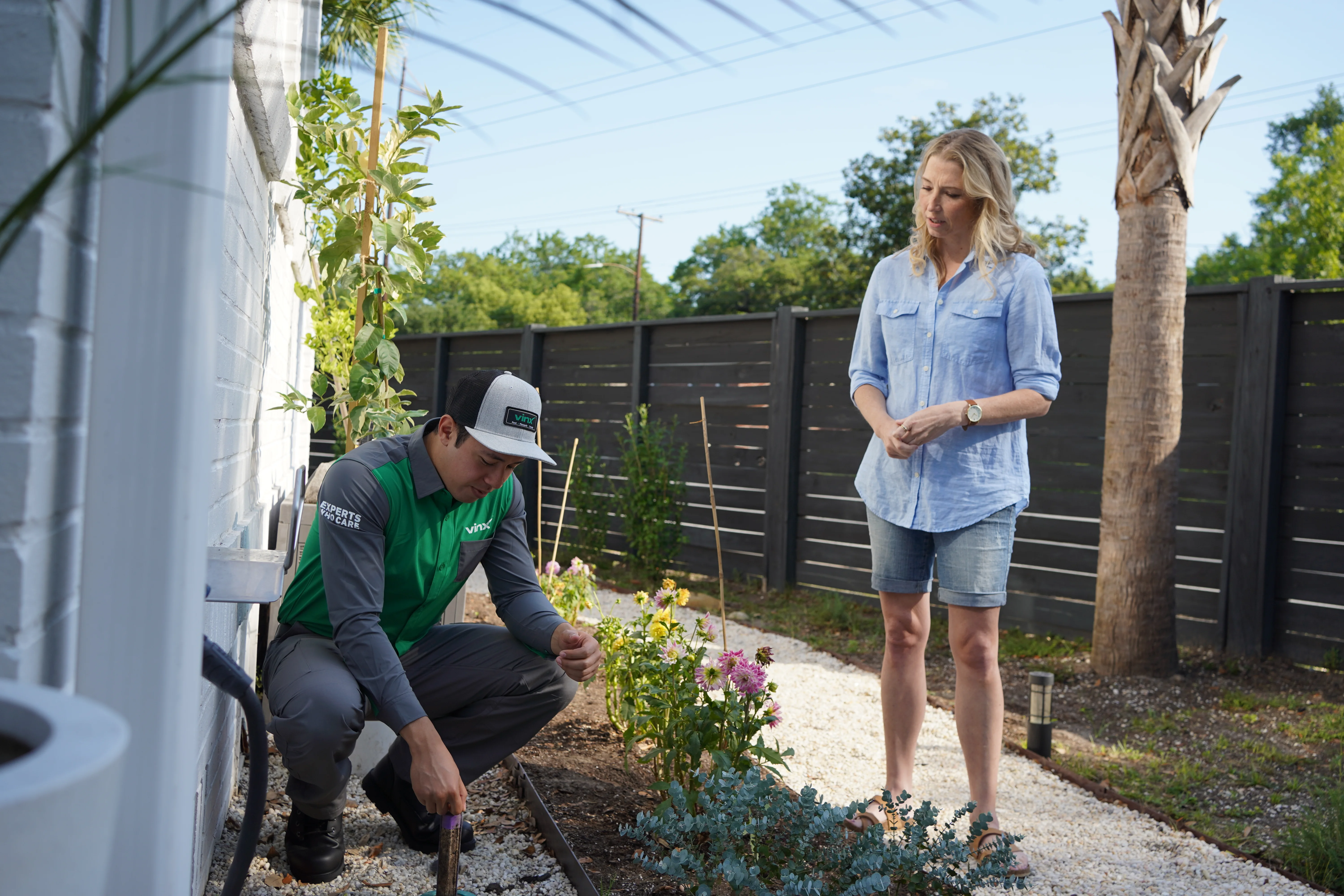
Exterior Foundation Treatment
A micro-encapsulated barrier goes three feet up and three feet out around the entire foundation, taking in utility lines, mulch beds and anything touching the structure. Clay soils, which NC State Extension says tend to hold excessive amounts of water, keep rain against a Cary foundation, and that persistent damp is what brings termites, ants and roaches to the base of the house. EPA-approved products, yard usable again 30 to 60 minutes after drying.
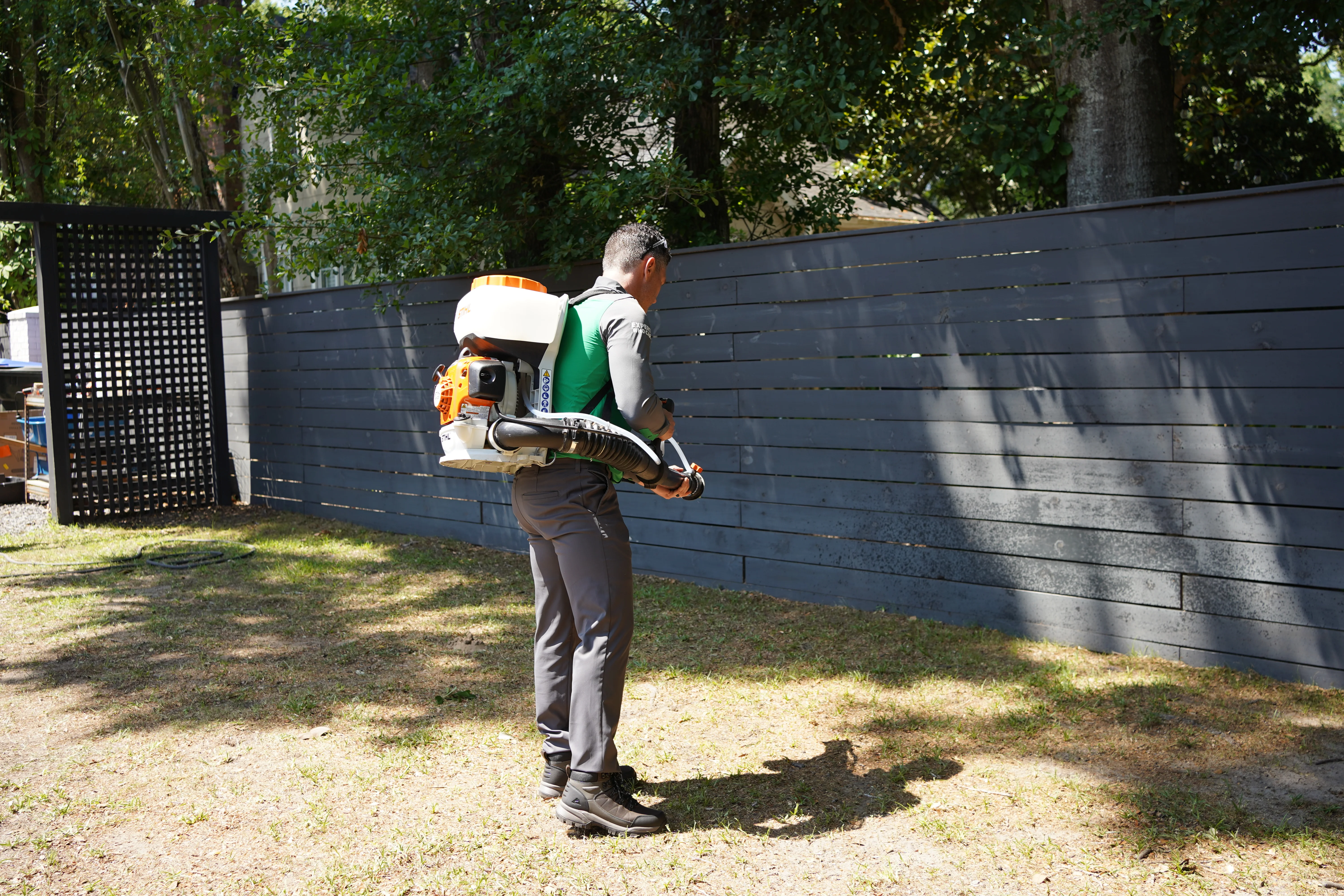
Yard Treatment
Treatment extends up to 30 feet out to cut pressure before it reaches the foundation. In Cary that reach earns its keep, because more than 100 miles of paved greenway now link Cary’s parks and neighborhoods, so a tree line or greenway buffer is often the neighbor rather than another yard.
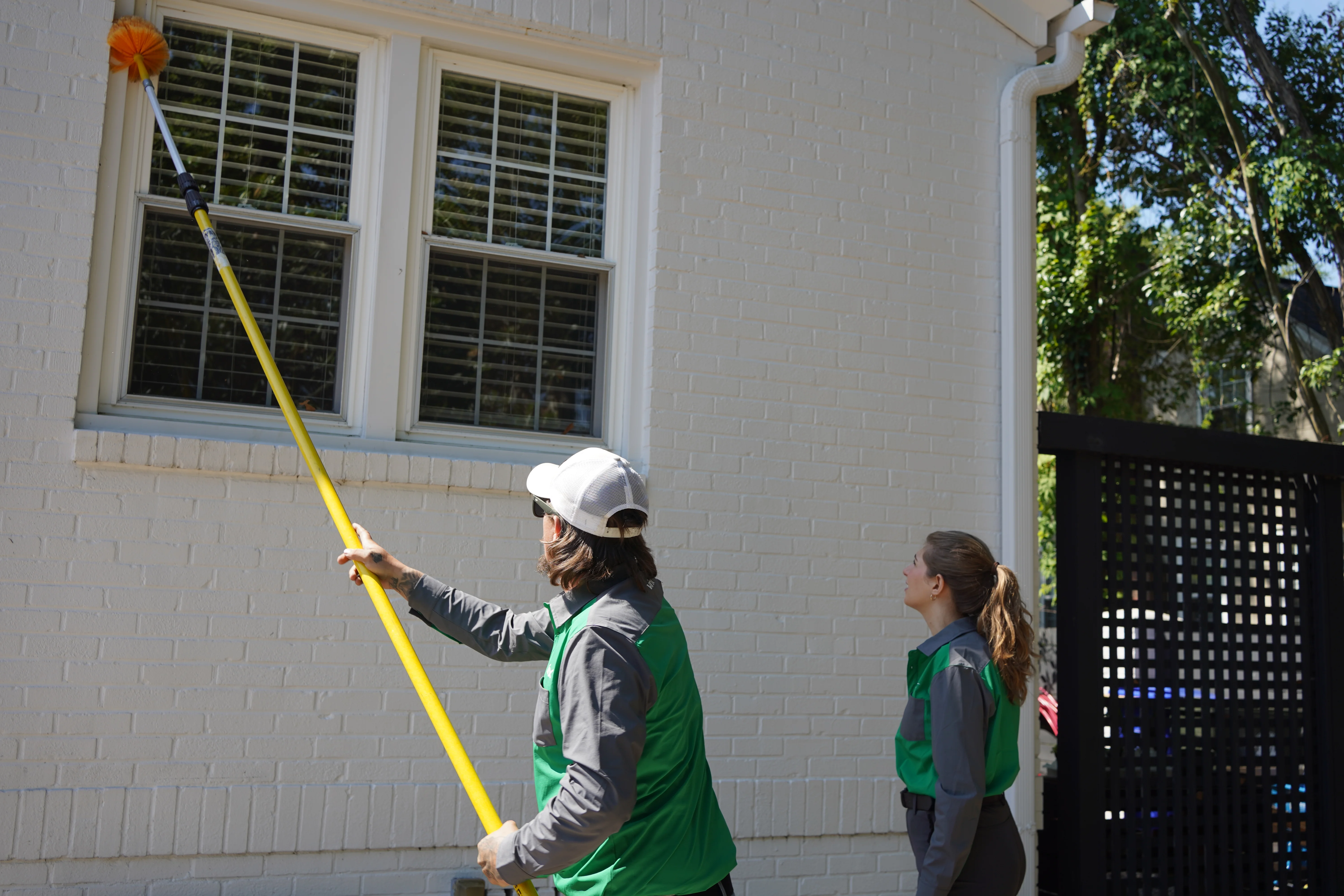
Sweep & Treat Eaves
Every visit sweeps first- and second-story eaves, clearing cobwebs, wasp nests and egg sacs, then lays a residual so the site is not reused. Wasps navigate back to old nests by pheromone, and the treatment is already in place when they arrive.
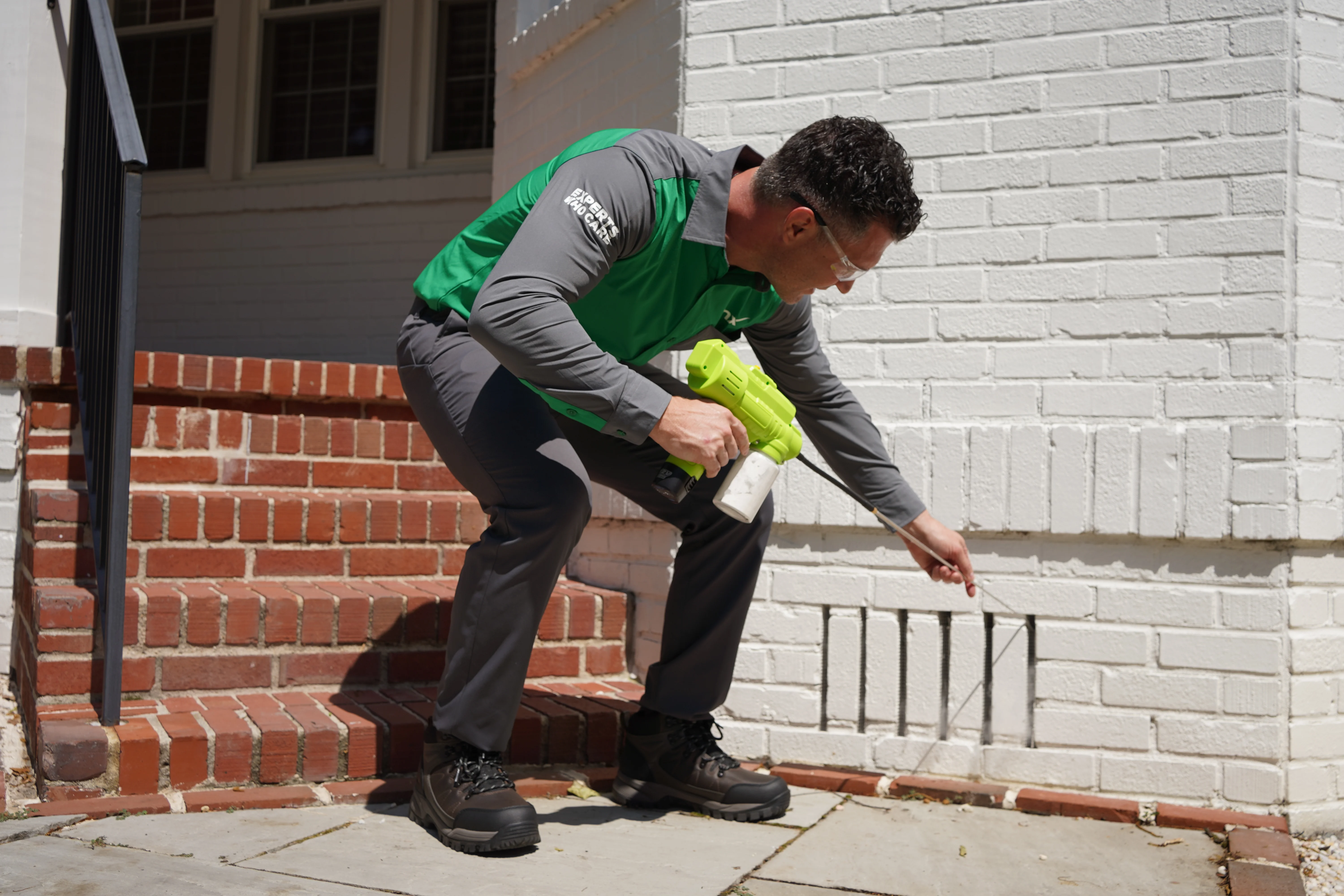
Power Dust Injection
A handheld compressor pushes dust into exterior cracks, weep holes and expansion joints, the routes into wall voids. Kildaire Farms houses dating to the 1970s have settled gaps; a Green Level slab has new joints and open penetrations. Either way the dust keeps working far longer than a surface spray, because rain and heat never reach it.
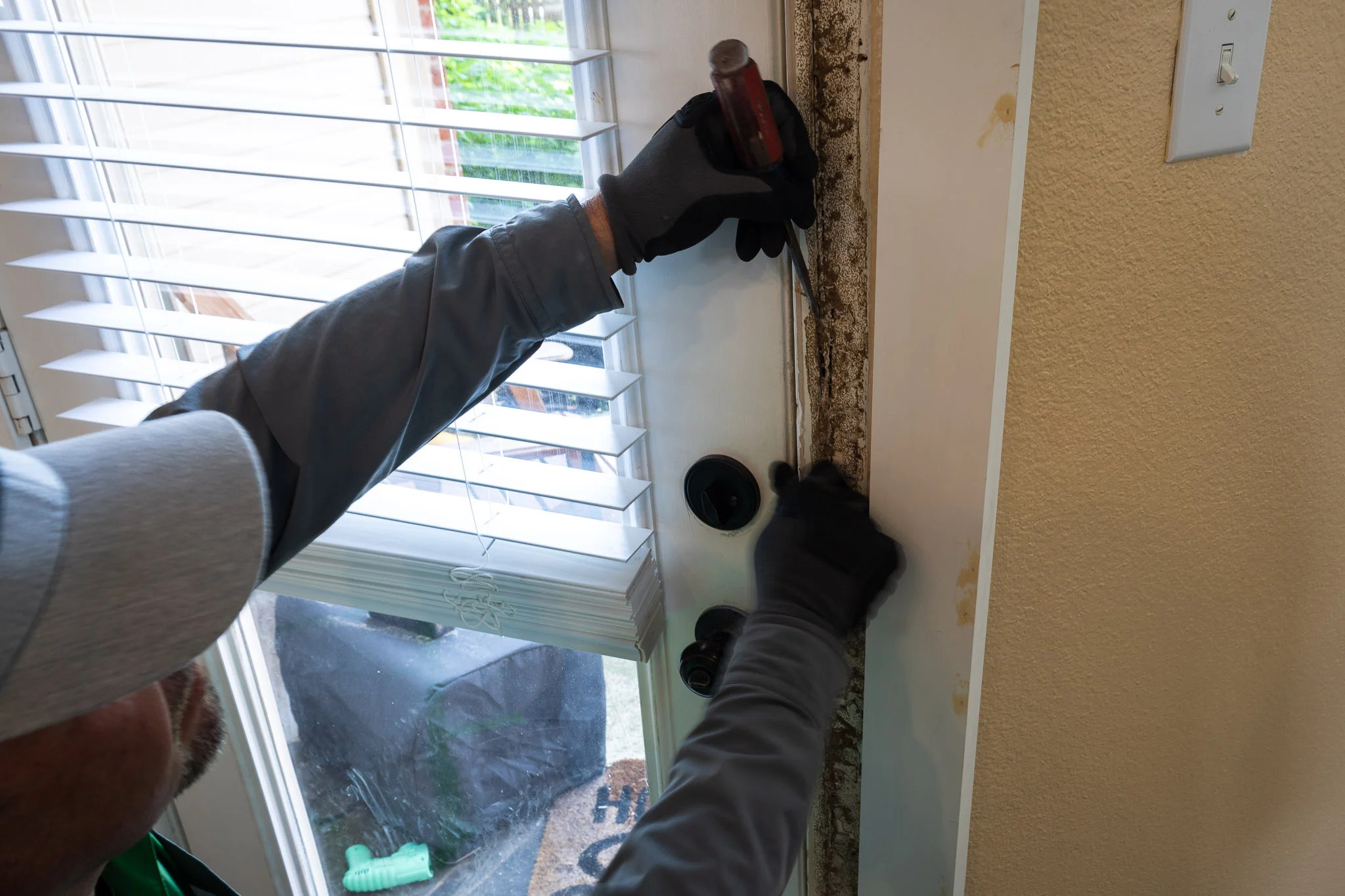
Interior Treatment (If Needed)
Interior work is rarely needed, since proper exterior treatment stops most pests before they become an indoor problem. When something does get in, the interior visit is covered by your plan at no extra charge, whether that is baseboards, entry points, the garage or a detached structure.
Customer Reviews
Real Reviews from Cary Homeowners
Dakari was very polite & professional in understanding our pest concerns and addressed them very quickly. Thank you for the service you provided us today.
Verified Google ReviewThey sprayed for mosquitoes and my garage for spiders and such. Quick service and nice workers!
Verified Google ReviewJordan did an excellent job I’m happy that we chose your company
Verified Google ReviewAmazing service - informative, prompt, efficient and kind! Awesome company!
Verified Google ReviewJoseph was informative, professional and customer focused. He gave us suggestions on what we could do to ensure the best quality for our service.
Verified Google ReviewDerek did a great job. Friendly, explained everything he was doing, efficient for a quick completion.
Verified Google ReviewDakari was so kind and patient and really listened to my concerns. I named a few different pest concerns and he never seemed annoyed or like he didn't want to do it. And that's saying a lot because it was very hot outside. I appreciate the kindness and the great job!
Verified Google ReviewDakari was great! Kind efficient and helpful! He even picked up a dead bug we found for me along the way. Great experience!
Verified Google ReviewSolid experience all around. Salesman took time to explain all the offerings and we found one that fit. Technician was on time and answered any and all questions. They also did a great job and followed any requests I had for the service.
Verified Google ReviewDerek came out and sprayed for bugs. He was professional and courteous. He went above and beyond.
Verified Google ReviewScott did a great job- he was so helpful and informative and really made me feel he is experienced. Thanks!
Verified Google ReviewYear-Round Pest Pressure
Why Pest Control in Cary Is a Year-Round Commitment
Cary was shaped by deliberate planning. Kildaire Farms, a 967-acre development on the old Pine State Dairy Farm, was North Carolina’s first Planned Unit Development, and its homeowners association records that 22 more PUDs were approved in Cary between 1980 and 1992. The result looks more like a park than a suburb, but that same tree cover and pond-heavy stormwater design gives pests exactly what they need. Cary now counts more than 100 miles of paved greenway, all of it habitat, not just amenity.
Geography compounds the problem. The state’s 2014 historic resources survey of Cary notes that early roads and railroads followed the level, high ground between the tributaries of Crabtree Creek, Swift Creek and Walnut Creek, and the county’s 2019 hazard plan shows over 7 percent of Cary in FEMA’s mapped 100-year floodplain. Low ground that stays wet after a storm is where floodwater mosquitoes hatch, while the Asian tiger mosquito breeds in the water left in gutters, saucers and toys.
6 Pest Pressures in Cary
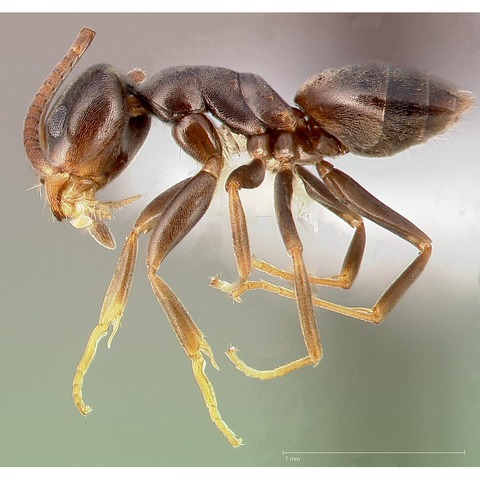
Ants
Odorous house ants and pavement ants trail into Cary kitchens from landscaped areas throughout the active season, flooding indoors through foundation gaps after heavy rain saturates the red clay soil. Carpenter ants nest in moisture-damaged wood on the mature, wooded lots common across Kildaire Farms and MacGregor Downs. Fire ants establish on freshly graded lots in West Cary. House and pavement ants are covered on every Vinx plan, with fire ants on Plus and Platinum; carpenter ants are inspected and quoted separately.
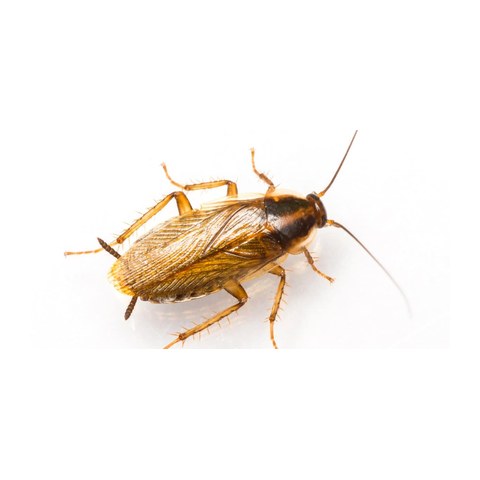
Cockroaches
American and smoky brown roaches work in from damp crawl spaces and mulch beds around Cary foundations, heaviest in the older housing stock near the downtown Historic District. German cockroaches spread indoors through shared walls in apartments and townhomes and are handled through our specialty gel-bait program. All outdoor roach species are covered on every Vinx plan.
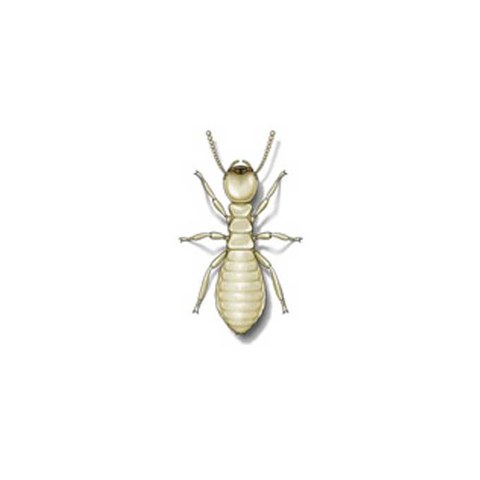
Termites
Eastern subterranean termites are active across Cary and the whole of Wake County. NC State Extension estimates a colony of roughly 60,000 can eat a foot of 2x4 lumber in about five months. The invasive Formosan termite has turned up in North Carolina only in Brunswick and Rutherford counties, so Cary’s problem is the native species. Standard homeowners policies typically exclude termite damage, which is why Termite TotalDefense with Sentricon bait stations is available as a separate program alongside any plan. Risk concentrates in the oldest downtown housing and on lots where a retention pond keeps the surrounding soil saturated well past a normal rain event.
Mosquitoes
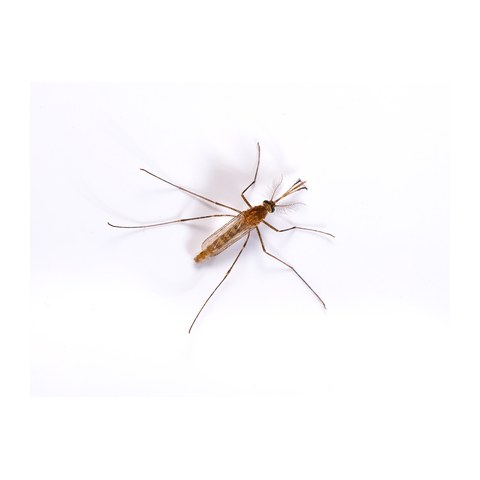
The Asian tiger mosquito breeds in the yard itself, in clogged gutters, flowerpot saucers and birdbaths, not in Jordan Lake. Pond edges and shaded greenway buffers give adults a place to rest during the day. Platinum covers mosquitoes with monthly visits from April through November, aimed at that resting vegetation.

Rodents
Roof rats use the mature tree canopy of established Cary neighborhoods to reach rooflines, while Norway rats burrow along foundations and displace from active West Cary construction. Homes bordering Umstead State Park and the RTP wooded buffers see added pressure as mice and rats move toward the nearest yard each fall. Rodent control is a separate service from the pest plans, priced after a free inspection.
Spiders & Other Pests
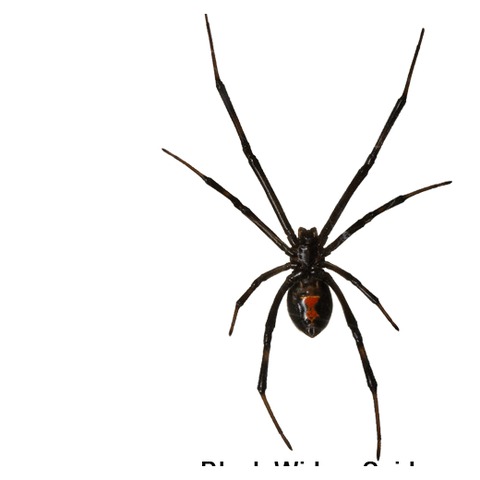
Black widows in garages and undisturbed storage, wolf spiders from wooded lot adjacency, and orb weavers at exterior lighting each fall, amplified by Cary’s tree preservation and greenway insect base. Wasps and hornets nest in eaves spring through fall, and occasional invaders (silverfish, earwigs, centipedes) move in during the mild winters. All covered on every plan.
The soil itself works against homeowners too. Cary’s Piedmont clay holds rainwater far longer than sandy or loamy soil, keeping crawl spaces damp and extending the season for the Eastern subterranean termite, a species NC State Extension warns often goes unnoticed for years until serious damage has occurred.
Cary’s winters help less than most homeowners assume. Average lows sit near 34°F in December and 32°F in January, and the year averages about 65 nights at or below freezing. That’s not a hard freeze that knocks back an ant colony, it’s just cold enough to send spiders, stink bugs, and overwintering ants looking for a warm crawl space or attic to wait it out in.
Cary has been a commuter town far longer than most people assume, and the pest consequences are cumulative. The Town’s historic resources survey dates the turn to 1917, when a new paved road called the Western Wake Highway — now Western Boulevard — let people live in Cary and work in Raleigh. The town had roughly 700 residents at the time. Every decade since has added another ring of housing, which is why Cary has no single typical house and no single typical pest problem.
Year-Round Awareness
Cary NC Pest Activity: What to Expect Every Season
| Season | Pest Activity in Cary NC |
|---|---|
| Spring March–May |
Termite swarmers emerge as Wake County clay soil warms; odorous house ants establish new colonies; mosquitoes emerge as spring rain refills gutters and saucers around Cary homes, and Platinum mosquito service begins in April; stinging insects begin nest building on eaves and soffits. |
| Summer June–August |
Peak pressure across all species; mosquito pressure tops out along Cary’s greenway edges; cockroaches surge in older crawl spaces near downtown; the hottest weeks drive spiders and roaches indoors seeking cooler conditions. |
| Fall September–November |
Spiders, rodents, and cockroaches move indoors seeking warmth, heaviest near the Umstead and RTP wooded buffers; stinging insects become aggressive before colony die-off; mosquitoes stay active through October, helped by September, the wettest month at Raleigh-Durham at 5.15 inches on average; termites keep feeding in heated crawl spaces. |
| Winter December–February |
Rodents and cockroaches remain active indoors in heated structures; subterranean termites continue foraging in heated crawl spaces; Wake County clay soil retains moisture keeping termite conditions active; indoor pest pressure continues year-round. |
Pest Pressure by Area
Pest Pressure Across Cary
Downtown Cary & the Cary Historic District: ROACHES, MOISTURE PESTS & AGING FOUNDATIONS
The Cary Historic District’s older homes, along with the streets around the old Page-Walker Hotel, include some of the town’s oldest housing stock, much of it with crawl spaces and foundation grades that predate current building code. Moisture collects underneath these homes more easily, a major driver of American cockroach and moisture-pest activity downtown.
Kildaire Farms, MacGregor Downs & Lochmere: MATURE LANDSCAPING & TERMITE PRESSURE
North Carolina’s first Planned Unit Development, built out through the 1970s–90s on former dairy land, now carries decades of mature tree canopy and established mulch beds. Good for curb appeal, but it also means more shaded, moisture-retentive ground cover and mature root systems for subterranean termites to colonize undetected for years. Carpenter ants are a frequent call here too.
Preston & Amberly: RETENTION PONDS & MOSQUITO PRESSURE
These West Cary communities are laid out around stormwater ponds and landscaped common ground. The ponds matter less than the water left standing near homes in gutters, saucers and low spots, which keeps mosquito pressure steady from spring through fall.
Green Level & West Cary: NEW CONSTRUCTION, DISTURBED SOIL & ANTS
Far western Cary, around the Green Level Historic District (National Register, 2001) and out toward the Chatham County line, is still transitioning from agricultural land to new subdivisions. Freshly graded, disturbed soil is close to ideal for new ant mound establishment and gives subterranean termites an easy path to a slab that hasn’t fully cured. A liquid soil treatment only works as a continuous barrier, NC State Extension notes, so a house finished in the past couple of years is worth inspecting rather than assuming.
North Cary & the RTP Corridor: WOODED EDGES & RODENT PRESSURE
Neighborhoods bordering William B. Umstead State Park and the wooded buffers near Research Triangle Park sit right against large tracts of protected, undisturbed woods. That proximity brings more rodent and occasional-invader activity as wildlife moves between wooded land and the nearest yard, particularly as fall temperatures drop and mice and rats look for a way indoors.
Kids & Pets
Treating Around Your Whole Family: Including the Furry Members
Every product we use is EPA-registered and applied strictly at labeled rates by licensed North Carolina pest control technicians. Your technician tells you exactly when kids and pets can go back into treated areas.

EPA-Registered Products Only
All products we apply are EPA-registered and used strictly per label requirements. Our licensed technicians are trained to apply the right product in the right place at the right rate, every time.
Dry Time Before Re-Entry
Exterior spray treatments dry in 30–60 minutes. Keep children and pets off treated surfaces until they are dry. Your technician confirms the all-clear before leaving.
Interior Treatment On Request
We treat only what’s needed, where it’s needed. Gel baits and crack-and-crevice applications keep products away from areas pets and children frequent most.
Botanical Options Available
Ask your technician about our plant-derived treatment options. We offer botanical alternatives for households that prefer a more natural approach.
Have a concern about products used near your pets or children? Call (984) 600-8469 and we’ll walk you through exactly what we use and when treated areas can be used again.
Cary NC Pest Control Services
Pest Control Services in Cary

Termite Control Cary
Bait systems & liquid treatment

Mosquito Control Cary
Monthly barrier treatments

Ant Control Cary
Household ants & others

Spider Control Cary
All spider species covered

Cockroach Control Cary
American & German roaches

Rodent Control Cary
Rats, mice & exclusion

Bed Bug Treatment Cary
Heat & liquid treatments
Exterminator Cary
Same-day local service

Tick & Flea Control Cary
Yard & pet protection
Common Questions
Pest Control in Cary, NC: Frequently Asked Questions
Pest control runs on the HomeGuard, Plus and Platinum plans, priced by home size and visit frequency rather than by pest. In Cary a lot backing a retention pond or greenway buffer usually warrants the 6- or 9-visit plans. Call (984) 600-8469 for a quote.
Ants and termites all year, mosquitoes from spring into autumn around the retention ponds, cockroaches in summer, and rodents moving indoors from October. More than 100 miles of greenway and the creek-bottom neighborhoods along Crabtree, Swift and Walnut Creeks add mosquito and tick pressure wherever Cary yards meet the woods.
Yes. Eastern subterranean termites are active throughout Cary, standard homeowners policies typically exclude the damage, and the oldest downtown housing has had the longest possible window for a colony to establish. Termite TotalDefense adds Sentricon bait stations to any plan.
All products are EPA-registered and applied per label by licensed technicians. Keep kids and pets off treated areas until they’re dry, usually 30–60 minutes; your technician will tell you when. Botanical, plant-derived options are also available on request.
Quarterly suits most Cary homes. Properties beside a retention pond, a greenway corridor or Umstead State Park usually do better on 6 or 9 visits, because preserved green space produces pressure continuously rather than in bursts.
Call (984) 600-8469.
The same stormwater ponds and more than 100 miles of paved greenway that make Cary attractive to live in also create wooded corridors that push rodents and ticks toward the nearest yard. The ponds are rarely the main mosquito source: the Asian tiger mosquito breeds in small pockets of standing water close to home, so water in a Cary yard’s own gutters and saucers matters more, and tree-lined greenway buffers give ants, spiders, and rodents a direct path into adjacent subdivisions.
Yes. On freshly graded farmland, pests reach a new house through the gaps around new utility lines before anything else. We recommend an inspection within the first 90 days of move-in for any home built in Cary’s western growth corridor near Green Level.
A full exterior walk-around checking entry points, moisture conditions, foundation grade, and any visible pest activity, plus an interior check of common problem areas like under sinks, behind appliances, and crawl space access. In postwar neighborhoods and in older Kildaire Farms homes that includes a look inside the crawl space. You get a straight report of anything we find, inspections are free with no obligation.
Yes. Vinx services all of Cary and the surrounding Wake County area, including downtown and the Historic District, Kildaire Farms, MacGregor Downs, Lochmere, Preston, Amberly, Green Level, and the neighborhoods bordering Umstead State Park and the RTP corridor.
Yes. Vinx Pest Control is licensed and registered under the North Carolina Department of Agriculture’s Structural Pest Control program and fully insured to operate in NC. Technicians pass background checks and complete ongoing training in pest biology and label-directed treatment application.
Service Coverage
Pest Control Across Cary & Western Wake County
Serving every neighborhood in and around Cary