




Flying ants in the house look alarming, especially when dozens show up on a window at once. Most of the time they're a short, once-a-year event. Sometimes they're a sign of a nest inside the walls. And now and then they aren't ants at all but termites, which is a different problem entirely. This guide covers what flying ants are, why they appear, how to tell them from termites in a few seconds, which ants swarm when in the Carolinas and Virginia, and what to actually do. It's based on extension guidance from Clemson, NC State, Virginia Tech, Kentucky, Texas A&M and the University of Florida.
Flying ants are winged male and female ants leaving a mature colony to mate. Outdoors, especially on a warm day after rain, they're normal. Indoors, they mean a nest is inside, under or very close to the house. Texas A&M says that in most cases, if worker ants haven't been a problem inside, an indoor swarm "should not be a cause for concern," and a vacuum is often all you need.
First, make sure they're ants. Ants have elbowed antennae, a pinched waist and front wings longer than the back ones. Termite swarmers have straight antennae, no waist and four equal wings, and the University of Kentucky says finding them indoors "almost always indicates an infestation warranting treatment."

What Are Flying Ants?
Flying ants are the colony's future kings and queens. Most ants you see are wingless workers, all of them female. Once a colony is old enough, it raises winged males and females, called swarmers or alates, whose only job is to fly out, mate and start new colonies. Clemson notes this happens "normally after a colony is several years old," and Iowa State says an established colony "may produce hundreds of swarmers."
What happens next is brief. The males die soon after mating. Each mated queen lands, tears off her wings and digs a small chamber to start a colony. A fire ant queen raises her first workers on the energy stored in her now-useless wing muscles, according to Clemson.
Very few make it. Clemson says "nearly 99.9 %" of fire ant females die before they can start a nest, eaten by predators or stranded in pools and ponds. A Florida field study by Tschinkel and King found only 5 of 980 newly founded queen nests still alive after 120 days. So the swarm on your window is almost never the start of a new colony in your house. It's a sign of a colony that already exists somewhere nearby.
Why Flying Ants Suddenly Appear
Swarms are timed by the weather, and all the colonies of one species in an area tend to fly on the same day. That's why you can go months without seeing a winged ant and then find them everywhere one afternoon. Texas A&M says swarms usually happen "on a still, warm day," triggered by temperature, wind speed, humidity and day length.
Rain is the big one in the South. Clemson says fire ants mate when it's between 70 and 95°F, "usually within 24 hours of a rain," with high humidity and calm wind, and that flights can happen any time of year but peak in spring and fall. A swarm usually lasts one or a few days, and most species fly only once to a few times a year.

Flying Ant or Termite? How to Tell in Ten Seconds
This is the question that matters most, because the two swarm at the same time of year and they mean very different things. Ants and termites also look alike at a glance, and a wrong ID can cost money. One commenter on a popular YouTube video, who says he gave the homeowner a second quote, described a large company trying to sell her a termite job when the insects were actually carpenter ants.
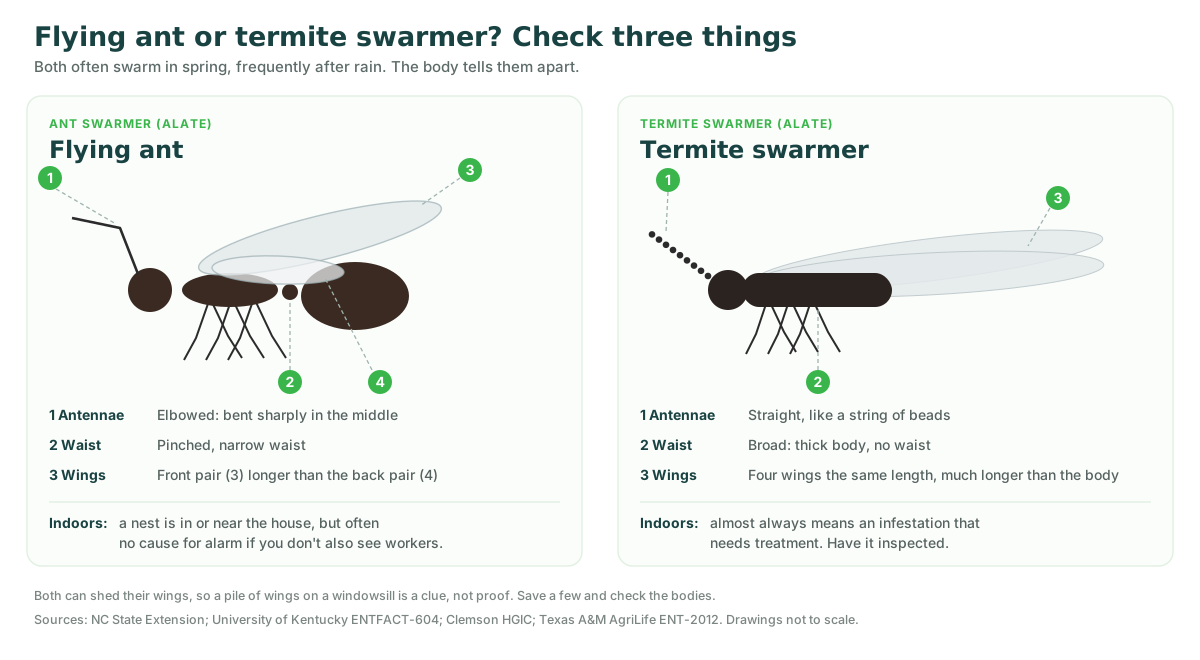
| Flying ant | Termite swarmer | |
|---|---|---|
| Antennae | Elbowed, bent sharply in the middle | Straight and beaded |
| Waist | Pinched, narrow | Broad; the body is the same width all the way along |
| Wings | Front pair longer than the hind pair | Four wings of about the same size and shape |
| Indoors, it means | A nest in, under or near the house; often minor if you don't also see workers | "Almost always" an infestation that needs treatment (University of Kentucky) |
The ID points come straight from NC State and the University of Kentucky. One popular shortcut is less reliable: a pile of shed wings on a windowsill is a strong hint of termites, but Texas A&M notes that "both ants and termites can lose their wings shortly after emergence." Mated ant queens tear their wings off too. If you only find wings, save a few whole insects next time and check the bodies.
Timing helps a little. In South Carolina, Clemson says native subterranean termites usually swarm "in the early spring, often in the afternoon," while Formosan termites swarm "from mid-May to July, often in the evening," and are drawn to lights, mostly along the coast from Charleston south to Beaufort. NC State notes that in North Carolina, eastern subterranean termites can swarm at "nearly any time of the year" given the right conditions. If you think you have termites, see what to do about flying termites and our guide to insects mistaken for termites.
Which Ants Swarm, and When, in the Carolinas and Virginia
Knowing which ant you have tells you where the nest probably is. Here's what the extension services say about the species most likely to show up around homes here.
| Ant | When it swarms | What a swarm near the house usually means |
|---|---|---|
| Red imported fire ant | Any time of year, peaking in spring and fall, usually within 24 hours of rain (Clemson) | Indoors, it "usually" means an outdoor mound next to the foundation (Texas A&M) |
| Black carpenter ant | Late spring or early summer (Clemson); May through July in Virginia (Virginia Tech) | Indoors, "an indication of a nest in or under the house" (NC State) |
| Pavement ant | Usually June (NC State), but can swarm in winter from nests under heated slabs (Penn State) | A nest under a slab, sidewalk or foundation |
| Acrobat ant | When colonies are mature and conditions are right (Virginia Tech) | A nest "in or close by the house," often in moisture-damaged wood (Virginia Tech) |
| Asian needle ant | Early March through September, mostly summer (Mississippi State) | A nest close by; the winged females can sting (Mississippi State) |
| Little black ant | June and August (Mississippi Entomological Museum) | A colony nearby |
| Argentine and odorous house ants | Rarely. Argentine ant queens don't make mating flights (UF), and odorous house ants mostly mate inside the nest (Utah State) | Swarms are unlikely; these spread by budding off new nests instead |
For more on the species themselves, see our guides to fire ants, carpenter ants, Asian needle ants and Argentine ants.
What Flying Ants in the House Mean
The extension services agree on the basic point: winged ants inside mean a colony is close. The University of Kentucky puts it this way: "When a swarm of ants emerges indoors, it's an indication that a nest is present." Kentucky also says the chance of those swarmers starting a new colony inside a building is low. How worried to be depends on two things.
How many you see. Iowa State's rule of thumb is a useful one. Hundreds indoors means the colony is "almost certainly in the house somewhere – in the walls, or rotten wood, or under the slab." Fewer than 10 are "likely" strays from an outdoor colony, so keep an eye out for other ant activity.
Whether you also see workers. Texas A&M says that if worker ants haven't been a problem inside, an indoor swarm usually isn't a cause for concern, and if you see no other sign of ants, "no further control may be needed."
Two situations deserve more attention:
- Large black ants with wings indoors, especially in spring. Those are often carpenter ants, and NC State says swarmers indoors are "an indication of a nest in or under the house." A colony doesn't produce swarmers until it's established: Virginia Tech says that can take "3-6 years or longer." Virginia Tech also says that carpenter ants (wingless workers included) active indoors in late winter or early spring, February or March, probably come from a nest inside.
- Swarms in winter. Most outdoor colonies wait for warm weather, although Clemson notes fire ants can fly on suitable days any time of year. Penn State says pavement ants can swarm "any time of the year in heated structures," including late fall into February, which points to a nest under a warm slab.
Do Flying Ants Bite or Sting?
Mostly no, but it depends on the species. Fire ant males have "no stinger," according to LSU AgCenter. Carpenter ants can bite if you handle them or disturb the nest (Kentucky), but they don't sting (Ohio State and UF). Odorous house ants "cannot sting" (Utah State), and Argentine ants don't sting or bite people (UF). One species worth knowing is the Asian needle ant, now spreading in the Carolinas: Mississippi State notes its winged females "also have a sting." If you're unsure what you have, sweep or vacuum swarmers rather than picking them up.
How to Get Rid of Flying Ants
The swarmers themselves are easy. The colony that produced them is the real target, and spraying the ones you see won't reach it. Kentucky's extension says: "The mistake most people make when attempting to control ants is only spraying the ones they see." NC State, writing about carpenter ants, adds that spraying them indoors "only serves to repel and send them elsewhere."
- Vacuum the swarmers. Texas A&M says that because swarms last only a day or a few and happen once to a few times a year, "a vacuum cleaner, or one-time use of an indoor flying insect spray, is often all that is needed."
- Save a few for ID. Put several whole insects in a sealed bag or jar. If there's any chance they're termites, a pest professional or your county extension office can tell you for certain.
- Find where they're coming from. Watch where the swarm is thickest: a window frame, a crack near the baseboard, a bathroom wall, a light fixture. Then look for worker ants trailing to the same spot over the next few days.
- Check for carpenter ant signs. NC State describes the debris they push out of nests as "similar in appearance to pencil shavings," mixed with insect parts. Ohio State says an active colony can make "a distinct, dry rustling sound" in a wall. Penn State suggests checking the basement, attic, garage and outside walls between 10 p.m. and 2 a.m. from May through July, when the workers are most active.
- Use bait for the workers, not spray. Kentucky explains that ants carry bait back to the nest and feed it to the queen. You'll often see more ants at the bait at first; that's the point, so "DO NOT SPRAY THEM." For carpenter ants, NC State says complete eradication can take one to two weeks, especially if the colony is large. For fire ants, Clemson recommends a two-step method (broadcast bait, then treat problem mounds seven to ten days later), and says fire ant baits cut populations by 85 to 95 percent in most research trials.
- Fix the moisture and seal the gaps. NC State says carpenter ants prefer wood with a moisture content of 15% or higher, so leaks, clogged gutters and damp crawl spaces invite them. Kentucky also recommends sealing cracks, reducing mulch around the house and pruning overgrown trees.
The pattern in the comments on popular carpenter ant and swarmer videos is that people find the nest late, in wood they weren't looking at. One homeowner found a nest only after pulling off fascia boards, with the ants "tunneling in the long wooden beam that forms the peak" of the roof. Another sees carpenter ants every summer and suspects a tree stump beside the house. Both fit what Clemson says: carpenter ants are "primarily attracted to moist wood," and the key to control is finding the main nest and as many satellite nests as possible.
When to Call a Professional
A one-time swarm with no worker ants afterward usually needs nothing more than a vacuum. Call a professional if:
- You can't rule out termites, or you find piles of wings indoors with no bodies to check
- The winged insects are large and black, or you find sawdust-like debris, which suggests carpenter ants
- Swarmers keep appearing indoors, or appear in winter
- Worker ants keep coming back after you've baited
- You've found ants in wet or damaged wood, which may also mean a leak that needs repair
Our ant control service identifies the species, finds the nest and treats it with the method that species responds to, and our termite control team can inspect if the swarmers turn out to be termites. If ants keep coming back after treatment, see why ant problems come back.
The short version
- Flying ants are winged males and queens leaving a mature colony to mate, usually on a warm, calm day, often after rain.
- Check that they're ants: elbowed antennae, a pinched waist and longer front wings. Termites have straight antennae, no waist and four equal wings.
- Indoors, they mean a nest is close. A few with no worker ants is usually minor; hundreds, or swarms in winter, point to a nest inside.
- Large black flying ants indoors may be carpenter ants, which means an established colony in or under the house.
- Vacuum the swarmers, bait the workers, and fix moisture. Spraying only the ants you see won't reach the colony.
Frequently Asked Questions
It means an ant colony is nesting inside, under or very close to the house, and it's old enough to produce winged males and queens. The University of Kentucky says an indoor swarm indicates a nest is present, but the chance of the swarmers starting a new colony indoors is low. If you don't also see worker ants, Texas A&M says it usually isn't a cause for concern.
Ant colonies release their winged males and queens on a few warm, humid, calm days a year, often right after rain, and every colony of the same species in the area tends to fly at once. That's why they seem to appear out of nowhere. A swarm usually lasts one to a few days.
No, but they're easy to confuse. Flying ants have elbowed antennae, a pinched waist and front wings longer than the back wings. Termite swarmers have straight, beaded antennae, a broad body with no waist and four wings of the same length. Termite swarmers indoors almost always mean an infestation that needs treatment, so check before you vacuum them all up.
Usually not, if it's a one-time swarm and you don't see worker ants afterward. Pay more attention if you see hundreds indoors, if they appear in winter, or if they're large black ants, which may be carpenter ants nesting in the house. And rule out termites first.
Not always, but large black winged ants indoors in spring are often carpenter ants. NC State says carpenter ant swarmers indoors indicate a nest in or under the house, and Virginia Tech says colonies take 3 to 6 years or longer before producing swarmers, so it points to an established colony. Look for sawdust-like debris and wet or damaged wood.
Usually just a day or a few days. Texas A&M says swarming typically lasts only one or a few days and happens once to a few times a year. The males die soon after mating, and mated queens shed their wings and look for a place to nest.
Most don't. Fire ant males have no stinger, carpenter ants can bite if handled but don't sting, odorous house ants can't sting, and Argentine ants don't sting or bite people. One to watch for is the Asian needle ant, whose winged females can sting.
A vacuum is often all you need for the swarmers themselves. Spraying kills only the ants it hits and doesn't reach the colony. To stop future swarms, find the nest and use an ant bait the workers carry back to the queen, and fix any moisture problems in the house.
Many ants, fire ants included, time their mating flights to warm, humid, calm weather, and Clemson says fire ant flights usually happen within 24 hours of a rain.
Some species are. Iowa State notes that some ants are attracted to lights at night, which can explain a few swarmers indoors from an outdoor colony. Termite swarmers are strongly drawn to light, which is why they often gather at windows and light fixtures.
Most outdoor colonies wait for warm weather, though Clemson notes fire ants can fly on suitable days any time of year. Ants nesting under a heated building can swarm in the cold months: Penn State says pavement ants can swarm any time of year in heated structures, including from late fall into February. A winter swarm indoors points to a nest under the slab or inside the structure.
The swarm will, usually within a day or a few. The colony that produced them won't, and it may swarm again next year. If you also see worker ants or signs of carpenter ants, find and treat the nest.
Sources: Clemson Cooperative Extension, "Fire Ant Management in the Home Lawn (HGIC 2501)"; Clemson Cooperative Extension, "Carpenter Ants (HGIC 2406)"; Clemson Cooperative Extension, "Ant Control Indoors (HGIC 2428)"; Clemson Cooperative Extension, 2022, "Formosan Termites Increase Distribution in SC"; NC State Extension, "Biology and Control of Carpenter Ants"; NC State Extension, 2025, "Biology & Behavior of Eastern Subterranean Termites"; NC State Extension, "Pavement Ant"; Virginia Cooperative Extension, "Carpenter Ants (ENTO-485NP)"; Virginia Cooperative Extension, "Acrobat Ant (ENTO-405NP)"; University of Kentucky, "Ant Control for Householders (ENTFACT-619)"; University of Kentucky, "Termites (ENTFACT-604)"; University of Kentucky, "Carpenter Ants (ENTFACT-603)"; Texas A&M AgriLife Extension, "Swarming Insects Indoors (ENT-2012)"; Iowa State University Extension, "Ant Swarming"; Penn State Extension, "Pavement Ant"; Penn State Extension, "Carpenter Ants"; Ohio State University Extension, "Carpenter Ants (HYG-2063)"; UF/IFAS, "Argentine Ant (EENY-767)"; UF/IFAS, "Florida Carpenter Ant (EENY-272)"; Utah State University Extension, "Odorous House Ants"; LSU AgCenter, "Red Imported Fire Ant"; Mississippi State University Extension, "Pest Snapshot: Asian Needle Ant (P4142)"; N.C. Cooperative Extension, Clay County, 2025, "Residents Urged to Watch for Invasive Asian Needle Ants"; Clemson Cooperative Extension, "Asian Needle Ant"; Mississippi Entomological Museum, "Monomorium minimum"; W. R. Tschinkel and J. R. King, Functional Ecology, 2017, "Ant community and habitat limit colony establishment by the fire ant"; homeowner accounts from YouTube video comments.
Photo credits: New York State IPM Program at Cornell University, CC BY 2.0; LordOfAnts, CC0; via Wikimedia Commons.