




It is a common summer story. Someone is sitting on the porch, a big beetle hits them in the dark, and a minute later they feel something sharp on their neck or inside their shirt. So did the June bug bite them? Almost certainly not. But the feeling is real, and there are good reasons for it.
No. June bugs do not bite or sting people, and they carry no venom. Extension entomologists at NC State and the University of Minnesota both describe them as not dangerous to people. What people feel as a "bite" is nearly always the beetle's hooked, spiny legs gripping skin, often when it gets trapped in clothing or hair.
If you got a painful welt that swelled for a day or two, look for a different culprit. A buzzing green June beetle is easy to mistake for a bee or wasp, and those do sting.
Which "June Bug" Do You Have?
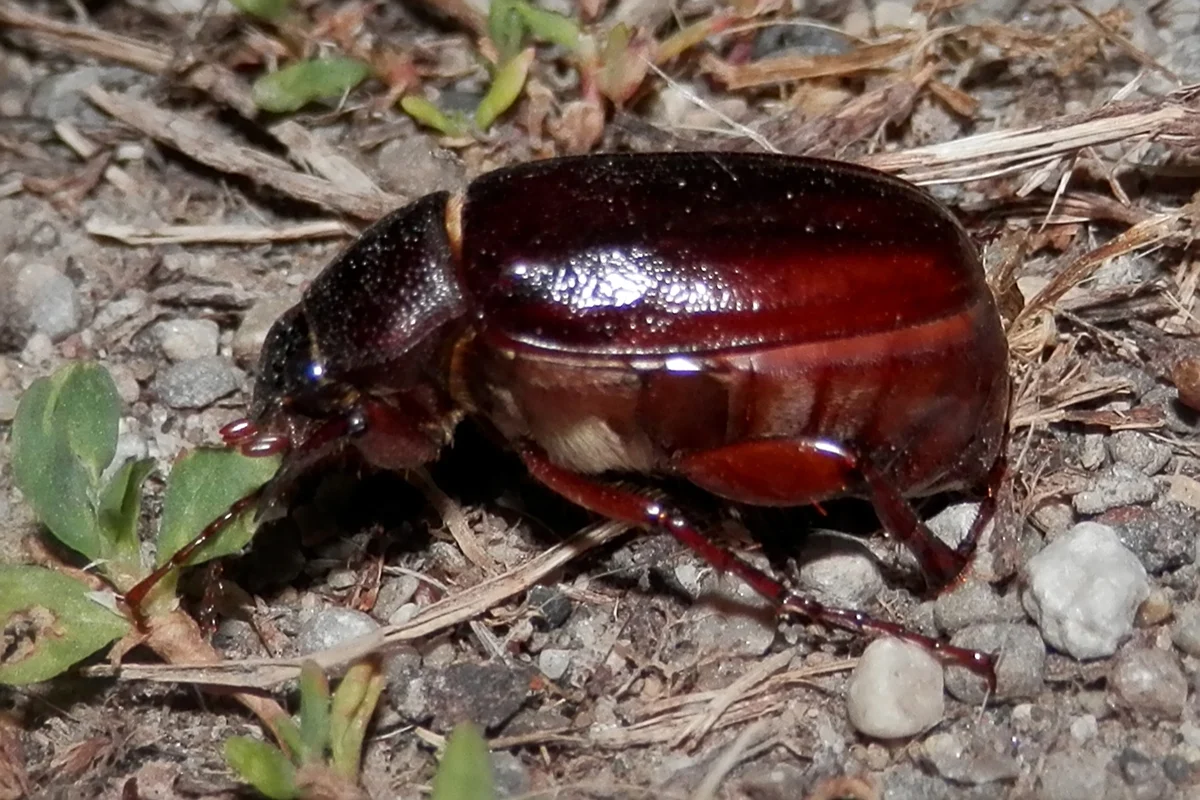
"June bug" is not one insect. In the Carolinas and Virginia, people use the name for at least three different beetles. Telling them apart explains most of what happens when one lands on you.
| Beetle | What it looks like | When you see it | Why it bothers people |
|---|---|---|---|
| Brown May/June beetle (Phyllophaga, more than 100 species) | Oval, shiny, reddish-brown to almost black, about 1/2 to 1 inch | Late spring into early summer, at night | Crashes into porch lights and window screens, then clings to screens and clothing with its legs |
| Green June beetle (Cotinis nitida) | Velvety or metallic green with yellow-orange edges, 3/4 to 1 inch | June and July, during the day | Loud buzz like a bumble bee. Flies fast and low over lawns |
| Japanese beetle (Popillia japonica) | Smaller, about 1/2 inch, shiny green head with copper wing covers and white tufts of hair along the sides | Early to late summer, during the day | Turns up in big groups on roses, grapes and other plants. Often called a June bug, but a separate pest |
In North Carolina, "junebug" has long meant the green one. NCpedia, the state's online encyclopedia, describes it as a metallic green beetle with yellow sides, a bit under an inch long, that shows up in June and July, eats pollen, ripening fruit and leaves, and makes a lot of noise when it flies. It also records that children once tied a thread to a green June beetle's leg and flew it like a living kite. That is not something you would do with an insect that bites.

Why It Can Feel Like a June Bug Bit You
None of these beetles has a stinger, and none feeds on blood. Adults chew plant material: leaves for the brown beetles, soft ripe fruit and pollen for the green ones. So where does the sharp feeling come from? Four things, and in the owner reports we read, the first one covers most cases.
- The legs grip. June beetle legs end in small hooked claws and are lined with stiff spines. NC State's Lee County Extension office notes that the brown beetles cling to window screens hard. Skin and fabric are no different. When a beetle that has landed on you starts climbing, or when you try to pull it off, those claws prick and catch. It feels like a pinch.
- It gets trapped. A June bug that falls down a collar or into a shirt is pressed against your skin and scrambles to get out. Hair works the same way. A trapped, struggling beetle digs in with every leg at once, which is why so many reports describe a "bite" on the back, chest or neck.
- You squeezed it. A beetle crushed against skin, under a hand or a foot, can scratch. A heavy, hard-shelled insect pressed hard enough can leave a small scrape or a pinprick mark.
- It wasn't a June bug. NC State's Plant Disease and Insect Clinic points out that the green June beetle's fast, buzzing flight can cause "momentary terror" for people who are afraid of stinging insects, because it resembles a bee or wasp. The reverse happens too. If a bee or wasp stings you while June beetles are flying around, it is easy to blame the beetle you can see.
What People Actually Report
We read through owner accounts on Quora and the Reddit threads Google surfaces for this question (Reddit itself blocks automated reading, so we worked from Google's excerpts of those threads). Nine first-hand reports described a June bug "bite." Here is what they had in common.
| What people described | Reports | Most likely explanation |
|---|---|---|
| Felt a sharp nip on the back, chest, arm or foot, then found a June beetle in the shirt, on the skin or underfoot | 6 | Claws gripping, a trapped beetle, or a beetle pressed against skin. In one case the person had flipped the beetle onto a bare foot and hit it with a broom, and found a tiny hole in a toe afterward |
| Was nipped while picking up a white grub | 1 | The grubs chew roots and have real jaws. Handled roughly, a large grub can pinch |
| Pain "like a bee sting" with swelling that lasted two days | 1 | Almost certainly a stinging insect, not a beetle. June beetles have no venom to cause swelling |
| "Chewed on" by a large striped beetle in a western state | 1 | A ten-lined June beetle, a big western relative that is not part of our Carolinas and Virginia mix |
Several more people mentioned beetles flying into their hair. None of them described a bite. And in every Reddit thread where someone posted a photo asking whether a June bug had bitten them, the replies said the same thing: they don't bite, but those legs are spiky and they hold on.
Why Do June Bugs Fly at You?
"Why do June bugs attack me" is one of the most common questions people ask about these beetles. They are not attacking. Two different things are going on, depending on the time of day.
At night: they are stuck on the light, not chasing you
Brown June beetles fly at night and end up at porch lights, and that pulls them into the exact spot where people sit. For a long time the explanation was simply that insects are "attracted" to light. A 2024 study in Nature Communications by researchers at Imperial College London and partner universities filmed night-flying insects around lights in high-speed 3D. They found that the insects were not steering toward the bulb at all. A flying insect keeps its back turned toward the brightest part of the sky, which helps it stay level. Near a bright bulb, that instinct tilts it toward the light, and it ends up circling, stalling or tumbling in a way it can't escape.
That is why a June bug seems to come straight at your head on the porch. It is losing control near the light, and you happen to be next to it. These are heavy, clumsy flyers to begin with, so a beetle in that state hits whatever is in the way: a screen, the siding, or your face.
By day: green June beetles are looking for a mate
If big green beetles keep buzzing low over your lawn in the morning, the reason is mating. Penn State Extension describes the pattern: female green June beetles fly just over the grass early in the morning and release a scent that draws males, and the males then fly mid- to late morning searching for them. A male cruising at knee-to-waist height and zig-zagging over the turf will run into a person standing in the yard. It isn't targeting you. You are just in its flight path.
Are June Bugs Dangerous, Poisonous or Harmful?
To people: no. They don't bite, sting, carry venom or spread disease. The NC State Lee County office puts it plainly: May and June beetles "are not dangerous to people." It is safe to touch one or brush it off. Expect it to grip, and peel it off gently rather than yanking it so the claws don't catch.
To pets: June bugs are not known to be poisonous. Dogs and cats chase them, and most that eat one have no problems. A pet that eats a lot of the hard shells can get an upset stomach, with vomiting or diarrhea. If your pet has eaten a large number of beetles, or has eaten beetles from a lawn that was just treated with insecticide, call your vet or the ASPCA Animal Poison Control Center at (888) 426-4435.
To your yard: this is where the real damage happens. The adults chew leaves (brown beetles) or ripening thin-skinned fruit such as peaches, grapes and tomatoes (green beetles). Their larvae, white grubs, feed underground on grass roots and can leave brown patches of turf that lift up like a loose rug. NC State's insect clinic lists the green June beetle as a pest of soft fruit and corn.
What About June Bug Grubs?
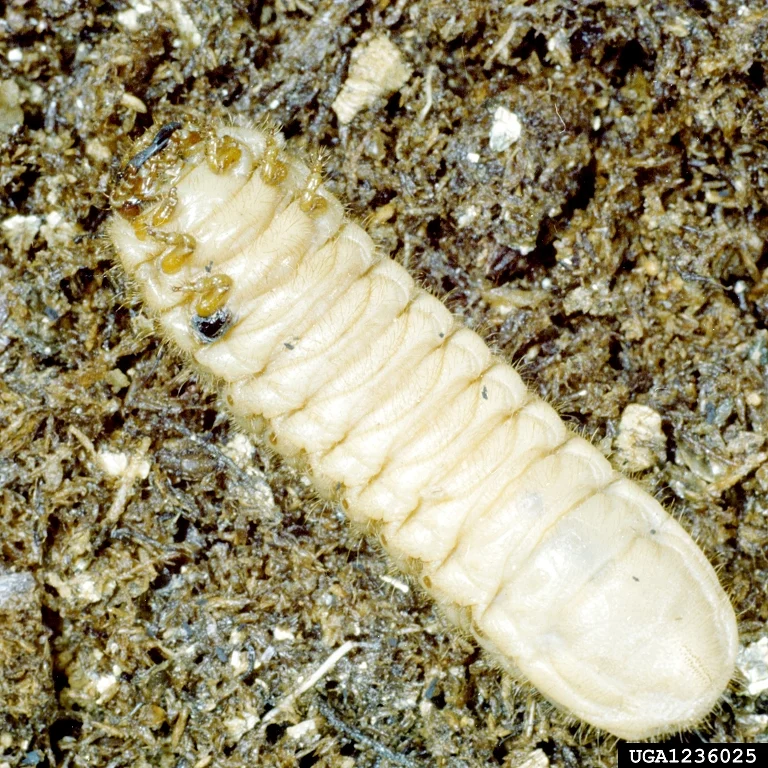
June bug grubs are fat, C-shaped, cream-colored larvae with brown heads. You find them when you dig in a flower bed, or, for green June beetle grubs, lying on the driveway after a heavy rain. NC State notes that green June beetle grubs crawl on their backs, both on the surface and in the soil. It looks strange, but it is normal and does not mean the grub is dying.
Grubs are harmless to people, but they do have chewing jaws. If you pick up big ones with bare hands, an occasional nip is possible, so wear garden gloves. A lot of grubs in one patch of lawn, especially with birds, skunks or raccoons digging there at night, is the sign to deal with them. Our guide on how to get rid of June bugs covers grub control and when to treat.
If You Think a June Bug Bit You
- Look at the spot. A June bug leaves a scratch or a pinprick at most. It won't leave a raised, hot welt.
- Wash it with soap and water, the same as any small scratch.
- Look around for what else was there. Bees, wasps and yellowjackets visit the same ripe fruit green June beetles feed on, and bed bugs, mosquitoes and fleas cause small itchy bumps indoors. A bump that itches more each day, or several bites in a line, points to a different insect.
- Get medical help for any sting-like reaction that spreads or comes with trouble breathing, swelling of the face or throat, or dizziness. Those are allergy symptoms from a stinging insect. June beetles can't cause them.
How to Keep June Bugs Off the Porch
The fewer beetles near your seating area, the fewer surprises down your collar.
- Turn off lights you don't need on summer evenings, or put them on a motion sensor. Since the light is what traps the beetles, less light at the door means fewer beetles at the door.
- Use warm, yellow-toned bulbs in porch fixtures. Night-flying insects generally collect less around them than around bright white or blue-white bulbs.
- Close curtains at night so indoor light doesn't pull beetles to the windows and screen doors.
- Pick ripe fruit promptly and clear fallen fruit to cut down on daytime green June beetles in the garden.
- Deal with grubs in the lawn. They are next year's beetles. Our June bug control guide walks through it.
If beetles are only one of the bugs crowding your porch, our residential pest control service covers the outside of the house around entry points, eaves and lights in South Carolina, North Carolina and Virginia.
Key Takeaways
- June bugs don't bite or sting, and they have no venom.
- The "bite" is the legs. Hooked, spiny legs grip skin, especially when a beetle gets trapped in clothes or hair.
- Swelling means a different insect. A painful welt that lasts usually comes from a bee or wasp.
- They aren't attacking you. At night, lights trap them in uncontrolled flight. By day, male green June beetles are cruising low over lawns looking for females.
- Safe for people and generally for pets. The real damage is from grubs in the lawn and adults on ripe fruit.
Sources: J. L. Mills, "Junebugs", NCpedia, 2006; M. Bertone, "June beetle time", NC State Plant Disease and Insect Clinic, 2016; M. Daughtry, "May/June Beetles", NC State Extension, Lee County Center, 2021; P. Heller, "Green June Beetle", Penn State Extension; University of Minnesota Extension, "June beetles"; S. T. Fabian et al., "Why flying insects gather at artificial light", Nature Communications 15, 689 (2024); ASPCA Animal Poison Control Center; owner accounts from Quora and Reddit (via Google search excerpts).
Frequently Asked Questions
No. June bugs (May/June beetles, green June beetles) do not bite people. They chew plants, not skin. What feels like a bite is usually their hooked, spiny legs gripping your skin, especially when a beetle is trapped in clothing or hair.
No. June bugs have no stinger and no venom. If you had a sting with swelling that lasted a day or more, it was almost certainly a bee, wasp or yellowjacket. The buzzing green June beetle is often mistaken for one.
Not with their jaws. Their legs end in small hooked claws lined with spines, and a beetle that is climbing on you or being pulled off can prick and catch, which feels like a pinch. Peel it off gently instead of yanking it.
Since they don't really bite, the worst you will usually see is a small scratch or pinprick from the legs. Wash it with soap and water. A raised, hot or swelling welt means a different insect, and spreading swelling or trouble breathing needs medical care.
No. June bugs carry no venom and spread no disease to people. The NC State Extension office in Lee County says May and June beetles are not dangerous to people. The damage they do is to lawns (grubs eat roots) and to ripe fruit and leaves.
They are not known to be poisonous. A pet that eats one or two is usually fine. Eating many hard shells can upset the stomach and cause vomiting or diarrhea. Call your vet or the ASPCA Animal Poison Control Center at (888) 426-4435 if your pet ate a lot of them or ate beetles from a freshly treated lawn.
They aren't targeting you. At night, lights throw their flight control off: insects keep their backs toward the brightest light, so near a bulb they circle and crash into whatever is close. By day, male green June beetles fly low over lawns looking for females and bump into people in their path.
Yes. They can't bite or sting you. Expect the legs to grip your skin, so lift the beetle off slowly. Wash your hands afterward, as you would after handling any insect from the garden.
No. The green June beetle feeds on pollen and soft, ripe fruit and can't bite through skin. Its loud, fast buzz makes it seem like a bee, but it has no stinger. North Carolina children used to fly them on a thread like a kite.
Adult beetles live only a few weeks. In the Carolinas and Virginia, brown May/June beetles are most active from late spring into early summer, and green June beetles fly mostly in June and July. The grubs live in the soil for most of the year.
Photo credits: Ryan Hodnett, CC BY-SA 4.0, via Wikimedia Commons; Christina Butler, CC BY 2.0, via Wikimedia Commons; Clemson University - USDA Cooperative Extension Slide Series, Bugwood.org, CC BY 3.0, via Wikimedia Commons.