Termite Control in Goose Creek, SC
Formosan, Eastern Subterranean & Drywood Termite Experts: Sentricon TotalDefense Bait System
Naval Support Activity Charleston occupies the Cooper River’s west bank inside Goose Creek — more than 17,000 acres, of which some 10,000 are forest and wetland. That is a standing timber reservoir on the town’s edge, and Charleston is among the oldest known Formosan termite infestations in the continental United States — the species arrived through the Port of Charleston in the mid-1950s, the period Clemson HGIC gives for its introduction here. Goose Creek also has the metro’s newest housing, which changes what protection means here: the builder’s soil pre-treatment, and whether the paperwork still exists.
Get Started in 60 Seconds
Choose what’s easiest for you
Request a Quote
We usually respond in 2 minutes
Call (855) 800-8469
Get a Live Person (no AI agents here!)
Sign Up Online
Get pricing and schedule now





Welcome to Vinx Pest Control
A Company That Actually Backs What It Says
At Vinx, we combine professional-grade treatments with a level of service most pest control companies don't offer. Local technicians, fast response times, and a guarantee that actually means something.
Get a Free Quote"I'm not passionate about killing bugs. I'm passionate about customer service. At Vinx, you get experts who show up, do the job right, and stand behind every visit. No runaround, no fine print."
WELCOME TO VINX PEST CONTROL
Protection Plans for Goose Creek Homeowners

Standard Residential Protection
- 4 Seasonal Treatments Per Year
- 50+ Covered Pests
- Interior, Exterior & Yard Treatment
- Unlimited Free Re-Services
- 100% Money-Back Guarantee

Upgraded Yard Protection
- 6 Home & Yard Treatments Per Year
- 50+ Covered Pests
- Yard Ant Elimination Guarantee
- Flea & Tick Elimination Guarantee
- 100% Money-Back Guarantee

Most Comprehensive Protection
- 9 Treatments Per Year
- 50+ Covered Pests
- 8 Mosquito Treatments (Mar–Nov)
- Flea, Tick & Ant Coverage
- Free Bed Bug Treatments if Needed*
*Starting rates vary by home size and area. All plans billed monthly.
Request Your Free Termite Inspection
Fill out the form below and a Vinx team member will reach out within 2 minutes during business hours.
Prefer to talk? Call (855) 800-8469 for a live person, no AI agents.
Our Approach
How Vinx Protects Your Goose Creek Home from Termites

Thorough Termite Inspection
Your technician inspects the full structure, foundation, crawl space or slab edge, attic and every wood-to-soil contact. In Goose Creek the slab edge gets extra time: on a post-2000 house the failure points are form boards left in the pour, grade stakes, and final grading that buried the treated zone. Findings are documented and drive the plan.
Foundation & Perimeter Treatment
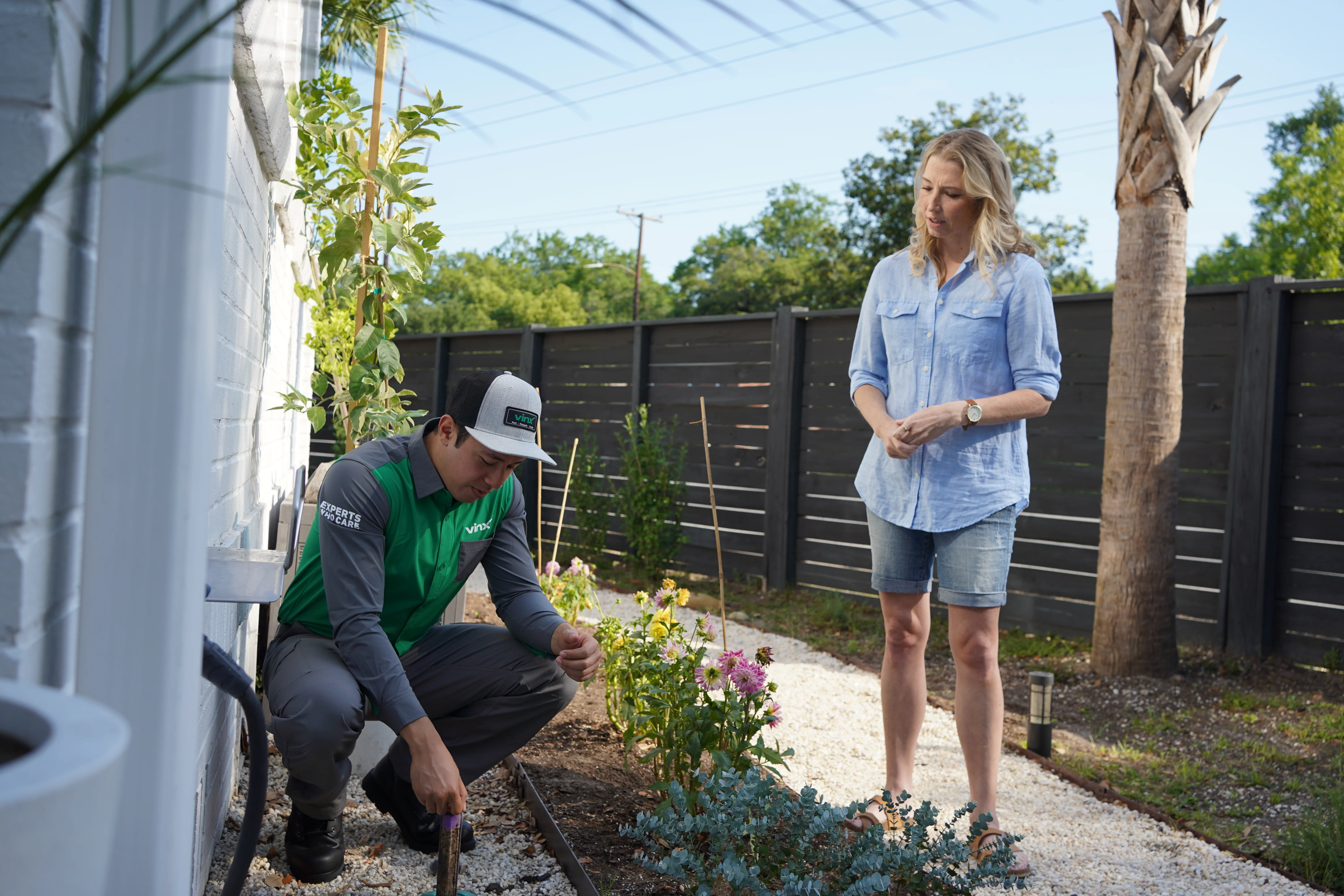
A liquid termiticide barrier is applied around the full foundation perimeter, beneath slab edges and around utility penetrations, on both interior and exterior faces. On a Goose Creek house where the two-stage pre-treatment was never documented, this is the treated zone the builder should have left you.
Direct Colony Treatment
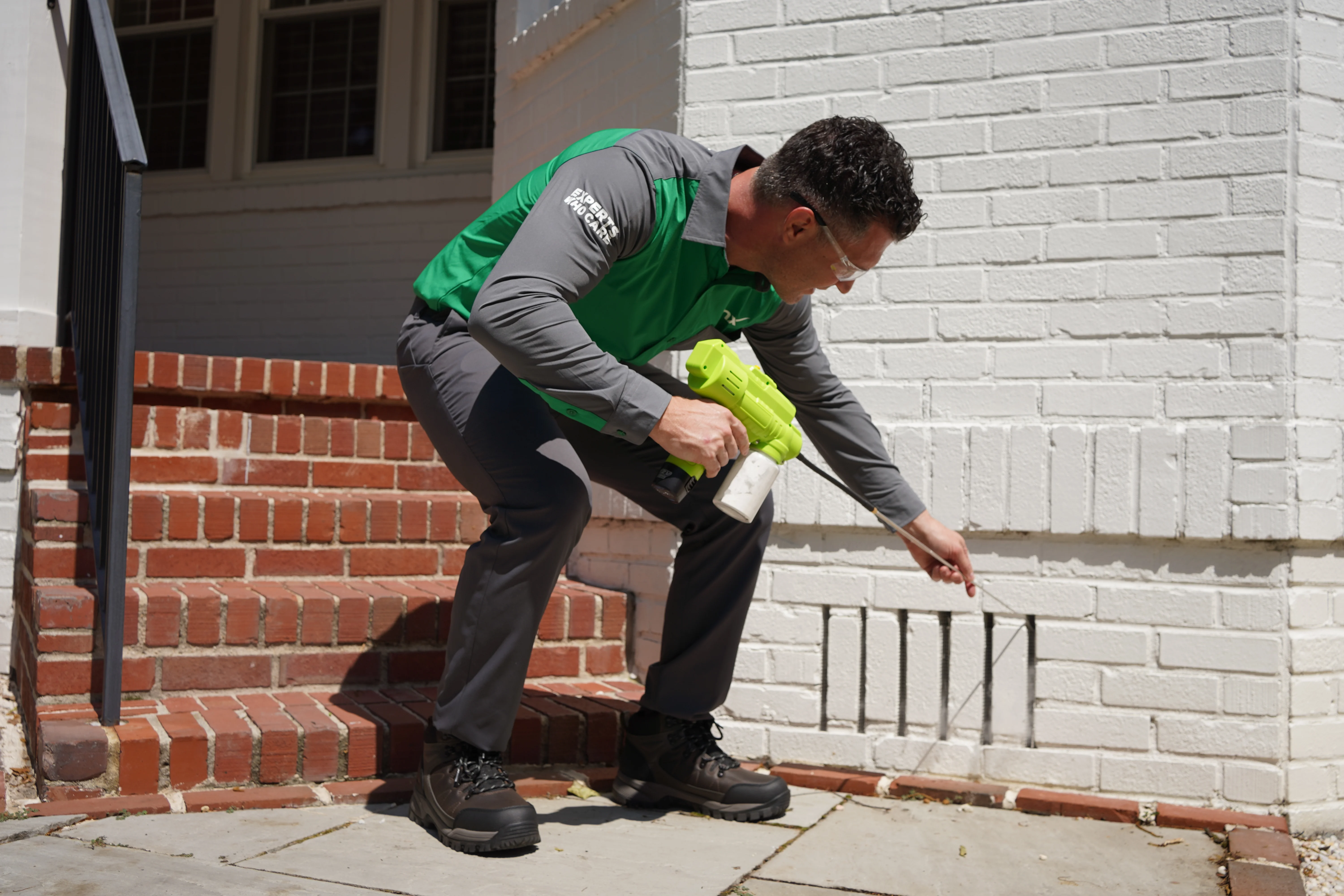
Active galleries and mud tubes are treated directly with termiticide foam or dust. On lots backing the Naval Weapons Station’s 10,000 acres of forest and wetland, or Crowfield’s wooded grounds, the exterior side is where activity is usually found first, because that standing timber is a permanent colony reservoir.
Annual Inspection & Re-Treatment Guarantee
Annual inspections keep protection current and catch new activity early, and if termites return between visits we re-treat at no charge. Your technician also advises on irrigation and drainage, since Crowfield’s watered turf and the town’s freshwater wetlands keep foundation soil damp.
What Our Customers Say
What Goose Creek Homeowners Say About Vinx Termite Control
Vinx has been fantastic! I have appreciated all of the staff I have worked with and had come to our house. They have been very professional and knowledgeable and happy to explain the process to me and answer all of my questions. The services provided for termite bond and inspection and monthly pest control have been exactly what we needed and for a great price!
I’ve been with Vinx for roughly 5 years. They always call and text with a heads up regarding the scheduled service date. Leon has been at my property most of the time we’ve had Vinx service. He is courteous, helpful, thorough, and asks what else he might be able to do (e.g. - spray inside house or garage, termite trap inspection scheduling, etc…).
Not only are their technicians thorough and friendly. Their product really works. Great prices as well. I highly recommend anyone to give them a shot and switch to Vinx Pest Control you will not regret the decision!
Jack was very professional yet personable. He was thorough, took time to listen to my concerns. Jack also explained what he was doing so I’d understand the benefits of the services that I purchased.
We have used Vinx for years. Great communication, Great service and care for our property. We would highly recommend
Jonathan was polite, professional and expedient. He stopped and showed me one of the “traps and explained what would have been seen if there had been termites. I am so happy with the service that I am encouraging my daughter to sign up with Vincent as well
I am a Very satisfied customer of Vinx pest control. I have received top customer care and service since 2020. The technicians are always polite, friendly and accommodating. The technicians have been servicing my home so long that they are mindful not to show up too early as they are familiar with my work from home schedule. I appreciate the flexibility and consideration. I am a happy customer. 😊
Courteous and prompt service. Pleasant and professional team members. Affordable services.
The tech who came by was a very nice guy. He answered all my questions and I could tell that he was good at his job. He gave me confidence that I made the right choice going with Vinx for our termite bond.
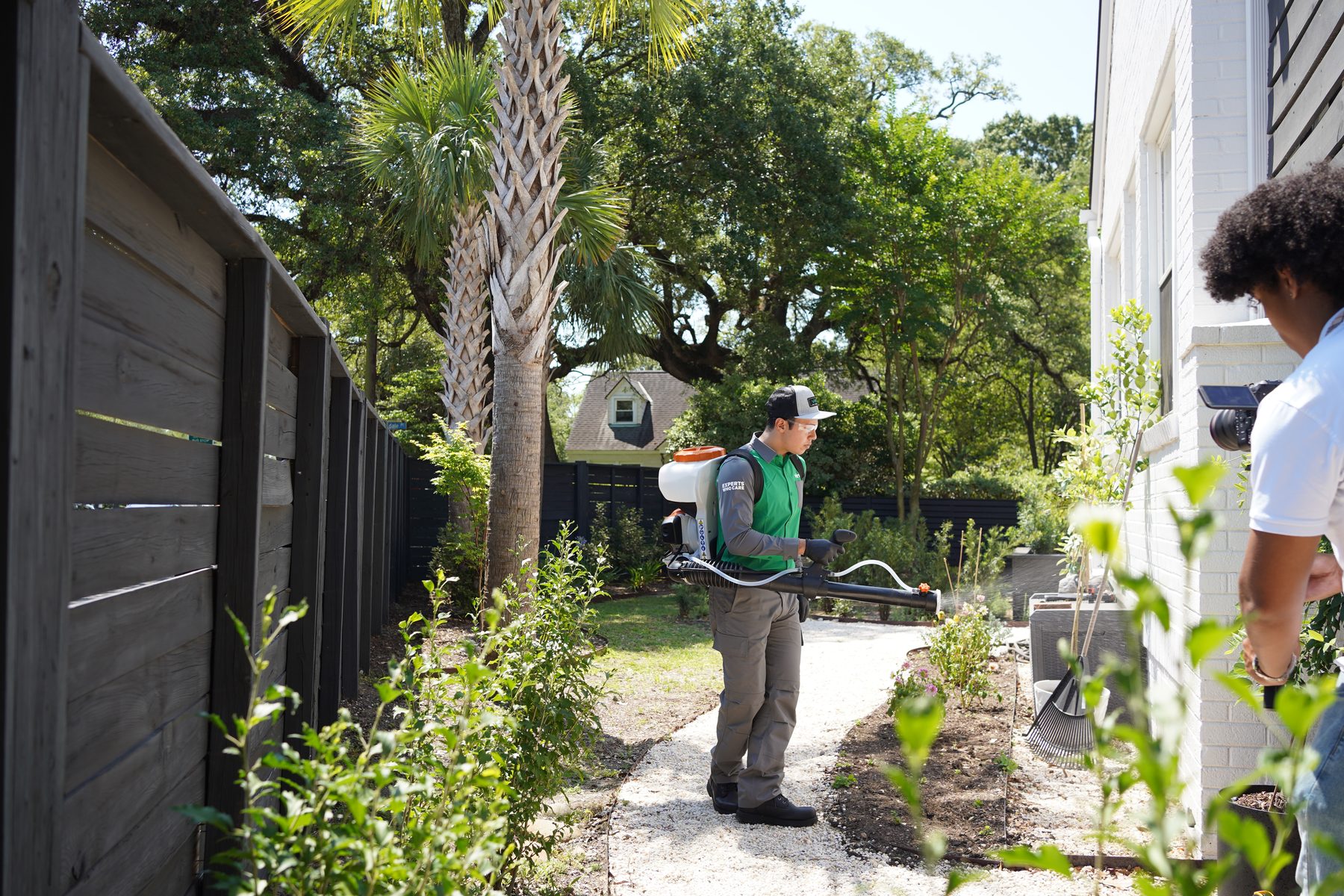
Ready to Protect Your Goose Creek Home?
Free termite inspection for Goose Creek homes, same-day availability in most cases. On a 2002-median house the first question is whether the builder’s pre-treatment went in twice, and we can usually tell.
The Local Threat
Why Termite Control in Goose Creek Isn’t One-Size-Fits-All
Goose Creek is the newest housing stock in the Charleston metro sitting on some of the oldest Formosan ground in America. The Formosan subterranean termite arrived through the Port of Charleston in the mid-1950s, the period Clemson HGIC gives for its introduction, and Clemson has since confirmed it in Berkeley County, where all of Goose Creek sits. Census figures put the median house here at 2002, with about 31% of 18,500 units built since 2010 and only 3% before 1960. A new house is not a termite-free house; it is a house whose protection depends on a pre-treatment somebody may or may not have done in both stages.
Goose Creek has the newest housing stock in the Charleston metro, and that shapes the whole problem here. Census figures put the median year of construction at 2002, with about 31% of its 18,500 housing units built since 2010 and only 3% predating 1960. A new house is not a termite-free house; it is a house on freshly disturbed ground, which is what subterranean termites colonize. The protection that matters here is the builder's soil pre-treatment and whether it was done in both stages — after the footings and again after completion — so the useful question on a Goose Creek property is usually documentary before it is chemical.
A mature Formosan colony can number several million workers. In a town where the median house dates from 2002, the decisive question is usually whether the soil pre-treatment was done in both stages — after the footings and again after completion — and whether anyone kept the record. The native Eastern subterranean termite is the baseline risk regardless of age, and drywood termites need no soil contact at all. Vinx treats for all three.
Two facts about the ground and the buildings here are worth putting side by side. The USGS names a formation after this town — the Goose Creek Limestone, an upper Pliocene calcarenite up to 50 feet thick, its base marked by a bed of black phosphate pebbles — so the subsurface under these foundations is calcareous rather than ordinary coastal sand. And the historic record shows what local ground can do to a building: Yeamans’ Hall, a large two-story house set on a high basement, stood in reasonable repair until it was shattered by the earthquake of 1886. Foundations here sit on unusual material in a place with a documented history of ground movement, which is an argument for inspecting the foundation itself rather than assuming it is sound.
Goose Creek Termite Species
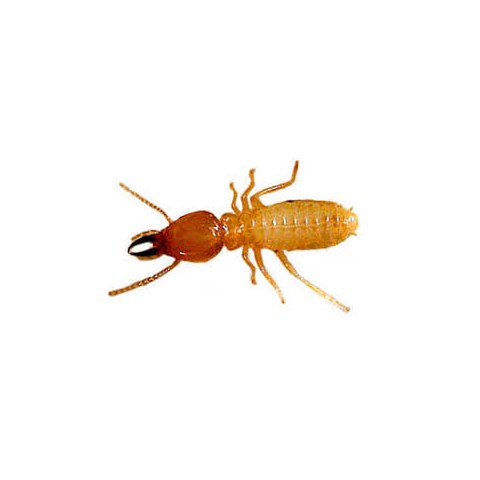
Formosan Subterranean Termite
The Formosan subterranean termite (Coptotermes formosanus) was first documented on the U.S. mainland in nearby Charleston in the mid-1950s, and Clemson University entomologists have since confirmed its activity in Berkeley County, where Goose Creek sits entirely. Colonies can number in the millions of workers, several times larger than a native subterranean colony, giving them a far larger foraging range and a documented ability to infest live trees as well as structures.
Individual Formosan workers aren’t resistant to termiticides and colonies aren’t invincible, but their sheer size means an undetected infestation can progress faster and cause more extensive damage than a native colony of the same age, which is why bait systems here are installed with a colony of that scale in mind.
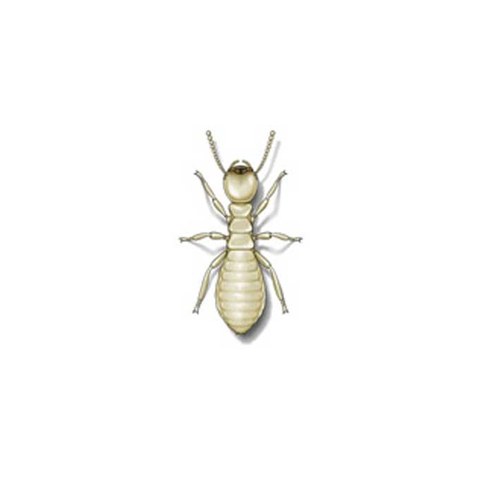
Eastern Subterranean Termite
The native Eastern subterranean termite remains the most widespread termite threat throughout Goose Creek and the broader Lowcountry. Colonies live underground and build pencil-width mud tubes to travel from soil to wood while avoiding light and dry air.
Hundreds of thousands strong, a mature colony can cause serious structural damage over years with no visible surface sign until it is extensive. The most reliable detection is quarterly inspection and bait station monitoring, well before a major repair is needed.
Drywood Termite
Unlike subterranean and Formosan termites, drywood termites need no soil contact at all, they nest directly inside dry structural wood, attic framing, and furniture. Clemson research notes drywood termites are most common specifically along South Carolina’s humid coastal areas, making Goose Creek more exposed to this species than most inland cities.
Because colonies are hidden entirely within wood, infestations are often only discovered during renovation work or a professional inspection, and treatment sometimes requires localized wood treatment or structural fumigation rather than a soil-based approach.
Know Your Risk
Termite Risk Across Goose Creek
St. James & Otranto Historic Corridor: Formosan & Drywood Termite Risk
The oldest corridor in a very new town, and the only part of Goose Creek where wood-to-soil contact has had generations to accumulate. Formosan colonies do not announce themselves in older structures; they work the framing from the inside out.
- Century-old homes built before modern pest-proofing
- Settled foundations with wood-to-soil contact
- Established Formosan super-colonies documented by Clemson University
- Annual species-specific inspection strongly recommended
Crowfield Plantation: Formosan Termite Risk
Crowfield Plantation’s mature landscaping and wooded lot lines put established trees close to houses. Clemson’s research documents Formosan activity in living trees across the Charleston area, so the canopy is part of the inspection, not scenery behind it.
- Mature live oak and canopy Formosan colonies exploit
- Damp, low-lying ground keeps soil moisture elevated
- Formosan termites documented infesting live trees, not just structures
- Full property inspection, trees included, matters here
Devon Forest: Drywood Termite Risk
Devon Forest is dense residential construction where roof and attic framing sit close together. Drywood termites need no soil contact and travel in infested wood and furniture, which makes them a structure-to-structure problem rather than a soil one.
- Humid coastal air favors drywood colonization
- Drywood termites nest directly in structural lumber, attic framing, and furniture
- Infestations often found only during renovation or inspection
- Localized wood treatment may be needed alongside bait systems
Sedgefield: Eastern Subterranean Termite Risk
Sedgefield’s slab-on-grade construction concentrates the risk at the edges: expansion joints, plumbing penetrations and the grade the builder left behind. Native subterranean termites need only a gap the width of a business card.
- Settled foundations with wood-to-soil contact points
- Damp soil under dense landscaping keeps moisture elevated
- Native subterranean pressure is the baseline here
- Annual inspection plus perimeter bait recommended
Naval Weapons Station Corridor: Eastern Subterranean Termite Risk
Along the Weapons Station boundary, 10,000 acres of forest and wetland meet residential streets, and the base itself carries 38.2 miles of railroad. Timber crossties in ground contact are a known way termites travel, and the forest edge is a permanent foraging front.
- Wood-to-soil contact points across a range of housing ages
- Native subterranean colonies in the surrounding soil
- Mud tubes on foundations and crawl-space piers
- Bait station monitoring catches activity before it’s extensive
Warning Signs
Signs of Termites in Your Goose Creek Home
Mud Tubes at the Slab Edge
Pencil-width soil tunnels climbing a slab edge or foundation wall, the route subterranean termites use into a post-2000 house.
Hollow-Sounding Trim
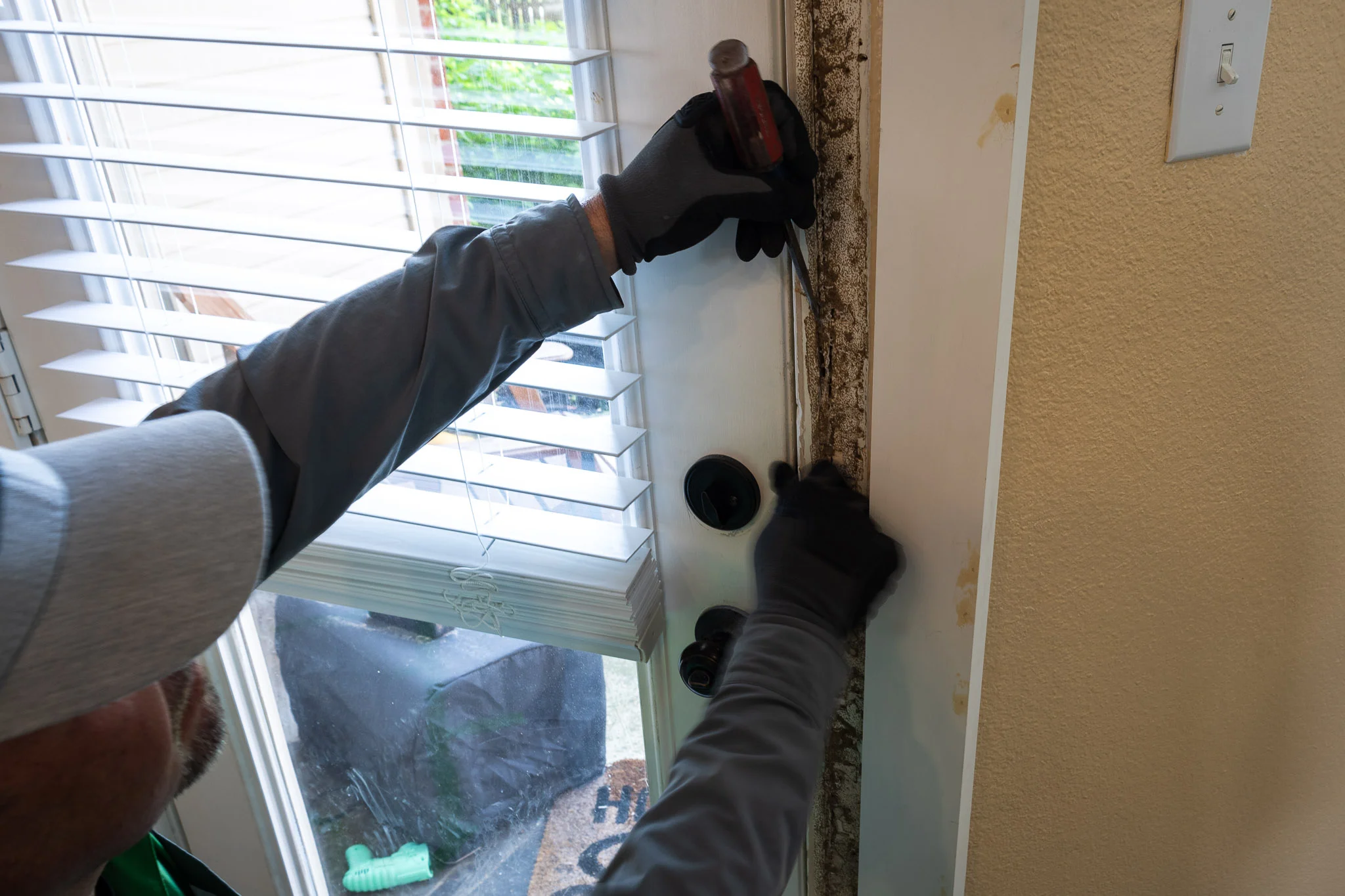
Tap baseboard, door casing or framing with a screwdriver handle. A papery sound means the interior is gone.
Sticking Doors and Windows
Damage and the moisture that comes with it warp frames; on a newer house that is rarely settling alone.
Bubbling Paint Near the Floor
Paint that blisters in odd patterns near baseboards or window frames can signal moisture from activity below the surface.
Frass on Window Sills
Drywood termites push sand-like pellets out of kick-out holes; small piles collect on sills, common in the older homes of the St. James and Otranto corridor.
Wings on a Summer Evening
Formosan swarmers fly on May-to-July evenings toward lights; wings on a sill or under a porch fixture are a classic sign.
Soft Spots Underfoot
A spongy floor near a bathroom or exterior door can mean damaged subfloor or joists below.
Pinholes in Drywall
Small round holes, sometimes with faint rustling inside the wall, can signal an active colony in the framing.
Homeowner Tips
6 Ways to Reduce Termite Risk Right Now
Kid & Pet Safe
Our Treatments Are Safe for Your Whole Family: Including the Furry Members
Every product we use is EPA-registered and applied strictly at labeled rates by licensed technicians. We take the guesswork out of safety so you can feel confident letting kids and pets back into treated areas quickly.

EPA-Registered Products Only
All products we apply are EPA-registered and used strictly per label requirements. Our licensed technicians are trained to apply the right product in the right place at the right rate, every time.
Dry Time Before Re-Entry
Exterior spray treatments dry in 30–60 minutes. Once dry, treated surfaces are safe for children and pets to contact. Your technician will confirm the all-clear before leaving your property.
Interior Treatment On Request
We treat only what’s needed, where it’s needed. Gel baits in cabinets and crack-and-crevice applications keep products away from areas pets and children frequent most.
Botanical Options Available
Have specific sensitivities? Ask your technician about our plant-derived treatment options. We offer botanical alternatives for households that prefer a more natural approach.
Have a concern about products used near your pets or children? Call (855) 800-8469 and we’ll walk you through exactly what we use and why it’s safe.
Explore More
More Pest Control Services in Goose Creek

Pest Control Goose Creek
General pest protection

Mosquito Control Goose Creek
Monthly barrier treatments

Ant Control Goose Creek
Household ants & others

Spider Control Goose Creek
All spider species covered

Cockroach Control Goose Creek
Palmetto bug & roach removal

Rodent Control Goose Creek
All rodents covered

Bed Bug Treatment Goose Creek
Heat & liquid treatments

Tick & Flea Control Goose Creek
Yard & pet protection
Exterminator Goose Creek
Same-day local exterminators
Frequently Asked Questions
Termite Control FAQ for Goose Creek Homeowners
Vinx termite protection starts at $75/month as part of the Protection Plus plan, which includes Sentricon bait station installation, ongoing monitoring and the free re-treatment guarantee. The install price follows your foundation's linear footage. Call (855) 800-8469 for an exact quote for your Goose Creek property.
Yes. The bait stations are enclosed and sunk into the ground, so children and pets cannot reach the active ingredient. No liquid is injected into soil or foundation, all products are EPA-registered, and your family can remain at home throughout and after installation.
The first Sentricon install usually takes 2 to 4 hours according to foundation footprint and station count, without tenting or any need to leave. Goose Creek’s newer slab homes usually install at the short end. Monitoring visits last 30 to 60 minutes.
Sentricon is ongoing protection, not a single treatment. We check stations on a schedule through the year and treat any activity immediately at no extra cost. In Goose Creek it is the standard way to protect a house whose builder pre-treatment was never documented.
Yes. If live termites turn up in a structure under our protection, Vinx re-treats at no cost, no deductible, no fine print. Protection Plus and Premium both carry the guarantee, which stays active as long as annual monitoring runs.
Most Goose Creek appointments are same-day or next-day. Call (855) 800-8469 to book, and if we cannot service your home the next business day your initial service is free. We serve all of Goose Creek, from Crowfield Plantation and Devon Forest to Sedgefield, the St. James and Otranto corridor and the neighborhoods around the Naval Weapons Station.
In the ground the house was built on, and in the paperwork. Goose Creek has the newest housing stock in the metro — Census figures give a median construction year of 2002, with about 31% of its 18,500 units built since 2010 and only around 3% predating 1960. That profile removes most of the classic old-house failure modes and concentrates the risk at a single point in time: whether the soil pre-treatment was carried out properly when the subdivision went in. Clemson recommends it be done by a licensed South Carolina operator in two stages, after the footings and again after completion. The follow-on risks are specific and checkable. Form boards, grade stakes and spacers left in a slab give termites a path to eat their way in. Construction debris buried under a porch or stoop draws them directly under the structure. And a liquid soil barrier does not last forever, so a 2005 pre-treat is not doing in 2026 what it did when it went down. The right question on a Goose Creek property is when it was treated and what has happened since.
Yes. Clemson University entomologists have confirmed Formosan activity in Berkeley County, where Goose Creek sits entirely, and the species is documented infesting live trees around Charleston. Naval Support Activity Charleston’s 10,000 acres of forest and wetland inside the city and Crowfield’s mature grounds are standing timber reservoirs, so the older St. James and Otranto corridor and the wooded lots beside the base carry the highest exposure.
Swarming for native Eastern subterranean termites runs February to April, usually on a warm day after rain. Formosan termites swarm mid-May into July per Clemson, in the evening and strongly drawn to lighting, with larger golden-brown swarmers. Wings under a porch light in June are the sign to call about.
No. Standard South Carolina policies exclude termite damage as a maintenance issue rather than a sudden loss, so repairs come entirely out of pocket. A new house in Goose Creek is not exempt; an undocumented pre-treatment is not something the insurer will cover for you.
The CL-100 is the official Wood Infestation Report for South Carolina, used in property transactions. It records visible evidence of wood-destroying insects and fungi in accessible areas on the day of inspection. Most SC lenders require one before closing. On a Goose Creek slab house much of the structure is not visible, which is why the report is a starting point and not a guarantee.
An agreement for service with a licensed pest control company, giving ongoing protection and re-treatment. In Goose Creek, where the housing is young and the pre-treatment records are often missing, a bond is how protection is actually carried. The Vinx Plus plan serves as the termite protection agreement.
Four things, and they are all documentary. First, was a soil pre-treatment applied, by whom, and on what dates — two dates if it was done properly, footings and completion. Second, was it a liquid termiticide or a bait system, because they age differently and are renewed differently. Third, were the form boards, grade stakes and any tub trap boxes removed before the slab was poured, and was construction debris cleared rather than buried under the porch or stoop. Fourth, has there been a bond or a renewal since, and is there a transferable agreement. If the answers are vague, that is not unusual on a twenty-year-old subdivision home and it is not a reason to panic — it just means the protection should be treated as unknown rather than assumed, and an inspection is how you find out. Sellers in this market are generally asked for a CL-100 anyway, so the information tends to surface eventually; it is better to have it before you are against a closing date.
Service Coverage
Termite Control Across Goose Creek & the Tri-County Area
Serving every neighborhood in and around Goose Creek
Serving the Greater Charleston Area